Showing posts with label Carty Finkbeiner. Show all posts

Wednesday, November 06, 2013

Toledo election results - stuck on stupid


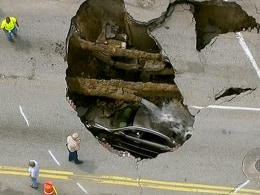
Has Toledo fallen into a sink hole
from which we will never recover?
I cannot express how disappointed I am in Toledo's election results. We've put back into office the same names, same philosophies and the same stagnation that has us wishing for the 'good ol' days' only to be disappointed - again and again and again.

You know the definition of insanity? Toledo exemplifies it.

The unions and the Blade didn't want Mike Bell to be mayor again, primarily because they couldn't control him. But they fail to realize that he was actually doing good things in the city.

D. Michael Collins ran ads excoriating Bell for his economic development trips to China and for selling the Marina District to business developers who - eek! - don't look like us. What Collins and his supporters failed to realize is that doing so turned the District into a revenue-producing asset (primarily through the property taxes paid) instead of a drain on the city requiring constant upkeep.

No, it's not yet been developed as everyone, including the owners, would like, but at least it's not an albatross hanging around the city's neck like it had been under the previous mayors.

Collins is now between a rock and a hard place. Does he really think the owners of the Marina District are going to want to work with him to actually develop the property? Or will they wait it out until the next election? Or perhaps, like so many other business owners, leave the city altogether?

How will a mayor who criticized the outreach now reach out to those who have the ability to bring companies and jobs to the city?

Did anyone stop to think about that when they were jumping on the bandwagon?

And then there is city council which, except for Sandy Spang (the only bright hope of the night) is nothing but a repeat of old, tired names we've had all along.

Rob Ludeman, Jack Ford, Sandy Spang, Steven Steel, Theresa M. Gabriel and either Adam Martinez or Larry Sykes will be our at-large representatives on council. But even Gabriel isn't for certain. Only 75 votes separate her from Martinez, who is only 34 votes ahead of Sykes. The results are unofficial and I'm sure there are provisional ballots which were cast so it's really to early for any of the three to be celebrating.

But for Toledoans, it doesn't really matter. They're what we already have in terms of philosophy and approach - and at least two of them are names we've seen and heard over and over and over again. I have to wonder, though, if Sykes thinks not running for re-election to the school board was a bad idea. He was pretty much assured of that seat.

We've gone back to Jack Ford - again. He was first elected to City Council in 1993, the year I was elected clerk of Toledo Municipal Court. He then served as mayor (between Carty Finkbeiner stints) and then went to the school board. I think he also did a term in the state legislature - hard to keep track of the offices he's jumped to and from. He was so bad as mayor that Finkbeiner, whom he defeated after two terms, was able to get elected again. The joke was that we were on a pendulum swinging between crazy and lazy and definitely preferred the crazy side, which is why we back to Carty.

You'd think we'd learn our lesson. Apparently not.

And Gabriel, if she is elected, is an old Finkbeiner ally having served in his cabinet, but also appears to get along well with Ford.

Rumor has it that Finkbeiner is interested in being appointed to fill the district seat Collins will vacate when he's sworn in as mayor. Can it be any worse for Toledo? These are the same people who led us to our current decline/stagnation, but they're old (both physically and in length of time in the public eye) and must be familiar. We just seem to have a disconnect between the people and the policies they advocate which keep earning us the name of 'little Detroit.'

Then there is the Toledo School School board. Bob Vasquez was the top vote-getter which is not surprising considering he was the only incumbent. I like Bob. I've always respected his service on boards and commissions, even when I might have disagreed with him - which wasn't as often as some may think. At TPS I believe he pays good attention to the financial aspects of the school district and he was an early supporter of the performance audit I pushed for. Again, we don't always agree, but I think he's better than most when it comes to an elected official.

But who fills the two vacant seats? Polly Gerken-Taylor, wife of sitting County Commissioner and former Toledo Councilman Pete Gerken and, until now, a perennial candidate ... and Chris Varwig. a long-time TPS volunteer who says she wants to be an advocate for parents and has no desire to run for city council. She may be the second bright hope - if she doesn't get railroaded by the politics inherent in the system. My hope is that she will find allies in Vasquez and fellow board member Dr. Cecelia Adams.at

As for Polly (because the hyphenated name is just too much), the primary thing she has going for her is her husband's name and unions. Then there was her ridiculous campaign slogan, "now is the time." For what? For her to finally get into public office? She didn't campaign for anything other than what the board has always done. And our test scores, declining enrollment and general failure of the schools is the result. No wonder parents send their kids elsewhere.

On a good note, Josh Lanzinger was elected judge of the Toledo Municipal Court. He'd been appointed to the position and was able to keep it, primarily through the limited incumbency, but also because of the extremely familiar name (his mom is Supreme Court Justice Lanzinger with a long successful history of election in Lucas County). He'll most likely keep the seat for as long as he wants it.

But that's about all...

Let me share with you some of the comments from my Facebook friends:

"Toledoans will elect and reelect the same names and faces that have presided over Toledo's decline for decades...and then complain that it keeps getting worse."

"What's funny Maggie is people in Toledo acting like there is "change" or we will some how move out of the status quo... yes they have said that... but they keep voting the same status crap in."

"Toledo Businesses are voting,... on their way out. Is it any mystery Maggie, that we builders and developers are putting up new houses and subdivisions in the surrounding area and not into Toledo. Failing schools, failing philosophy. Who with a clue wants to live there?"

followed immediately by:

"This is why I will never expand my business to Toledo."

And then this from dear friend and fellow blogger Tim Higgins:

"Perhaps Toledo can put in for designation as a "Green City" for all of the candidate recycling that it did this election."

Maybe, but it won't help. As Sam and I have said for decades: Toledo is like a drug addict who hasn't yet hit rock bottom to know it needs to change.

"Toledo.... the future Detroit of Ohio."

Indeed. :(

btw: this DEFINITELY qualifies for 'stuck on stupid' though now I'm wondering just how stupid am I that I stay....


Wednesday, June 27, 2012

Deconstructing The Blade's drug-pusher mentality on changing county government


Like a drug pusher trying to get you to get you hooked, The Blade is out with another editorial touting the benefits of bigger government and their 'revised' version of uni-gov. They've already sewn up the Toledo market (strong-mayor form of government they pushed) so now they want to expand into the county as a whole.

Like this effort, they pushed a strong-mayor form of government for Toledo telling us, in numerous 'news' articles and editorials, that a bigger city council with both district and at-large members along with a strong mayor who would appoint professionals to run Toledo would be a good thing.

Along with help from the Lucas County Democratic Party (who saw the inevitable outcome being more elected Democrats), they convinced a majority of Toledo voters and we were rewarded with the same 'stuck-on-stupid' thinking we've always had, except now from a larger, more costly government.

Oh - and we also had to suffer through two terms of Mayor Carty Finkbeiner, one term of Mayor Jack Ford, and another term of Mayor Carty Finkbeiner before getting a reasonable person, current Mayor Mike Bell, to hold that office. In case you're mathematically challenged, that's 16 years of two politicians from the same party with a council also dominated by Democrats, despite districts being drawn to supposedly provide for 'balanced' representation.

And how did all that work out? Well, they don't call us 'little Detroit' for nothing....

But if that's not enough to make your want to run screaming away from the county charter petitioners, let's take a look at what the unsigned editorial says about this proposal:

If you haven't yet endorsed the petition, you have every reason to do so.

Reform proponents need at least 14,500 signatures of registered voters, approved by the county board of elections, to advance their proposal for a new home-rule charter. Late last week, the grass-roots campaign said it had collected about 20,000 signatures. It seeks as many as 22,000 to fend off inevitable challenges by champions of business as usual.

Actually, no - you don't have 'every' reason to do so. In fact, the outcome from pushing for a similar structure for the city of Toledo should give you every reason NOT to.

Note the way they characterize people opposed to the idea: "champions of business as usual." Just because people like me - for valid reasons - do not support the proposal, it does not necessarily infer that we support the status quo. This is a logical fallacy - and someone who manages to make their way to the editorial board so as to write such attempts at persuasion ought to know that. Perhaps the author does, but expects readers not to know. What does that say about what they think of their readers?

I do want change in county governance - but I have yet to see any evidence that changing the form of the structure of our county government will give us anything different in terms of the policies, positions and actual governance of the county.

In fact, the study done by the self-appointed group that is recommending the change admits that, even under their structure, it boils down to who you elect - not the office you elect someone to. Given that admission from the study group, why are we going any further?

The reform plan would enable voters to exchange their 18th-century county government for a more-efficient structure. The new charter envisions a government that saves tax dollars, makes elected officials more accountable, and promotes economic growth and job creation.

This is the standard line from the limited supporters and it's what they've told their petitioners to tell people when they ask them to sign the petition.

But there is absolutely no evidence whatsoever that the new structure will save tax dollars. They've not done a financial analysis; they've not shared fiscal comparisons of the two structures; they've only used a total spending comparison between Lucas County and one of the counties that has gone to a charter form of government and concluded that Lucas spends more per person than Summit County does,

This may be true - but they didn't compare Lucas County to the other 86 counties that don't have a charter form of government to see if we spend more per person than any of them. Is it likely that successful counties, like our neighbor Wood County, have a more efficient government than Lucas does without changing their form of government?

I don't know - but I question (and so should you) that if per person costs of government are the standard, why didn't the group compare Lucas to all counties to see where we stack up? The answer is that doing so might have shown that other counties have a less-costly government without going through such a change and that wouldn't fit with the goal of the paper to achieve the uni-gov dream they've had for decades.

They claim the new structure will "make elected officials more accountable." How, they don't say. Right now, specific elected officials are accountable for the actions of their office and we get a chance, every four years, to judge them on their actions and either re-hire them (elect them) or fire them (elect someone new).

Just like with a city council - how are we to hold individual members of council accountable for the failed action of a particular department - such as the Department of Neighborhoods? We can't. We can make one or more of their votes an issue in an election, but that will not change what a bureaucratic department is doing.

Some may say we can hold the mayor accountable for a department's action and, in the case of a charter form of county government, we would hold the county executive accountable. But even that's not a good enough answer (can you say three terms of Carty Finkbeiner?) as people will often overlook one or more issues because they agree with the elected official on so many others.

Additionally, with the majority of the proposed county districts incorporating the city of Toledo, how will a suburban community like Waterville hold the body accountable when they decide to do something that benefits Toledo to their detriment?

It's much easier to hold three county commissioners accountable than it is to hold six county council members and a county executive accountable. And having the ability to judge the individual performance of people elected to the offices of treasurer, auditor, recorder and sheriff means those individuals are directly accountable for the functions of their office to the citizens - not to some other group of elected officials who can escape blame in various ways.

The Blade also claims changing our form of government "promotes economic growth and job creation." Again, they provide absolutely no evidence whatsoever to support this claim - but it sure sounds good, doesn't it? After all, job growth is what the area needs.

The hypocrisy, however, is something that cannot be overlooked. Economic development is not a function of the structure of government - it is a function of the policies the government puts in place. Elected individuals can implement policies that encourage or discourage economic development.

Sadly, too few elected individuals in Toledo and county government have any experience whatsoever in the business world so they make decisions that feel good (recreation levy) or that benefit a certain constituency (government unions and other groups that rely upon government funding for their existence) to the detriment of the business community which hurts their ability to grow, prosper and provide jobs.

The Blade did not oppose Toledo's living wage ordinance. While supporters claimed this was a good policy, it was - in effect - a mandate on employers and unnecessarily drove up the cost of contracts the taxpayer ended up paying. That's not-business-friendly and it hurt job providers. No doubt the paper will push for such a policy county-wide.

The Blade did not oppose the county's most recent plan to mandate Project Labor Agreements (PLAs) on all county contracts, despite having done so when the matter was first brought up. In case you're not familiar with that, it's when the county mandates that you must have a union agreement with your workers - whether you are a union shop or not - for the project you do for the county and the county will negotiate that contract for you to be sure it's consistent with what other contracts say. But it goes further and also mandates the same thing on any sub-contractors you may use. (Background and more details are available here, here, here, here, here, and here.)

Talk about increasing the cost per person of county government! Bet the committee didn't look at that aspect before concluding that our government costs more than Summit. But I digress....

In fact, many of the numerous 'not-business-friendly' policies and votes that work to the detriment of economic development and job growth have been supported by The Blade. I've heard our local daily referred to as the "single most destructive force in the county" because of its many stances in favor of things that have hurt economic development and job growth in the area.

So how, exactly, will changing the form of government help? Are we to assume that a new county council (made up of a majority of Toledo elected officials who are term-limited, I predict) will repeal such anti-business policies in order to free our job providers from unnecessary costs and mandates? (That sound in your head is called hysterical laughter.)

Here's where one of the supposed 'champions of business as usual' believes change for the better could be made - and it doesn't require a change in structure. Just repeal all these anti-business rules, quit saying yes to every tax increase that comes along, lower property taxes and sales taxes and get out of the way of the people who are actually providing jobs in the county. See???

Like the authors of the study admit, it depends upon electing the right people.

The proposal would abolish the three-member Board of County Commissioners and seven of the county's eight elected -- but largely invisible -- row offices. The current government structure encourages wasteful fragmentation and redundancy, and leaves taxpayers wondering who's responsible for what.

Again, the editor clearly thinks people in the area are stupid if we don't know who is responsible for what. As for 'encourages wasteful fragmentation and redundancy,' this is incorrect. As a former county commissioner I can tell you that any redundancy in county government is a factor of governance - not of structure. And having been in the office, there is not as much redundancy as some claim and the ability of the commissioners to control the budgets of the other elected officials means that the commissioners can insist upon elimination of duplication - if they have the will to do so. Again, it comes back to the people - not the structure.

The ballot plan calls for an elected, nonpartisan county executive who would appoint professional administrators rather than politicians to head county offices. It also would create a county council whose nine members would mostly be elected by districts rather than at large. Those elections would occur in November 2013, and the new officials would take office the following January.

"Nonpartisan county executive who would appoint professional administrators rather than politicians" ... Yeah - because that's worked out so well with Toledo and the county already. Just take a look at who the elected officials surround themselves with - partisan individuals who support the partisan or electoral efforts of the people who appointed them.

Lucas County had one of the most respected and admired county administrators in John Alexander. But when Pete Gerken was elected to the board of county commissioners, he and Tina Skeldon-Wozniak told Alexander they didn't want him anymore. Alexander graciously went away and is now benefiting Perrysburg. The county got Michael Beazley - a former Democratic Party officer - and when he left for an even higher paying position in Oregon, they hired Peter Ujvagi, former Toledo city council member and former state representative who was termed out and had, in his background, the bankruptcy of his family business. So much for 'professional administrators' - I can't wait to see who they hire next!

So do you really think that if someone like Pete Gerken gets elected the county executive that he's going to hire all professionals? Again, that sound you're hearing in your head is hysterical laughter.

A similar structure in Cuyahoga and Summit counties has cut costs of county government. It also has encouraged central cities and suburbs in these counties to cooperate in providing regional public services, thus reducing duplication, and discouraged them from raiding each other for businesses and jobs.

There is absolutely no evidence whatsoever that costs in Summit and Cuyahoga have been cut as a result of the change in government structure. As for cooperation in providing regional public services, The Blade forgets the cooperation and collaboration that already exists.

When Mayor Jack Ford decided to push The Blade agenda of uni-gov, then-County Administrator John Alexander made a list of everything the county and its jurisdictions cooperated on. The list was two pages long! It included everything from joint purchasing of items like office supplies and road salt, to the first-in-the-nation completely integrated criminal justice computer system. The paper isn't going to tell you about the ways the municipalities do work cooperatively because that might make you question their premise that a change in government structure is needed.

But the real kicker is this: "discouraged them from raiding each other for businesses and jobs." The Blade has long opposed what it perceives as suburban communities raiding Toledo for businesses and job - even residents. They believe Toledo needs to dominate the area and be the focus of the region.

There is a lot to be said for strong cities, but in today's world and with the technology now available to us, that concept is as antiquated as they claim our structure of county government is.

It also presumes that businesses should have no other choice but to be inside the city limits, despite the more business-friendly policies of surrounding communities and whether or not surrounding communities would better meet the needs of the business.

Since Toledo is showing it really can't compete with the surrounding communities because of the bad decisions Toledo has made (usually with the strong backing of the paper's editorial board and publisher) The Blade's solution is to make the entire county like Toledo. And note that they have no problem with Toledo raiding other communities for businesses and jobs - just the other way around.

But here's the rub: businesses who found refuge from bad Toledo policies by moving to the suburban communities can also move to Wood, Fulton or Ottawa county if those bad business policies are exported, as I expect they will be, into county government.

The businesses, if they are to survive, will find the place that provides them with the tax, fee and regulatory structure necessary to support their legitimate goals of growth and profit. The Blade will then start complaining about how the surrounding counties need to support Lucas instead of 'raiding' them. Do you see where that is going?

The reform plan would make the Lucas County executive a focused, high-profile agent of economic development in northwest Ohio.

Oh my - where to start on this one? The structure of government will not make any person a focused, high-profile agent of economic development. The only way to get someone like that, as the study authors reluctantly admit, is to elect someone who is already like that. Duh! And what if we elect someone like Carty Finkbeiner or Jack Ford? Or like the new Cuyahoga County Executive Ed FitzGerald who, in his first term under a brand-new governmental structure, is already "sending strong signals" that he's interested in running for governor in 2014. I'll bet his attention is fully focused on economic development.

Advocates argue plausibly that it also would make county government more diverse and bipartisan.

"Plausibly"??? Really??? Take a look at this proposed district map and tell me how in the world we'd get a more bipartisan body.


It may be true that we'd get one Republican county council member out of six - but I'm living proof that a Republican can be elected Commissioner - one of three. So to say we'd get 'more' bipartisan representation is false. One of three is greater than one of six, so just electing a Republican in the current structure would actually be better if numbers of R's and D's are all we're looking at.

The problem is that party affiliation and skin color are immaterial to what we really need, which is a diversity of ideas and perspectives. What we'd get with proposed districts like these is Toledo-centric domination - and Toledo doesn't have a very good track record of saving tax dollars, making elected officials more accountable, and promoting economic growth and job creation.

The four months until Election Day will provide ample time for a thorough public debate on the merits of county reform. But that can't occur unless county voters give themselves the opportunity now to opt for positive change and modernized government in November. That means adding your signature to the petition drive.

Somehow I can't help but think of Rep. Nancy Pelosi's statement that "we have to pass the bill so you can find out what is in it."

The fallacy - again - is thinking that we should have a measure on the ballot before we have a "thorough public debate" on the merits and that such debate "can't occur" unless we sign the petitions.

What they really mean is that if the measure makes it on the ballot, they can use the 'support' of the signers as 'proof' that people want the change. They've done that before, when it suited them. If The Blade really wanted debate on the issue, they'd seek out and publish the valid arguments against the proposal and allow the people to decide, rather than demonizing those of us who oppose it.

But tell me - what news article have you seen (out of the dozens they've published on the subject), that 'focused' on any argument against this proposal? What news article have you seen that provides for any 'public debate' on the issue? I'd wait while you search, but you won't find it, so you might as well keep reading.

The problem is that what they're putting on the ballot is flawed - in original premise and, thus, in conclusions. They write:

“Simply put, we believe government must lead.”

They don't say why, they don't explain any other option, but with this as their premise, the study group obviously had no other choice but to conclude that:

Lucas County needs a single unifying leader. The absence of such an office and such a person makes reversing our condition more difficult and perpetuates a fragmented decision-making environment.

So rather than look at the decisions - or the people who make those decisions - that make our current condition a bad one, they conclude we must change our form of government so we can elect a perfect person to lead us to salvation.

So sign those petitions so ignorant people can be swayed by fallacious arguments like these to do The Blade's bidding and achieve uni-gov once and for all!

Okay - back to the facts...

The Blade and the study have failed to demonstrate a need, failed to identify and analyze various methods to meet the need and failed to document why their preferred option is the best. They have just decided and are expecting everyone else to just fall in line.

But fortunately, this tactic of theirs is too well known and, hopefully individuals in Lucas County will reject The Blade's belief that they know what's best for us and refuse to sign the petition.


Tuesday, January 10, 2012

Finkbeiner, Ford criticize Mayor Bell; embarass themselves in the process

Former mayors Carty Finkbeiner and Jack Ford, neither of whom distinguished themselves positively during their terms on the 22nd floor of Government Center, criticized current Mayor Mike Bell over his handling of issues in the Department of Neighborhoods.

According to both these politicians, the firings of Kattie Bond and Mike Badik are wrong - for some reason. You see, the two former mayors didn't have any problems with these two people when they employed them. They found them to be honest and good workers, with Finkbeiner going so far as to say he had "no knowledge" of any wrong-doings in the Dept. of Neighborhoods. So obviously, Bell must be wrong to fire them.

Of course, neither politician has the results of the investigation which is still on-going, so they can't possible know what Mayor Bell has found. They don't know any details; they don't know what facts Bell has found; and they don't know what, if any, evidence exists of mistakes or lack of oversight by these two employees. In fact, they know nothing. But that didn't stop them, just like when they were mayor, of forming an opinion and holding a press conference.

Finkbeiner had the temerity to tell Bell to "be a man" and take responsibility. Yes, this from a person who threw a coffee cup at a subordinate, left his dog in his hot car and has faced continued rumors of abuse of his wife.

Ford actually accused Bell of making these decisions to 'please The Blade,' the local daily newspaper. I had to get out the duct tape and wind it around my head so it wouldn't explode at that one.

Mayor Bell, acting responsibly, made himself available to the press following the Finkbeiner and Ford statements. In response to Finkbeiner's claim that he needed to 'man-up' said that's exactly what he was doing. He made decisions to change the direction the department was going; is holding people accountable for their actions; is not 'kicking the can down the road' but actually dealing with the situation in a timely and up-front manner and, despite taking such criticism, is standing by the decisions which he believes are right.

Talk about being a man.

For the record, I don't know any details of the investigation either and many people have said that Bond and Badick are honest individuals and highly trustworthy. Several people I know and trust said they don't believe these two did anything wrong.

I don't personally know Bond and Badik, but I do know Mike Bell and I know what it's like to oversee a large operation and to have no faith in the people you have in charge of a department. If these two knew what was going on and did nothing about it, their firing is justified. If they were in charge and didn't know what was going on, I'd have to question: why not?!?

Finkbeiner said Bell needed to take responsibility - but at the same time, he said that Bond and Badik needed to have no responsibility for what was going on under their watch. Talk about a double standard - but that's common from Finkbeiner.

In the end, Bond and Badik are at-will employees of the Mayor. Bell has decided to make a change in the leadership in that department. That is his prerogative, one his two predecessors routinely practiced - for much less valid reasons.

Tuesday, March 30, 2010

Toledo politicians will raise taxes - that's all they know how to do

I do not envy Mayor Mike Bell and the limited options he has to address this year's nearly $50 million budget deficit.

Part of the problem is that he had only three months in which to find solutions. While cutting spending and reducing the size of government is clearly the best choice in both the short and long term, last year's decision by council and then mayor Carty Finkbeiner put Bell in a tough spot with union contracts, leaving a rock and a hard place as choices.

The bigger problem we have is that Toledo City Council, as a body, did nothing.

Well, that's not exactly correct. They continued 'business as usual' when it came to union contracts, wages, benefits and pensions, hoping that a six-month moratorium on some of those items would buy them time.

And it bought the time: six months.

Now the situation is even worse because they've failed, over a period of years, to make the decisions necessary to address the declining revenue and skyrocketing costs.

Throughout the last several years, I've paid particularly close attention to the revenue projections and have made numerous posts here about how they cannot possibly be obtained. It comes as no surprise to me, those of you who read this blog and most ordinary citizens, that the practice of inflating revenue to justify spending is a significant problem - that Toledo politicians have known about, and embraced.

Even this year, we have some who are saying that Bell's revenue projections are too low. Can you say 'stuck on stupid'????

Better that they be too low than too high, resulting in further deficits!

Members of city council are now faced with having to produce a balanced budget by tomorrow, or the city faces dire circumstances, including the inability to expend money. Temporary spending authorizations cannot continue to be made like they are in January, February and March.

So what will council do? The cowardly thing - though they'll try to spin it as courageous.

They are going to increase taxes.

They will not make the hard choices of cutting non-mandated services. They will not repeal ordinances they've previously passed in order to eliminate boards and commissions that suck up tax dollars. They will not examine the operations of government and eliminate duplicate functions/tasks (not that they could in the two days left). They will not prioritize safety and basic services and eliminate lower priorities. They will not challenge the unions.

They will tell us they did the only they could do continue that elusive 'quality of life' they're constantly telling about. Of course, that assumes that they can define each of our 'quality of life' criteria - or that they know what adds to our quality of life better than we do. How typical of elitist statists on our council.

My 'quality of life' is certainly enhanced when I have more money in my pocket. In fact, that's the best thing I could ever hope for to enhance my quality of life. That point is too often missed or ignored by city council.

They will tell us they've made a difficult choice in raising taxes. And they might see it that way because they will (hopefully!) suffer the consequences of that decision and that could mean loss of office. (Though this is Toledo, so while that should be a given in most communities, it's not here.)

Just remember this: Whenever government raises taxes, fees, or increases its income (in whatever form), the politicians are telling you that they need your money more than you do. They are telling you that their special projects and priorities are more important that yours - including your mortgage or rent, your utilities, your food, your retirement, your children's college funds, your home improvements - everything!

And as a result of their actions, you will go with less while they brag about 'saving' city services.

Every one of them who votes for any increase in taxation - in any form - deserves to be thrown from office.

Does Toledo have the political will to do so remains an unanswered question. But I can hope. Because only by changing the philosophy of those on council will Toledo ever get out of the mess we're in.

And that goes for all of council, regardless of the political affiliation they claim.

Monday, January 04, 2010

Finkbeiner should be judged by the promises he made

If you read the headline of Sunday's Toledo Blade article on out-going mayor Carty Finkbeiner, you'd think that even his critics gave him praise on his terms of office.

After all, that's what the headline says: Finkbeiner's legacy: Even critics admit he made Toledo better.

The problem is, the only 'critic' they found was fellow Democrat Frank Szollosi, who didn't get mentioned until the 35th (yes, 35th!) paragraph. And, even then, gave no praise. The article states in paragraph 34:

Even his critics agree the city is, in some ways, a better place after his 12 years in office - the first eight of which were with Mr. Finkbeiner as Toledo's first modern strong mayor.

But they don't provide the name or quotes of any 'critic' who actually says this.

So is this editorializing? Wishful thinking? An attempt to 'spin' Carty's actions? Or is it bad editing, leaving out details/quotes the reporter included? You can decide on your own, especially in light of the more wide-spread reputation the paper is developing for disguising their opinions as news stories.

What is a more accurate reflection of Carty's term are his original campaign promises. Here are his promises from his campaign website (in italics), saved just for today, along with my comments on whether or not he actually achieved them:

"I will outline our mission and agenda:
Our mission
The Finkbeiner administration will unite and promote, in every way possible, a clean, green, and safe city with vibrant colors everywhere – a city that inspires our citizens to improve our neighborhoods, educate our children and create jobs that offer a future in their hometown.
To accomplish our mission, we will:
1. Work with the University of Toledo, Bowling Green State University, Medical University of Ohio and Owens Community College to develop a “technology corridor,” creating the jobs of the future.


* FAIL - Carty's administration did 'work' with these entities but there is no technology corridor as of his last day in office. These institutions of higher learning are working together more effectively without the mayor.

2. Develop the marina-housingrestaurant-entertainment project on the east side of the river that voters approved in September, 2001. The Marina District project will act as a complement to The Docks, which we built in 1995.

* FAIL: While the taxpayers did fund a road and street lights and some basic infrastructure, there is no vertical development and no private funding available for the housing/restaurant/entertainment portion of the Marina District. In fact, after 9 years, there is no one capable of putting forth the private sector support needed to actually bring this plan to fruition. While Larry Dillin still hopes to have some financing for his part of the contract, we haven't seen it yet. One has to wonder if all the efforts and expenditures of employee time and tax dollars have been worth what we have to show today: a road to nowehere with really nice street lamps...and that's about it.

3. Seek private-sector developers to build a new sports arena in the city.

* MASSIVE FAIL: The city gave up the arena to the County and there was no effort by the County Commissioners to find a private developer for the new sports arena. In fact, every suggestion I made toward that end was soundly rejected by my two fellow commissioners at the time, Pete Gerken and Tina Skeldon Wozniak. They didn't want a privately-run arena. They wanted one owned by the County, despite the fact that they/we had no money for such a project. In the end, the total cost of the new arena project was over $105 million, despite a budget estimate of around $80 million ... and identified funding on only $80 million. Of course, there still is no 'name' to the arena and no estimated $14 million in naming rights income, not to mention the other revenue sources that haven't panned out. But never mind the financial facts, isn't it pretty????

4. Meet with the ownership of Southwyck Mall to forge a compact leading to a revitalized mall in 365 days.

* MASSIVE FAIL: After realizing what just about everyone else already knew, that the owners of Southwyck had no interest in revitalizing the mall, Carty embarked upon a plan to take over the property so he could have his way. That, too, failed, and all we have now is an empty space following the demolition of the mall buildings.

5. Meet with the ownership and property owners in the Westgate-Cricket West district to define the future redevelopment of this area.

* I cannot rate this promise as I do not know if Carty actually met with any of the owners of the properties in this area. What I do know of his actions regarding the planned redevelopment of Westgate would give him a FAIL rating. He, along with Gerken and Wozniak, aggressively fought the plans of the property owner to revitalize the private property with new stores and options for consumers. Together, these three politicians almost cost us the new Costco that went up. Fortunately, between the plan commission and then District 5 Representative Ellen Grachek, their efforts to derail the project failed.

6. Nurture small-business development, and establish a 25-person business advisory council, consisting of our best and brightest small-business leaders, to advise the administration on how it can help business develop in our region and eliminate government obstacles. This advisory council will review council legislation passed during the last 25 years, and we will rescind any laws that have hampered job creation.

* FAIL: While Carty did create this council, he didn't allow it to do anything. In fact, one of the first acts Carty embarked upon was the takeover of the ambulance services for basic life support transport from the small, private companies. His business advisory council asked him to postpone the effort until they had a chance to review the plan, but Carty said no. About a year after the establishment of the council, I contacted several individuals the city said were serving as part of the group. Two of them didn't even know they'd be named to the council and two said they'd only received notice of two meetings. Oh - and just to solidify my 'fail' rating, City Council did not rescind any laws relating to 'job creation.'

7. Work with Ann Arbor and Detroit public and private leaders to create an automotive R&D corridor linking our cities. The purpose – job creation.

* FAIL: There is no automotive R&D corridor linking these cities and, with the financial mess the Detroit automakers find themselves in, I doubt they had time to even consider such a plan.

8. Fill the vacancies and voids in the Central Business District with new entrepreneurs and businesses, using tax breaks and incentives..

* PARTIAL SUCCESS: There are some new businesses in the downtown area, but not enough ... and I doubt it is enough to overcome the ones that left, or to replace the employees who were laid off or whose positions were eliminated.

9. Encourage and promote a regional government to include, city, county and suburban governments all under one roof, in as many ways as possible.

* FAIL: I think Carty forgot about this one since he hasn't talked about a regional government since his first year in office. However, his failure on this is a good thing, from my perspective, because I'm opposed to a regional government as described by the Democrats in this town.

10. Establish a grass-roots neighborhood program, in which every neighborhood has representation in City Hall and will be involved in decisions impacting them. This will be modeled after the Dayton program.

* FAIL: I don't think this even got to the planning stages.

11. Develop a “neighborhood pride” program to encourage home ownership, civic pride and urban beautification. This program will include neighborhood competition to honor outstanding efforts to improve properties.

* PARTIAL SUCCESS: Carty did establish a 'neighborhood pride' and beautification program. He used various federal programs to encourage home ownership. Of course, we don't know how many of those individuals in new homes were part of the massive foreclosure problem as a result. And while he had a program, this gets a 'partial' rating because there is no evidence the program achieved the stated goals - or that it will remain once Carty is out of office.

12. Restore the urban beautification program on main streets and in city parks while expanding these efforts into neighborhoods. We will raise $250,000 annually from the private sector to accomplish this.

* PARTIAL SUCCESS: Carty did endeavor to restore the urban beautification program and received a ton of criticism for making this a priority (with limited budget dollars) over such essentials as police and roads. As for the promise to raise $250,000 annually from the private sector? That was a MASSIVE FAIL. I don't think he got to that much total for the entire term.

13. Revitalize the urban-blight program, and return the demolition program for blighted housing to 300 demolitions annually.

* SUCCESS: I believe he did his target goal of 300 demolitions annually.

14. Commit to hiring more police officers, so Toledo will no longer have the fewest police per 1,000 residents of any major city in Ohio.

* MASSIVE FAIL: He actually laid off police officers.

15. Will actively and personally work to restore the Erie Street Market as a centerpiece of downtown revitalization.

* FAIL: Oh, he worked at it - to no avail. The place is a money pit and still isn't breaking even, costing taxpayers and creating a continual drain on general fund dollars while we go without roads and police.

16. Implement a city Gateway project that will utilize the resources of the city as well as the private sector to improve the appearance of the main entrances to the city.

* PARTIAL SUCCESS: He did work to spruce up some of the entrances, but ignored other ones. My impression that his idea of 'entrance' was an entrance to the central core of the downtown area, not the major entrances into the city proper.

17. Increase emphasis on repairing potholes more swiftly and permanently.

* PARTIAL SUCCESS: He may have had an increased emphasis, but if it he did, it wasn't enough.

18. Commit to prioritize city Capital Improvement dollars to resurface city streets, with a target of 40 miles per year.

* SUCCESS: He made the resurfacing a priority in the CIP budget and did achieve his targeted 40 miles.

19. Commit to return every phone call to citizens within 24 business hours, and respond to specific concerns within 7 business days.

* FAIL: From my personal experience, I know that he did not return every phone call within 24 business hours and I waited much longer than 7 business days for some 'specific concerns' I raised. This was a either a bad promise to make or one that sounded good in the heat of a campaign because he did not put the effort forth to ensure he would keep it.

20. Establish monthly “Meet the Mayor” nights that will rotate locations throughout the city.

* PARTIAL SUCCESS: He did get off to a good start with this, but as the meetings got contentious, he stopped having them.

21. Establish a City Hall mentoring program that will pair city officials with young people seeking such guidance.

* PARTIAL SUCCESS: He did start this, but who knows what happened with it or how successful it was.

22. Establish privately funded, summer youth-development programs in city parks.

* FAIL: Never happened.

23. Develop a summer-job program for high school students, working with the Chamber of Commerce.
24. Seek commitments from our local companies to hire college students as “interns” during the summer months.


* PARTIAL SUCCESS: These two went together. I believe there was some type of program begun, with commitments from a few businesses, but it did not continue.

25. Develop job training and retraining programs for the unemployed and underemployed while working with corporations, labor unions and our universities.

* FAIL: The city did not do this, though The Source, the county/Workforce Investment Board (federal mandated program) one-stop shop, does have such programs in place and operating on a continual basis. Carty never should have made such a promise because the federally-mandated program was already in place. He should have just promised to support those efforts and be part of a 'regional' approach to job training.

26. Work with public and private school leaders to assure that new and/or improved academic campuses become the stimulus that creates family oriented neighborhood living opportunities around the academic setting.

* SUCCESS: Carty did work with the existing New Schools New Neighborhoods program which focuses on creating a core of services/opportunities in and around the new schools that are being built.

27. Encourage adaptive reuse of vacated school properties into neighborhood community centers.

* PARTIAL SUCCESS: He may have 'encouraged' this, but there was no success in achieving it.

28. Monitor the levy requests of TPS to assess that the taxpayer is getting his money’s worth from their product.

* FAIL: If he 'monitored' this, he never shared his analysis with the taxpayers so we would know if we were getting our money's worth. Of course, perhaps his failure in this is a good thing, because it's not the job of the mayor to perform this task.

29. Work with county officials, local civic leaders and regional organizations to seek ways to share resources, reduce costs and improve economic conditions in Northwest Ohio to the benefit of all.

* FAIL: The only 'sharing' Carty wanted was for the other organizations and municipalities to 'share' their income taxes with Toledo. Despite opportunities to improve economic conditions to the benefit of all, Carty was interested only in the benefits to the City of Toledo. He even tried to steal Bass Pro from a neighboring jurisdiction because he wanted it in Toledo and not just in Northwest Ohio.

30. Pursue further discussions on establishing a regional water/sewer authority to serve our area while ensuring Toledo residents a reasonable return on their infrastructure investments.

* FAIL: This went nowhere.

31. Will appoint a health and fitness honorary chairperson to promote a “healthier lifestyle” in Toledo.

* I have no idea if he appointed an 'honorary chairperson' or not. Obviously, the effort didn't garner much attention and Toledoans ignored it, if it existed.

32. Establish a courageous and boldcommittee to define how utility rates can be reduced in Northwest Ohio.

* BOLD FAIL: (sorry, couldn't resist)

33. Restore the minority health commission to improve the life expectancy and general health of those impacted.

* Another one I couldn't find information on. If he did restore the health commission, it worked without publicity and unknown impact. But again, this isn't the role of the mayor.

34. Seek “loaned leaders” from the business and union sectors to seek ways to reduce city costs and implement modern systems to promote increased productivity.

* FAIL: City costs were reduced through furloughs, layoffs and the elimination of funding for certain city departments - not because of suggestions made by 'loaned leaders' but because of the economy and the declining tax revenues of the city. I'm certain that 'loaned leaders' would have found even more ways to reduce the costs of government if convened and allowed to actually made and implement recommendations.

Conclusion
Toledo needs a leader who not only hears, but listens to, the voices echoing throughout the city. Toledo needs a leader who not only sees problems of joblessness and lost vision, but sees solutions involving the creation of jobs and growth. Toledo needs a leader who will awaken this city to the great dreams that helped turn this once-stagnant swamp into a jewel set along both shores of the Maumee River. And Toledo needs a pro-jobs, progrowth, pro-Toledo citizenry. It is a time for citizen/heroes. It is a time for each and every Toledoan to take up the cause of building a better, stronger Toledo. With every Toledoan’s help in this endeavor, I seek to be your Mayor – your leader."


So we come up with 19 promises NOT kept, 9 that were only partially kept and many of those without success in achieving an outcome, 3 promises kept and 2 unknown.

That's not good in terms of grades - in fact, eliminating the two unknowns, his partial success and success rate is only 37.5% ... about a third of the promises he made he actually kept in some way or another.

And this doesn't even get into the huge budget deficit he leaves, the zero balance in the city's rainy day fund, or the increased taxes we're all paying thanks to his 'leadership.'

But judging him by what he said he was going to do is much better than trying to spin his term and claim that unidentified critics say he made Toledo better.

Saturday, November 21, 2009

Another 'I told you so' on Toledo's budget

In 2008, I questioned the revenue assumptions of Mayor Carty Finkbeiner - especially the projected revenue from red-light cameras.

Item #3 from the list I sent to Finance Director John Sherburne (who never replied) was this:

3. You've doubled the number of speed cameras but the projected revenue from all those cameras is 6 times more than in 2007. Why isn't the revenue projection just double?

That was in March. By October, The Blade was reporting that the city was facing a $10 million budget shortfall for 2008:

Mr. Sherburne said the primary causes for the shortfall include:

•Income tax collections through September that were down $6.6 million.

•Overtime costs for city employees that are $2 million over projections.

•Revenue from red-light cameras that is $750,000 less than expected. (emphasis added)

•Fuel costs that are $1.5 million over budget.

But failing to learn their lessons in 2008, the city did the exact same thing in 2009. As I wrote in November 2008 (city-presented budget assumptions in bold, my comment follows):

• Red Light Camera revenue is provided for at $2.584 million for 2009. While this is the same as for 2008 it reflects an increase over actual collections for 2008.

So what makes the city think that it's going to have INCREASED collections from these cameras in 2009? Every study - even from the camera companies themselves - shows that income/revenue from the cameras decreases over time. So far, in 2008, red light/speed camera revenue is $750,000 less than expected. What evidence does the city present to document why they think they'll have 30% more income in this line item? Do they plan to add more of these cameras to get to that point? And what will happen if residents, like those in Cincinnati, pass a charter amendment to prohibit the cameras? These are the contingencies the city should think about and build into their budget projections.

Valid questions - in more ways than one - because on Friday 13ABC reported 2009 revenues from red-light cameras were were far from meeting projections.(hat-tip Lisa Renee at Glass City Jungle)

The mayor left out a very important number when writing up next year's budget. Toledo's red light cameras were projected to earn the city $2.5 million in paid fines in 2009. But in reality, that number is only $600,000.

The revenue dropped because the state forced Toledo to make the yellow lights longer by one second and Toledo increased the fine to $120-- too rich for some drivers who simply refused to pay.

Police chief Mike Navarre say unpaid fines cost Toledo $1 million. "It's a problem with photo enforcement. It's a problem with parking tickets. It's a problem with people that don't show up for court on traffic tickets."

Those unpaid fines go to collection, but Toledo is now adjusting next year's red light camera revenue at just $900,000.

Note the side comment about the state requiring the city to increase the yellow light time? Most traffic safety studies show that increasing the yellow light times and going to all red in all directions for a moment prior to the lights changing to green increases safety at intersections more than cameras do. And there was much speculation that yellow light times had been decreased at camera intersections in order to generate more money in fines. But that's another topic ...

This line item is currently $1.984 million short. They overestimated their revenue by 331%!

What's even scarier is that, even with two years of data, the city is still projecting an INCREASE in revenue from this source. If they've only collected $600,000 in 2009, what makes them think they'll collect $900,000 in 2010? That's a 50% increase!!!

Does anyone in their right mind really expect a 50% increase in ANY Toledo revenue line item?

Will City Council actually question this figure this time around? They failed to do so previously and we've got pretty much the same people asking the questions.

Perhaps Toledo's best hope for a realistic budget is our new mayor, Mike Bell, and the common sense approach he showed during the campaign. I hope he and his new administration will question these outrageous assumptions and give us a budget based in reality - rather than wished-for revenues to cover the spending they just can't seem to cut.

Monday, November 16, 2009

Random thoughts of deference, dogs, destruction and deficits

It's raining where I am and there's a lot going on - so some random thoughts on various issues.

* My uncle is Chinese. He's a U.S. citizen and has been for decades. But being Chinese gives him unique perspective on the Asian cultures and the practice of bowing. President Barack Obama again made news with his 'bow' before the Japanese Emperor. He bowed at a 90-degree angle.

Now, it is appropriate to greet such individuals with a bow, participating in the customary greeting of the nation. But, according to my uncle, a 20- to 30-degree angle is acceptable and recommended. Additionally, the Emperor should greet our President with a handshake, which is our custom.

But to do as Obama did and lower himself half-way is not proper for the President of the United States. Either he is intentionally trying to send a message of submission to foreign monarchs, or he's being served very, very poorly by his protocol office.

* When I was a commissioner, I had a phone call from a woman who wanted the dog warden to do more in getting dogs at the pound adopted out. She insisted that there were many groups just waiting for dogs and they'd be glad to take them instead of having them euthanized at the pound.

Since she obviously knew so much more than me about such groups, I suggested that she contact the various groups, work out how many and what type of dogs they'd be willing to take each week and then draw up a plan for how it could work.

Despite the fact that I'm allergic to dogs (and just about all pets and furry creatures), I love the creatures and don't want to see them killed by anyone. However, I'm also a realist and know that the dog warden and pound are supposed to be self-sufficient, paying for itself out of the licenses/fines/fees for services. When dogs are kept for longer periods of time, they cost money - and someone has to pay for those bills.

I also know that the state law and Ohio Revised Code place mandates on what a dog warden must, and can, do. Those tasks must come first, as they are statutory requirements.

So, I thought that this woman would be in a perfect position to devise a plan with all these dog rescue groups and, since she was certainly passionate about the issue, that she would embrace the challenge.

However, from her reaction to my suggestion, I didn't expect I'd ever get any sort of plan and I never heard from her again.

You see, she didn't want to do what I suggested. She wanted the dog warden to do it. She was willing to call up and tell me how the dog warden could do what she thought was a better job, but she wasn't willing to put any effort into it herself.

That's part of the problem with too many people these days. They're so willing to tell others what to do, but so unwilling to apply the same directions to themselves. And it's even worse when the entity they're targeting for action is the government. Too many think government should do all things so they don't have to.

This is not to say that improvements are not needed at the dog pound - that would be ridiculous. There are always places for government to improve. But too many of the voices shouting for the dog warden to 'do something' are not willing to 'do something' themselves. Some are - but most aren't. They just want to join the chorus of condemnation without assuming any of the responsibilities for the actions they want to achieve - like the woman who called me.

But if all the people currently complaining about the dog warden instead spent that energy working with various rescue groups to come up with ways to save the dogs at the pound, wouldn't that be a more productive use of energy and benefit the dogs and our community more than one person being fired?

I hope the task force looking at the operations of the pound will take a serious look at the financial aspects of what they recommend and include funding recommendations as well. Their current recommendation for a moratorium on 'killing puppies' (sensational impact intended) has a cost that needs to be addressed. Emotion without reason and logic on the issue will get us no where.

* I saw 2012 over the weekend and very much enjoyed it. It wasn't the greatest movie I've ever seen, but the special effects did not disappoint and they needed to be seen on the big screen of a movie theater with the surround sound as well. I wasn't expecting much in terms of a plot line - it's a disaster movie with a well-known premise - so I wasn't disappointed by that. In fact, some of the melodramatic moments gave me time between tsunamis, earthquakes and general destruction to actually catch my breath.

There are some who are complaining that Christian sites were destroyed in the movie, but no Muslim ones were. While it may be true that the makers of the film are anti-Christian (I have no idea and don't really care), equating the selection of destroying the statue of Jesus in Brazil and the Vatican to some sort of Christian-bashing would be the same as saying the makers of the film were anti-American because they also showed the destruction of the Washington Monument and the White House. And those who are complaining failed to account for the destruction of the monastery on the mountain in China...

Sometimes, a movie is just a movie. And since my expectations on the plot were not very high to begin with, I was glad I saw the massive global destruction scenes inherent in the 2012 hysteria on the big screen. So if you go see the movie, enjoy it for what it is: a work of fiction best seen on a big screen.

Besides - it stars John Cusak, and he's one of my favorites!

* Toledo Mayor Carty Finkbeiner is releasing his 2010 budget today. I received the email notice from Megan last night and asked how long it would be before the document was placed on line. I've not yet gotten a response, but Megan is usually pretty good about getting back to us on press-release questions. So stay tuned. I'll link to it when it's out and we all see what kind of deficits we're facing next year.

Thursday, October 22, 2009

UPDATED! Carty is right - again

UPDATE: Toledo Finance Director John Sherburne has issued a letter to city council regarding the debt proposal. The letter is below Carty's at the bottom of this post.

Original post:

I know, I know - it doesn't happen often, but when it does, we need to acknowledge it.

Yesterday, Toledo Mayor Carty Finkbeiner sent a letter to City Council objecting to the transfer of Capital Improvement Plan (CIP) funds into the general fund to pay for interest on the loan taken out to purchase garbage trucks and cans. (The letter is below.)

I explained yesterday how council had no plan for meeting the obligation they were making and paying for the debt they approved for this purchase, but I did not address the fact of the ballot measure - which is how we got the available funds in the first place.

Hoping to get voter approval to take money out of CIP to pay for police and fire, the council 'set-aside' roughly $3.9 million and did not allocate it any capital improvements. They put the question to the voters as Toledo Issue 1 and called it the 'Safety First' plan.

But the voters said no - and it wasn't even close (54% to 46%).

Carty's letter rightly points out that voters don't want money diverted from the CIP to cover general fund expenditures - and that's what Councilman Joe McNamara's plan for the garbage truck payment would do.

As Carty states, the voters didn't want the city to move those funds around - even for such critical services as police and fire. So why would council even remotely consider moving the money for garbage trucks?

"We are elected by the citizens and work for the citizens. In case of a city-wide vote initiative, Council and the Mayor should respect the voters decision.
...
I am uncomfortable, at the very least, in going against the will of the voters who spoke to us on September 15."

And he's right. The citizens have instructed their employees on council that CIP funds are not to be transferred - and council needs to follow those instructions.

However, knowing this council, I'm afraid they'll think they know better and will vote to use those CIP funds. This would allow them to avoid making the difficult decisions of cutting government spending. And when given an easy versus a hard choice, they'll take the easy way out.

Just remember, five of these people are up for election. If you expect to have better decisions on city council, you MUST vote for people who don't embrace these perspectives.

Here is the mayor's letter - you can click on it for a larger image:


Letter from John Sherburne to Toledo City Council raising concerns about the city's debt limit, the identified plan for payment of the loan for the garbage trucks and cans and a 'reality check' for the claim that McNamara's plan will somehow help the 2009 deficit - you can click on it for a larger image:

Monday, October 19, 2009

Toledo government's 'loss' is taxpayers' gain

Toledo Mayor Carty Finkbeiner is at it again with a 'letter' to both mayoral candidates and Toledo City Council, chastising them for not 'raising revenues' for the city. (see bottom of post for the three-page letter)

He again cites his proposed increase in the trash tax and the elimination of reciprocity for payroll income taxes paid to other jurisdictions as 'revenue' the city should be collecting.

But the perversion of thought that passes for logic in Toledo politics is most evident in this statement from the letter:

"Our refuse fee is one of the lowest in Michigan and Ohio - $8.50 per month if you don't re-cycle (stet) and $1.00 per month if you do. We lost $8.4 million this year because it is so low."(emphasis added)

I'll skip over the whole point that our payroll taxes are supposed to pay for this service and the 'refuse fee' is over and above those payments. I'll also skip over his hyphenation of the word 'recycle' - and even the mention of Michigan prior to Ohio.

Let's look at the perspective Carty has with his claim that "we lost $8.4 million." Just who is the 'we'? He clearly means the city bureaucracy because he certainly isn't referring to the taxpayers.

And he considers the lack of imposition of additional taxation a 'loss.' Now, that may be true in terms of the government. However, he fails to see the reality of the situation in that failure to pass this additional tax meant the residents of Toledo 'saved' $8.4 million. Those who would have been taxed actually kept all that money to themselves.

And what happened to that money? Well, we spent it - on items we needed like food, mortgages, utilities, college educations or even amenities that helped our local economy. Or perhaps we saved the money, putting it into a bank account and providing a resource for a longer-term goal - or even assets upon which the bank could base lending to others.

This is a really terrific thing for the taxpayers and for our local economy. Rather than turning over the money to government, we kept it and used it for our own purposes.

Carty, instead of complaining that the city 'lost' something it had no right to, should be advertising how much 'extra' residents of this city had as a result of the failure to implement an additional tax.

But Carty, the local paper and the members of council who support this taxation see only one side of the coin: additional money from us that they don't have to play with.

And they conveniently fail to address the 'what if' when it comes to the trash tax: what if they lose a lawsuit over whether or not their so-called fee is, indeed, a tax and implemented illegally? If they lose that case, they'll have to repay what they've collected to date. Where will that money come from and how much more in debt will the city be then? Well, let's not even think of that, they must be saying to themselves.

Toledoans are fed up with the way this government is spending our money - continuing to fund studies and non-essentials while cutting police and other required services. They say there's no where else to cut, but we obviously don't believe them because we see them spending money on such frivolousness as life insurance coverage for themselves and other non-mandatory items they justify with the 'it's only' logic.

But the bigger problem in all this is the perverted reasoning and perspective that permeates the halls of One Government Center: that forcibly taking more of your money (at any time, but especially in a down economy) is somehow 'good' for you, while the opposite - you keeping your own money - is somehow a 'loss' for government and a really terrible thing for the city.

We have an election on November 3rd. Do we have the courage to elect people who believe that government's 'loss' is, indeed, the taxpayers' gain?

Or will we just elect the same old names and philosophies that got us into this mess in the first place?

The letter:


Wednesday, October 14, 2009

Government tyranny in wake of Toledo bar shoot out

I picked up my Mom and Dad at the airport last night after their trip visiting my brother in Portland, OR. They asked what was going on in Toledo and said they saw the news story about the bar fight/shoot out .... in Portland ... and in Seattle ... on the national news.

They were surprised that no one was killed and said the video was pretty amazing.

I'll admit that I didn't watch it and only saw the headlines of the story. While a shootout is a bit unusual, even in Toledo, shootings at bars are a relatively normal event - happening periodically and getting just a blurb in the media.

At least that was our discussion, which then turned to talk about the inevitable push to outlaw guns. Of course, the fact that these individuals were breaking a law just having guns in a liquor establishment in the first place doesn't seem to phase the people who want more government control on this issue. If said individuals didn't mind breaking the law by the possession of the guns, what makes anyone - in their right mind - think that outlawing the guns would have made any difference?

And just how many of those guns in that shootout do you think were legally obtained in the first place?

Of course Mayor Carty Finkbeiner, ignorant in his analysis and clamoring for publicity, immediately started talking about shutting down this establishment and blaming the owner for not checking the patrons for guns before they came in.

Mr. Finkbeiner said the owner showed a lack of appreciation for the dangerous mix of alcohol and weapons and said a message has to be sent.

"The owner should have had the common sense if he cared about his establishment to pay attention to whether patrons were coming onto the premises with weapons in their belts, weapons in their pockets, weapons in their coats and shirt pockets," the mayor said.

Did you get that??? The mayor thinks the owner should frisk his patrons to be sure they're not committing the crime of possession.

Don't for a minute think this is just 'Carty being Carty' and brush off his comments. I predict that, in the near future, you'll see all kinds of gun-ban groups pushing for laws that require bars to have metal detectors at the door.

Stranger things have been known to happen - especially in Toledo where the politicians think owners of properties are to blame for laws that others break and end up paying settlements in lawsuits over the issue.

And, in typical over-reaction and righteous indignation, the mayor is going to "use every tool open to him, including health and nuisance inspectors," to make sure the bar is closed.

"Even though an incident might have been an isolated incident, this was a very violent, potentially hurtful incident that cannot be tolerated," he said.(emphasis added)

Talk about government tyranny! The mayor is promising to bring the full force of a municipal government to bear against a business owner because some idiot patrons did something illegal.

And note that no one was hurt! He doesn't react this way when someone is killed in a shooting - why now? Because it made national news?

The mayor's chief of staff, Robert Reinbolt, who doubles as city safety director, wore a large gold badge on his jacket pocket and made a statement saying, "This is a safety issue and we're going to do everything we can to make sure the issues are addressed and we don't have these problems occurring again."

Maybe the solution isn't to go after the business owner, but to eliminate unnecessary spending (like Reinbolt's shiny new badge) elsewhere in the city so we can bring back our laid off police officers and do increased patrols. What a thought!

Now, I realize that no amount of police officers or laws is going to prevent someone from possessing a gun illegally and using it. But increased patrols are going to be far more effective than shutting down this one business.

If this bar closes, those patrons will just go elsewhere - and take their illegal activity with them.

Finkbeiner disagrees:

The mayor also rejected the suggestions of some that his layoffs of 75 police officers last May - 60 of whom have since returned to work - contributed to the outbreak of violence. He noted that there was a riot in North Toledo four years ago and that was not blamed on a lack of police.

That riot he references? That was when the Nazis came to Toledo and some of our citizens reacted badly to the situation, destroying their own neighborhood. It is certainly not an apples-to-apples comparison.

Fortunately, it seems as if common sense prevails among the neighbors:

"This is mostly everybody's favorite spot, and they have good food, too," Ms. Otto said.
...
"He always tries to keep things down. He looks out for his customers," Mr. Haney said. "Anytime you are running a business you can't tell who's walking in off the street."
...
"Cut the guy some slack. He's struggling like the rest of us to keep his business going," Mr. Malczewski said.

Unfortunately, I have no faith that such common sense will prevail in the halls of government.

But I do have faith that Carty will keep his promise to use the full force of government to make an example in this 'isolated incident.'

Sadly, though, that example will expand government tyranny and end up doing more to enforce the 'not business friendly' attitude of Toledo government than it will to increase safety in the city.

Saturday, October 03, 2009

What 'duties' did Szollosi and Collins duck?

The Toledo Blade has an editorial blasting councilmen Frank Szollosi and D. Michael Collins for their decision to leave city council's meeting Tuesday rather than vote on a tax increase, giving Mayor Carty Finkbeiner a tie vote to break ... which would have resulted in said tax increase (even though they're calling it a 'fee' for trash service).

While it is a fact that these two men 'ducked' a vote, they were not, as the editorial claims, ducking their duties.

To understand this, you must first know what the duties of council are. The editors of the paper obviously believe council has more of duty to spending and making sure the city doesn't curtail it, but rather increases taxes so it can continue ... than council has to their constituents.

I, however, believe that council's duty is to us, the taxpayers and citizens of Toledo. We have spoken loudly and clearly enough that at least half of council understands that obligation and was willing to vote against a tax increase, especially in these difficult economic times.

If the only way that Collins and Szollosi could fulfill their duty to the TAXPAYERS was to walk out and, therefore, prevent a tie vote that would have resulted in a tax increase, then kudos to them for using this procedure to protect our wallets!

Their 'higher' duty is to represent their constituents, not to perpetuate a bloated, bureaucratic, overspending Toledo government that doesn't understand how to truly live within their means - or, rather, OUR means.

I don't, for a minute, believe that these two members of council don't want to balance the budget, as the editorial claims. They do want a balanced budget - they just want to do it via means other than additional taxation. And they should be praised for this approach, rather than vilified by The Blade and the mayor for not allowing a tax increase to go through.

I'm not sure, but has The Blade ever met a tax increase, fee increase, or property levy it didn't like? Would their record show they consistently support increasing the costs, scope and size of government, to the detriment of those of us who pay the bills? Could their past and current positions on such matters be part of the problem for why people flee this area for lower-cost/better-service jurisdictions and why politicians believe they'll have 'cover' for lack of fiscal prudence?

Toledoans know, despite what the editors want them to believe, that Collins' and Szollosi's action in preventing this vote was more in line with their best interests than allowing the city to increase taxes would have been. And they'll remember the positions all members of council took when it comes to decisions on election day.

Saturday, September 19, 2009

Oh, the irony!

For decades, we've listened to politicians in the Toledo area tell us how terrible our electric and gas suppliers are. They're overcharging, we're told. We have the highest utility rates in the entire state, they say. These are evil companies who are too greedy to give us lower rates, they bemoan.

But when one of those 'terrible, evil, greedy' companies comes through with some grant money - $3.2 million - that can help save the city and erase almost half of the 2009 deficit?

What then? Will those same politicians refuse to take the money that was obtained by 'overcharging' the residents? I doubt it!

They'll probably justify it by saying 'some good' is coming from the high rates. Of course, that overlooks the point that the 'good' came from the rate payers, but is going to the government. But that's how most liberals think it should be, so that wouldn't be much of surprise.

There's actually more to this story than meets the eye, though. The 'grant' is in exchange for a six-year extension of the contract nine jurisdictions have with FirstEnergy Solutions to provide service within those municipalities. Following deregulation, several communities - including Lucas County - joined together to aggregate their buying power in order to obtain lower rates for customers. The Northwest Ohio Aggregation Coalition has been successful in negotiating lower rates over the years, and this contract is no different.

But it's still extremely ironic that the recipient of the ire of politicians, especially in election years, is now somewhat of a savior when it comes to Toledo's budget deficit.

And talk about timing! Toledoans on Tuesday rejected a ballot measure that would raid the Capital Improvements Fund in order to balance the general fund deficit. If that measure had been approved and the city got this grant money, their budget problems would pretty much have been over. Now, though, council and the mayor will have to continue to reduce spending - which is what they should have been doing in the first place - unless they take the easy way out and decide to raise taxes through various 'revenue enhancements.'

But even if the tax switch had been approved and the grant money received, it would only address this year's problem. Many of the concessions agreed to in the union contracts are for 2009 only. The reduction in the amount the city 'picks up' for PERS will end beginning in January - putting the city back into the position of paying for the employer and the employee contributions to that retirement program. Those PERS pickups are a large part of what makes the union contracts unsustainable over time - as we've all seen over the last several years.

But instead of addressing the long-term issues of the city's financial situation - the spending that just doesn't end - council and the mayor look to short-term solutions and one-time payments to save them.

Oh, the irony of having to depend upon your 'enemy' for your 'salvation.'

Friday, August 28, 2009

Random thoughts on a rainy Friday

* Lisa Renee at Glass City Jungle has a post about the Freedom From Religion Foundation's opposition to the prayers said prior to Toledo City Council meetings.

First, I thought the Constitution guaranteed our freedom OF religion, not FROM. Also, despite my Christianity, I'm NEVER offended by someone of another religion offering up a prayer and have never thought that a prayer from a Muslim, Jew, Hindu, etc, prior to any gathering, including a political/governmental one, would in any way whatsoever hinder my participation in the function.

And then I wondered, considering all the talk about 'representing' the community, just what the religious affiliation of Toledo was. The Census Bureau is prohibited by law from tracking religion as a statistic, so it's hard to tell what portion of the city's population identifies itself as religious, or to get a breakdown of which religions. Here's the question: if the majority of citizens identify themselves as 'Christian' and the city council is trying to be representative of the community in their selection people to offer prayers, isn't it likely that the majority of those prayers will have Christian overtones?

Here's the other point: tolerance. I'm tolerant of people who have a different religion than me, or who are atheist/agnostic. Why can't they be tolerant of me and my Christian faith? And if they don't like the prayer being offered, can't they just get up and leave during that portion?

And just who is the person identified in the letter from this organization that is so offended by a prayer that mentions Christianity and Jesus Christ? Are they as offended by the mention of Muhammad by an Imam who practices Islam? The letter doesn't say...

* I'm tired of polls that ask people what they think about something without first finding out if the people can properly define the subject matter PRIOR to offering an opinion. I've written about this in relation to a poll about the recession and am now seeing it in polls about health care.

From a recent Denver Post story:

"Nearly 8 in 10 Americans support a federal health insurance plan for those who can't afford or can't get private insurance, but only 37 percent define "public option" correctly, a new national poll found."

If 63% of the people can't define a 'public option' correctly, why would we trust their support for it? How can they be in favor of something if they don't really know what it is?

At least this poll asked about the definition. Most pollsters don't want to include that aspect in their questions for fear of the criticism I've just given.

* This morning I heard a news clip of Toledo Mayor Carty Finkbeiner saying that the only mayoral candidate he's heard present an economic development plan is Republican Jim Moody. Considering Carty's history, I could only wonder if this was the kiss of death for the Moody campaign.

* I love rainy days when the clouds make it so dark in the house that you need to turn on the lights. I love the sound of the rain on the windows and the way I can watch the heavier downpours move across the surface of Maumee Bay. It's the kind of day where you want to stay in your pajamas, curled up on the couch with a good book or good movies on TV.

Alas, nothing good on TV and, not being able to predict the weather, I spent all day Wednesday reading Harry Potter and the Deathly Hallows. So I guess I'll have to get my work done, instead.

Friday, August 21, 2009

Finkbeiner wants to ban texting while driving

This just in via email from the Mayor's office:

FOR IMMEDIATE RELEASE
Friday, August 21, 2009

Mayor Finkbeiner submits ordinance to prohibit text messaging while driving.

Today at 1:00 p.m., Mayor Finkbeiner and City Officials will hold a press conference to announce an ordinance prohibiting the use of text messaging devices while operating a vehicle. The press conference will be held on the 22nd Fl. Conference Room of Government Center.

The media is respectfully asked to attend.

This is insane!

No - it's not because it's a really, really, really bad idea to try to read and send text messages while driving ... it is!

But there is already an ordinance on the books that deals with such circumstances. In fact, it's a catch-all so that all sorts of things you shouldn't do while driving are against the law without having to name each and every one. It's Toledo Municipal Code 333.02

333.02. Reckless operation on streets, public or private property.

(a) No person shall operate a vehicle on any street or highway without due regard for the safety of persons or property.

(b) No person shall operate a vehicle on any public or private property other than streets or highways, without due regard for the safety of persons or property.

And if that's not enough, there's also a similar law for the entire state in the Ohio Revised Code, under which law enforcement office can cite:

4511.20 Operation in willful or wanton disregard of the safety of persons or property.

(A) No person shall operate a vehicle, trackless trolley, or streetcar on any street or highway in willful or wanton disregard of the safety of persons or property

So why do we need this law? And if we need a law to ban this particular action, where are the laws to ban other equally dangerous actions like: eating while driving, lighting a cigarette while driving, putting on make-up while driving, shaving while driving, changing your clothes while driving (yes, I've seen that before!), holding your dog in your lap while driving, etc...

Before creating new ways to make criminals out of people, let's just enforce the laws we have.

But maybe, not everyone who texts while driving is dangerous. Could that be?

Yes, it is possible.

The problem is not that texting is causing too many accidents because, as I've demonstrated, if you're not paying attention to your driving that's already a crime and you can be penalized.

The problem is an issue of prior restraint. We don't want you to *possibly* cause an accident, so we'll censure your behavior ahead of time. We'll make the action a crime, rather than punish for the outcome. We'll control what you do and how you do it so you don't maybe do something that could be a problem.

This is the same logic used by liberals in just about every other circumstance where they seek to tell you how to live and what to do - despite your ability to make such decisions on your own. Whether it's soda pop taxes, smoking bans, seat belt laws, helmet laws, and on and on and on ... they'll tell us it's for our own good - as if some politician knows what is or is not best for you and your family, even when they've never met you.

Or they'll say that government picks up the cost for *some* individuals when they are hurt as a result of such behavior. Well, the answer to is to not let such individuals off the hook when it comes to paying for the consequences of their actions. If you're hurt more severely because you didn't wear a seat belt or a helmet, you'll get your treatment for your injuries, but you'll be responsible for paying - no more relying upon government (taxpayers, that is) for payment because you don't have a job - you or your family will just be in debt for the rest of your life.

A few well-publicized incidences of just such consequences and people will make better choices on their own. Most all people who know they'll be responsible for the consequences of their actions make better decisions. And those who don't make the good decision quickly learn not to make the same mistake twice when they are held responsible for the outcome.

This is a very steep slippery slope and, as I've said before, I think we're already at the bottom.

This is about control and behavior modification - and it's about time citizens told the government (and all the special interest groups such legislation caters to) to butt out! We don't need government to create new laws that turn us into criminals because of our actions, especially when such actions are not hurting anyone.

And doesn't Carty have anything better to do? You know, like an $8 million budget deficit????? Or is he trying to emulate Nero, fiddling while Toledo burns?
Google Analytics Alternative