Showing posts with label mandatory health insurance. Show all posts

Friday, August 02, 2013

Ohio insurance rates to increase 41 percent due to Obamacare; subsidies may not help


Here's the latest from the Ohio Department of Insurance:

Health Insurance Premiums to Increase 41 Percent Due to Affordable Care Act

Premiums for Federal Exchange Show Higher Costs for Ohio Consumers and Small Businesses


COLUMBUS — The Ohio Department of Insurance announced today that individual consumers buying health insurance on the federal government's health insurance exchange for Ohio will pay an average of 41 percent more than they did in 2013.

In addition, ODI confirmed previously-released preliminary calculations that insurance companies’ costs to provide individual health coverage will increase by 83 percent.

“Ohio has traditionally had a more competitive health insurance market than other states with a wider range of prices and choices – from simple, high deductible coverage to comprehensive, full service plans,” Lieutenant Governor Mary Taylor said. “That level of diversity is essentially outlawed under Obamacare so Ohio's rates and premiums are going up significantly, and going up more than in other states where prices were already high.”

Wonderful.

So Ohioans had a wide diversity of options and costs and with Obamacare, that much diversity is 'essentially outlawed'???

Did anyone who voted for and supported the Affordable Care Act really think about the implications?

Oh - wait - they had to pass to it to know what was in it. Even Congress doesn't like what it sees in the law and the IRS chief, charged with enforcing it, doesn't like it either.

For individuals plans in Ohio, the average cost is $236.29 per month. That cost will increase to $332.58 in 2014 due to the provisions of the Act.

The ACA is actually driving rates across the country closer together, the press release notes. Since Ohio had lower costs to begin with, we're seeing rate increases that are higher than other states, while some states with higher costs are seeing steady or even lower rates. Since the ACA is really a one-size-fits-all approach, Ohioans are also seeing fewer options when it comes to type of insurance because of the minimum level of coverage mandated by the federal law.

The states were supposed to be the place where innovations and 'experiments' could be tried. If a state was successful with an idea, other states could duplicate it. Conversely, they could avoid failures after seeing them elsewhere. Our federal government was never designed to be this involved in such affairs and the results, perhaps good for some, are very costly for Ohio.

Benjamin Franklin said:

"History affords us many instances of the ruin of states, by the prosecution of measures ill suited to the temper and genius of their people. The ordaining of laws in favor of one part of the nation, to the prejudice and oppression of another, is certainly the most erroneous and mistaken policy. An equal dispensation of protection, rights, privileges, and advantages, is what every part is entitled to, and ought to enjoy... These measures never fail to create great and violent jealousies and animosities between the people favored and the people oppressed; whence a total separation of affections, interests, political obligations, and all manner of connections, by which the whole state is weakened."

Apparently, our federal government took that as a prescription and not a warning when it came to Obamacare...
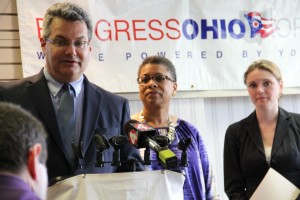
Photo from NetrootsNation.org
Interestingly, I received an email from ProgressOhio about the latest estimate which said:

** This statement can be attributed in whole or in part to Brian Rothenberg, Executive Director, ProgressOhio.

"It goes against the trends seen in big states and doesn’t include the discounts created by the subsidies. Announcing them without the subsidies is cynical because that’s not how people are going to buy insurance. If the goal is to enroll people, announcing rates without examples of subsidies makes no sense.

It’s not surprising that this is how Republican Lt. Gov. Mary Taylor would handle this. Her well known hatred for the Affordable Care Act is causing her to take an action as the state's insurance commissioner that hurts the people of Ohio. She shouldn’t announce rates without illustrating what that means for real people benefiting from tax credits that can be substantial in some moderate income categories."

It raises a good point about including the offset due to expected subsidies, but it misses the bigger picture regarding the basic concept that taxpayers are seeing increased rates while at the same time paying for others to have those higher rates subsidized.

And the subsidies might not be there for Ohioans.

According to this article in the Washington Free Beacon, the legality of the subsidies is being challenged.

As the article explains, the subsidies were part of the deal for the states to set up exchanges.

The law says that the government can provide subsidies for insurance sold on an “Exchange established by the state.” Thirty-four states have refused to set up their own exchanges, leaving the federal government set them instead.

The Obama administration maintains that the subsidies can be applied to a federal exchange as well, though some legal experts and Republicans in Congress say that's outside the scope of the law.

“When Congress passed the health care act, they presented states a choice,” (Oklahoma Attorney General Scott) Pruitt told the congressmen. “That choice was to establish a state health care exchange or to opt for a federal exchange. The ACA included with that choice a set of consequences and benefits.”

If states opted to create an exchange themselves, then their citizens would receive federal subsidies to buy insurance on the exchange, but employers would also be subject to fines for not offering affordable health insurance, Pruitt argued. However, if they opted against the exchange, they would not receive subsidies and employers would not be subject to fines.

Pruitt has launched a lawsuit against the administration arguing that they do not have the power to offer the subsidies on federally run exchanges. Experts predict that Oklahoma’s lawsuit, if successful, could fatally cripple the law.

Since Ohio did not set up its own exchange, defaulting to the federal one, residents may not see any subsidies if the lawsuit is successful.

Of course, states will then be criticized as being evil, uncaring and 'responsible for deaths' along with all sorts of terrible things for not wanting their residents to have that handout. But if it could "fatally cripple the law," Ohioans would benefit by not having such huge increases in insurance rates while maintaining a large diversity of plan options and costs.

The problem is that no one in Congress writing this law could have the depth of knowledge to re-design an insurance program/health care coverage that will fit the needs of so many people. This is where a free market comes into play.

In a 'free' market, entrepreneurs can create a product or service that fits the needs of some, while not needing to fit the needs of all. Ohio is a good example with our current variety of options that fit a multitude of needs and budgets.

With the federal government, they've decided what everyone must have (forced it upon us, actually) and then told us we'll have to pay for it, even if we don't need or want it.

Well-baby care is an example. My husband and I don't have kids and have no need for well-baby care which includes office visits, immunizations, etc... But that coverage is mandated by the ACA and the state of Ohio. So I'm paying for a portion of insurance that I don't need and will never use. A 'free' market, would give me the option to have a plan that didn't include that at, hopefully, a lesser cost than one that did.

Another example is young people who are generally healthy and don't need a full-service comprehensive plan. In a 'free' market, they could choose something like the old 80-20 insurance plans where routine doctor visits were not covered, but hospital bills for emergencies, injuries or serious illness were covered at 80%.

The Affordable Care Act - Obamacare - has removed those options from us, forcing us to have to what a bunch of bureaucrats in D.C. *think* we need. There is no way they can ever meet individual wants and needs the way a free market does so we are all forced into the one-size-fits-all mandate - and you and I will pay more as a result.

Thursday, September 22, 2011

Report shows Obamacare will have costly impact on Ohio

The Ohio Department of Insurance has analyzed Obamacare and its impacts on Ohio - and it's not good news.

From the press release about the report (emphasis added):

The report, conducted by Milliman, Inc., projects the impacts of the federal health care reform law starting in 2014, which is when most of the law’s provisions go into effect. The report shows significant changes that will increase premiums while dramatically expanding government programs.

"As I have been saying, the impacts of Obamacare will be widespread and expensive," Taylor said. "This report clearly shows what I have long predicted; Obamacare will result in bigger government, unsustainable costs, and ultimately, less consumer choice."

The report, available here, anticipates that premiums individuals pay could increase from 55-85% in 2014 - and that's not counting the existing trend of yearly increases which have averaged from 7-8% nationwide.

They expect that some people, depending on their individual health conditions, could see premiums rise by up to 130%, though they do show that some might actually see a decrease in costs.

The news for small group employers (those with 2-50 employees) could go up by as much as 15%, again, not including the yearly increases everyone sees. But groups with high numbers of employees with health issues could see their premiums rise by as much as 150%. Small groups with employees that have good health could see some decreases.

The report also predicts that more than 1,000,000 will be added to the state's Medicaid rolls while more than 500,000 will probably end up in the government-subsidized individual exchange. They anticipate that, when Obamacare is fully implemented, roughly half of Ohioans would be in some type of government-subsidized health care.

As Ohio Lieutenant Governor and Department of Insurance Director Mary Taylor said,

"These results are alarming when you consider what is going to happen to Ohio's already competitive insurance market. While Obamacare supporters may argue these changes are necessary to ensure access, the results mean even more financial burden on the backs of taxpayers."

And how much will that financial burden be?

The report projects that the annual operating costs, for which the state is responsible, will be between $19-34 million once the exchange is up and running - and that doesn't include any of the costs of the computer systems necessary to run the mandated exchange.

So while our own costs will go up - either through our employer passing along their increases or directly for those of us who purchase our own insurance coverage - our taxes will have to go up to cover the yearly operating costs of the federally mandated exchanges.

Again - we'll be paying for ourselves and then paying for everyone else, too.

What a bargain!

Tuesday, November 10, 2009

Two must-read petitions

I urge you to read these two petitions:

The Candlemaker's Petition - Petition of the Manufacturers of Candles, Waxlights, Lamps, Candlelights, Street Lamps, Snuffers, Extinguishers, and the Producers of Oil, Tallow, Resin, Alcohol, and, Generally, of Everything Connected with Lighting

The Healthcare Producers Petition - A Petition from the Producers of Health Insurance, Medical Equipment, Drugs, Diagnostic and Surgical Procedures, Physical Therapy, and, Generally, of Everything Connected with Healthcare

See how far we've come???

Monday, November 09, 2009

If health care bill just like Social Security and Medicare, how long until bankruptcy?

In looking at the news coverage of Saturday's vote on the Pelosi health care bill, nearly all reports include this statement:

"A triumphant Speaker Nancy Pelosi, D-San Francisco, likened the legislation to the passage of Social Security in 1935 and Medicare 30 years later."

And I just have to shake my head and wonder what happened to the brains these people were born with.

Why in the world would anyone liken this bill to two failing and bankrupt programs?

Do they not care that both Social Security and Medicare are insolvent and are paying out more than they're taking in? Do they not care that people who are paying into the system now are probably never going to see any benefit from those taxes they've paid?

Do they not understand that these two programs are just ponzi schemes that would put them into prison if they were in the private sector? As the Wall Street Journal reports:

The House also contains a new government long-term insurance program that starts collecting premiums in 2011 but doesn't starting paying benefits until 2016 and then runs out of money in 2029. North Dakota Democrat (Senator) Kent Conrad called it "a Ponzi scheme of the first order, the kind of thing that Bernie Madoff would have been proud of" in an interview with the Washington Post in late October.(emphasis added)


Maybe they understand all this - and are doing it BECAUSE of these facts. After all, we've continued to let them. And the more people they put onto the programs, the more support they have for extending them.

Under these rules and outcomes, they expect the same thing with health care. They'll make Americans dependent upon the government for health decisions and can then make all the decisions for the American people. We let them do this with our retirement, so why not health?

And when we are dependent upon government - that is, the politicians - we'll vote for the ones who promise to give us more, even if there is no way to pay for it.

Eventually, there won't be anyone left to tax to pay for the 'free' services others are getting. Then what? Will the politicians just borrow the money from China? And what if China stops buying debt?

Ah, those pesky 'what if' questions that politicians avoid like the plague.

If this health care bill is just like Social Security and Medicare, you can be sure it is not sustainable, will result in higher taxes, have limited service and, eventually, will result in bankruptcy for the program.

Pelosi said so herself.


Side Note: The Wall Street Journal has a great take on this as well.

Sunday, November 08, 2009

Thanks, Marcy Kaptur, for destroying liberty

"The powers delegated by the proposed Constitution to the federal government are few and defined. Those which are to remain in the State governments are numerous and indefinite. The former will be exercised principally on external objects, as war, peace, negotiation and foreign commerce." ~ James Madison

Some may say that her position was undecided, but most of us who know her voting record were very sure she was going to vote in favor of the government takeover of health care.

Final vote on the House version was 220 - 215 with only one Republican voting yes, though 39 Democrats voted no.

Sadly, the basic, core issue of the Constitutionality of the measure was never researched, though Republicans and at least one news source tried to raise the issue..

CNSNews asked many members of Congress where the Constitution grants the authority for mandating that citizens purchase a product and go to jail/be fined for failure to comply.

Answers ranged from 'for the common good' (a position our founders and authors of the document clearly did not intend) and 'general welfare' to 'we mandate car insurance so we can mandate health insurance.' Of course, it's the states that mandate car insurance - not the federal government, so this really isn't a valid argument for justifying the law.

Even worse was the claim that government isn't telling people WHICH insurance they have to buy - just that they have to have coverage. But the bill details what coverage you must have, so that 'logic' ends up looking as fallacious as it actually is.

Senate Judiciary Chairman Patrick Leahy said 'nobody questions' the authority.

House Speaker Nancy Pelosi said the issue of Constitutionality of the bill was "not a serious question."

Pelosi's spokesman later said it was covered under the 'interstate commerce' clause. But how that's possible is beyond me. I'm not participating in trade between the states when I purchase my insurance. In fact, irony of all ironies, I'm not even allowed to purchase insurance across state lines!

White House Spokesman Robert Gibbs said he had no idea if White House lawyers had reviewed the Constitutionality of forcing Americans to purchase health insurance. Gibbs went so far as to say, "... I don’t think it has gotten to the point where anybody questions the legitimacy of it.”

The reporter followed up: “Well, Orrin Hatch questions the legitimacy of it.” Gibbs quipped, “Well, you should ask him.”

The reporter asked, “Do you not feel there is any concern at all about whether it is constitutional for Congress to impose a mandate?”

“No,” Gibbs said.

So Congress 'assumed' they had the authority and then went about finding 'justification' for requiring Americans, as a condition of citizenship, to purchase a health insurance plan designed by government (regardless of their needs or wants) and to face fines, penalties and jail time for non-compliance.

And this isn't worth a discussion of the Constitutionality of the measure???? Shouldn't they settle the question of Constitutionality before they get sued over it???

In 1994, the Congressional Budget Office issued a report on the health care plan proposed by then President Bill Clinton. They wrote:

A mandate requiring all individuals to purchase health insurance would be an unprecedented form of federal action. The government has never required people to buy any good or service as a condition of lawful residence in the United States. An individual mandate would have two features that, in combination, would make it unique. First, it would impose a duty on individuals as members of society. Second, it would require people to purchase a specific service that would be heavily regulated by the federal government.

This is exactly the plan that the House passed yesterday.

As of today, 220 members of the House of Representatives, including Marcy Kaptur, think that the government has the authority to order to you purchase a product you may not want. Or, if you do want it, to purchase the product they define, rather than the one you believe best meets your needs.

This is not a question of health insurance, it's a question of freedom, as Terence P. Jeffrey, writes:

Can President Obama and Congress enact legislation that orders Americans to buy health insurance? They might as well order Americans to buy broccoli. They have no legitimate authority to do either. Yet neither Obama nor the current leadership in Congress seems to care about the constitutional limits on their power.

They are now attempting to exert authority over the lives of Americans in a way no president and Congress has done before.
...

... imagine an American sitting on his back porch casually enjoying the would-be anathematized state of not owning health insurance. When it comes to health insurance, this American has not been, is not and never intends to be engaged in any form of commerce with any entity in any foreign nation, distant state or Indian tribe.

If he did decide to engage in health-insurance related commerce with any entity in a foreign nation, distant state or Indian tribe, Congress could constitutionally regulate that action. But this American simply won’t oblige. As a free person—like generations of Americans before him—he has weighed the risks and benefits of buying health insurance, and he has decided not to buy it. He is fully ready to accept the good and bad consequences of this decision.

All he wants from the government is to be left alone.

For President Obama and Congress to reach into this American’s backyard and force him to buy health insurance would be a blatantly unconstitutional act.
...
All versions of the health care bill under consideration in Congress would order Americans to buy health insurance. If any of these bills is enacted, the first thing it would accomplish is the amputation of a vital part of our Constitution, and the death of another measure of our liberty.


Thanks, Marcy, for helping to destroy my liberty and for the arrogance of thinking that you know better than the majority of Americans who believe they can make better decisions with their money than you can.


Lest you think this is nothing to be concerned over, just take a look at this chart of how it all works...and they say this is supposed to help????

Wednesday, October 07, 2009

Did you know? Government already coerces your health care choice

I guess I wasn't aware of this fact until reading this article in the Wall Street Journal:

"A centerpiece of the debate over ObamaCare is government coercion and the right to choose a health-care plan. So it's worth watching a lawsuit now making its way through the federal courts that seeks to let seniors keep their Social Security benefits even if they reject Medicare. This could be a big deal."

That's right. If you want to collect your Social Security, you MUST enroll in Medicare, even if you don't want it or need it. If you've got a great health plan already and decide to 'opt out' of Medicare, the government will deny you the ability to collect your Social Security.

Seems contrary to everything we know and the rhetoric we're hearing in today's health coverage debates, doesn't it? Especially since the two are completely different programs, each funded by the individual through different taxes.

But there is some logic and reason making its way through this situation:

POMS were imposed in 1993 during the Clinton Administration and set forth rules that aren't in the statute or regulations governing Medicare. The three plaintiffs—Brian Hall, John Kraus and former U.S. House Majority Leader Richard Armey—all had health-care plans they preferred to the coverage they were compelled to receive through Medicare.

In her ruling this week, the judge said that "neither the statute nor the regulation specifies that Plaintiffs must withdraw from Social Security and repay retirement benefits in order to withdraw from Medicare." Article I of the Constitution gives Congress sole power to legislate—so when agency rules conflict with federal statute, the statute takes precedence.

The Obama administration opposed the suit saying that the plaintiffs had not yet exhausted their administrative remedies for challenging these agency rules. But the judge disagreed:

Judge Collyer rejected that notion, noting that one plaintiff had sought an administrative hearing but "received no response from the SSA for approximately three years." Exhaustion of remedies was therefore "futile." A three-year wait is precisely the kind of bureaucratic hassle, or deliberate stonewalling, that government is famous for.

The article continues with what appears to be just common sense - but also points out the contradiction when it comes to the actions in this situation versus the words coming out of politicians' mouths:

Keep in mind that the plaintiffs are merely asking for the freedom to spend their own money for their own health insurance. With Medicare careening toward bankruptcy, letting seniors opt out could help save the taxpayers money. The plaintiffs argue, and reasonably so, that they have paid a lifetime of taxes into Social Security and shouldn't have those benefits denied merely because they are willing to pay for their own medical care. Social Security and Medicare are separate programs, and both are financed by separate payroll contributions.

The response of the Obama Administration to this lawsuit is revealing about its principles, as opposed to its rhetoric. President Obama says his plan for a "public option" wouldn't be coercive, saying that "If you like your health-care plan, you keep your health-care plan. Nobody is going to force you to leave your health-care plan." But here is a case where federal bureaucrats are using their power to force Medicare on seniors. Let's hope the courts restore a genuine right to choose.

We need to keep this situation in mind and remember the excesses of government when it comes to a so-called 'choice' of health coverage in the future. Despite their words, we have a present-day example that demonstrates the words cannot be trusted.

Monday, October 05, 2009

And they said we wouldn't end up with 'death panels'

I thought this was an interesting article from the National Post, addressing Canadian health care decisions:

Choosing health
National Post
Published: Monday, October 05, 2009

Opponents of U.S. President Barack Obama's proposed health care reforms have just been handed a powerful talking point by Ontario's government.

Democrats cobbling together the U.S. plan want to include a "public option" -- a taxpayer-funded health-care alternative that would enable Americans to choose between private medical insurance plans or a government-backed system similar to Canada's. Opponents of the public option maintain that Canadian-style health care would entail rationing, caps on care, bureaucratic interference in medical decision-making and even "death panels" deciding when the ill become too expensive to save.

Most Canadians believe this is a gross exaggeration of reality. But then how to characterize Ontario's decision to cut off funding for colorectal cancer patients taking a life-prolonging drug, in order to save $9-million a year?

Andre Marin, the province's plain-speaking ombudsman, said the decision "verges on cruelty." Marin said the "arbitrary" limit on the number of cycles of the drug Avastin that Ontario will fund forces patients to pay out of their own pockets or abandon treatment.

Avastin does not cure cancer, but prolongs life when taken in conjunction with chemotherapy treatment, adding, on average, nine months of survival.

"For patients whose cancer has already metastasized, it stops their tumours from growing and prolongs their lives, at least for a while. It is, without exaggeration, their lifeline," Mr. Marin said.

Ontario Health Minister David Caplan rejected the suggestion that the cap on treatment was a financial decision alone, arguing it was based on clinical evidence. But it's easy to reach the conclusion that the province decided nine extra months of life for a dying patient wasn't worth the money. Which is pretty much the kind of decision a "death panel" would be confronted with.

While this is not labeled a 'death panel,' it is the end result: a government bureaucracy making a decision about what treatments are 'worth' the cost, and deciding life and death issues.

Many people will make the argument that insurance companies do the same thing. But comparing the force of government to a voluntary contract with a private organization is not comparing apples to apples.

Since we pay for our own insurance (yes, despite the fact that we are both healthy and have no medical issues), I examined multiple plans, what they offered, the cost and the limitations and we decided to contract with a particular company. We know the limits of our policy and are making our own arrangements for the costs we are obligated to pay out-of-pocket. We know that, should there be any changes to the terms of our contract, we have a mandated notification time frame and if we do not like it, we can go elsewhere.

In our options, we had different levels of deductibles, different items covered, different restrictions as to hospitals and/or doctors, etc. Interestingly, though we did not want a plan that included well-baby care, that's a mandate in Ohio so despite the fact that we do not have children, we are forced to have that coverage - and we are paying for it, knowing that we'll never utilize it.

Our choices would have been more numerous if we'd been able to purchase 'across state lines,' but that's not something included in H.R. 3200, America's Affordable Health Choices Act of 2009, though it should be.

If the Democrat plans for 'health reform' take effect, we'll be paying for everyone else's coverage for everything while having government mandate coverage for even more things that we don't need.

And with government paying for everything and everyone, eventually the bureaucrats will realize that there really isn't enough money to cover the costs and they'll start rationing service, services, drugs, treatments, etc... just like the article above indicates.

In the end, the problem with 'health care' in America isn't that people don't have it - they do. No one is ever 'denied' care - it's available. The problem is that not everyone has set aside the money necessary to cover the costs of their treatments, but they want them anyway - even if others have to pay for it.

Two things that would reduce costs - tort reform and competition across state lines - are not part of the plan, even though they'd do more to help Americans than anything in either Senate or House plan would.


SIDE NOTE: I'm just sick and tired of liberals saying that insurance companies are 'bad' and 'evil' because they, in effect, ration care. As I've noted above, there's a difference between a voluntary contract for services and the force of government. But if you listen to the arguments, liberals say that conservatives shouldn't object to a government plan that 'rations' because insurance companies already do. But if we need a government plan so people don't have to suffer the consequences of insurance companies 'doing terrible things to sick people,' how can you then support a the exact same 'terrible things' being done by the government plan you support? Because it's the 'government' it's somehow now okay????

Apparently, the irony/double standard/contradiction - call it what you will - is missed by those who believe government is the solution to every problem.

Friday, August 28, 2009

Random thoughts on a rainy Friday

* Lisa Renee at Glass City Jungle has a post about the Freedom From Religion Foundation's opposition to the prayers said prior to Toledo City Council meetings.

First, I thought the Constitution guaranteed our freedom OF religion, not FROM. Also, despite my Christianity, I'm NEVER offended by someone of another religion offering up a prayer and have never thought that a prayer from a Muslim, Jew, Hindu, etc, prior to any gathering, including a political/governmental one, would in any way whatsoever hinder my participation in the function.

And then I wondered, considering all the talk about 'representing' the community, just what the religious affiliation of Toledo was. The Census Bureau is prohibited by law from tracking religion as a statistic, so it's hard to tell what portion of the city's population identifies itself as religious, or to get a breakdown of which religions. Here's the question: if the majority of citizens identify themselves as 'Christian' and the city council is trying to be representative of the community in their selection people to offer prayers, isn't it likely that the majority of those prayers will have Christian overtones?

Here's the other point: tolerance. I'm tolerant of people who have a different religion than me, or who are atheist/agnostic. Why can't they be tolerant of me and my Christian faith? And if they don't like the prayer being offered, can't they just get up and leave during that portion?

And just who is the person identified in the letter from this organization that is so offended by a prayer that mentions Christianity and Jesus Christ? Are they as offended by the mention of Muhammad by an Imam who practices Islam? The letter doesn't say...

* I'm tired of polls that ask people what they think about something without first finding out if the people can properly define the subject matter PRIOR to offering an opinion. I've written about this in relation to a poll about the recession and am now seeing it in polls about health care.

From a recent Denver Post story:

"Nearly 8 in 10 Americans support a federal health insurance plan for those who can't afford or can't get private insurance, but only 37 percent define "public option" correctly, a new national poll found."

If 63% of the people can't define a 'public option' correctly, why would we trust their support for it? How can they be in favor of something if they don't really know what it is?

At least this poll asked about the definition. Most pollsters don't want to include that aspect in their questions for fear of the criticism I've just given.

* This morning I heard a news clip of Toledo Mayor Carty Finkbeiner saying that the only mayoral candidate he's heard present an economic development plan is Republican Jim Moody. Considering Carty's history, I could only wonder if this was the kiss of death for the Moody campaign.

* I love rainy days when the clouds make it so dark in the house that you need to turn on the lights. I love the sound of the rain on the windows and the way I can watch the heavier downpours move across the surface of Maumee Bay. It's the kind of day where you want to stay in your pajamas, curled up on the couch with a good book or good movies on TV.

Alas, nothing good on TV and, not being able to predict the weather, I spent all day Wednesday reading Harry Potter and the Deathly Hallows. So I guess I'll have to get my work done, instead.

Tuesday, August 18, 2009

The only health care question you need to ask

"I know no safe depository of the ultimate powers of the society but the people themselves; and if we think them not enlightened enough to exercise their control with a wholesome discretion, the remedy is not to take it from them, but to inform their discretion by education. This is the true corrective of abuses of constitutional power." ~ Thomas Jefferson, letter to William Charles Jarvis, 1820

People are rightly concerned about what's in HR 3200, the America's Affordable Health Choices Act of 2009, and, when they can find a representative, are asking tough and pointed questions about the components of the bill and how it will work.

But the questions are all about the details - who will do what, how will it work, what does section 1151 really mean?

These questions, while pertinent and important, miss the overriding and first principle of any legislation or action of congress: The Constitution.

Members of Congress have taken an oath to uphold the Constitution of the United States.

The first question we should ask - and demand an answer to - is this:

Where in the Constitution does Congress get the authority to implement any health care law?

If they cannot provide the section number, then they are bound by their oath to vote no on this bill.

If they cite their ability to provide for the 'general welfare' of the United States, you can remind them what James Madison wrote in vetoing a public works bill in 1817:

To refer the power in question to the clause "to provide for common defense and general welfare" would be contrary to the established and consistent rules of interpretation, ...

Such a view of the Constitution would have the effect of giving to Congress a general power of legislation instead of the defined and limited one hitherto understood to belong to them, the terms "common defense and general welfare" embracing every object and act within the purview of a legislative trust.

It would have the effect of subjecting both the Constitution and laws of the several States in all cases not specifically exempted to be superseded by laws of Congress, it being expressly declared "that the Constitution of the United States and laws made in pursuance thereof shall be the supreme law of the land, and the judges of every state shall be bound thereby, anything in the constitution or laws of any State to the contrary notwithstanding." Such a view of the Constitution, finally, would have the effect of excluding the judicial authority of the United States from its participation in guarding the boundary between the legislative powers of the General and the State Governments, inasmuch as questions relating to the general welfare, being questions of policy and expediency, are unsusceptible of judicial cognizance and decision.

A restriction of the power "to provide for the common defense and general welfare" to cases which are to be provided for by the expenditure of money would still leave within the legislative power of Congress all the great and most important measures of Government, money being the ordinary and necessary means of carrying them into execution.

...

I am not unaware of the great importance of roads and canals and the improved navigation of water courses, and that a power in the National Legislature to provide for them might be exercised with signal advantage to the general prosperity. But seeing that such a power is not expressly given by the Constitution, and believing that it can not be deduced from any part of it without an inadmissible latitude of construction and reliance on insufficient precedents; believing also that the permanent success of the Constitution depends on a definite partition of powers between the General and the State Governments, and that no adequate landmarks would be left by the constructive extension of the powers of Congress as proposed in the bill, I have no option but to withhold my signature from it, and to cherishing the hope that its beneficial objects may be attained by a resort for the necessary powers to the same wisdom and virtue in the nation which established the Constitution in its actual form and providently marked out in the instrument itself a safe and practicable mode of improving it as experience might suggest.
(emphasis added)

You don't have to use the entire quote - you can summarize. But if this is too long, you can try these:

"If Congress can do whatever in their discretion can be done by money, and will promote the General Welfare, the Government is no longer a limited one, possessing enumerated powers, but an indefinite one, subject to particular exceptions." - James Madison, Letter to Edmund Pendleton, January 21, 1792 _Madison_ 1865, I, page 546

"I cannot undertake to lay my finger on that article of the Constitution which granted a right to Congress of expending, on objects of benevolence, the money of their constitutents." - James Madison, regarding an appropriations bill for French refugees, 1794

"With respect to the words general welfare, I have always regarded them as qualified by the detail of powers connected with them. To take them in a literal and unlimited sense would be a metamorphosis of the Constitution into a character which there is a host of proofs was not contemplated by its creators." - James Madison, Letter to James Robertson, April 20, 1831 _Madison_ 1865, IV, pages 171-172

"Congress has not unlimited powers to provide for the general welfare, but only those specifically enumerated." - Thomas Jefferson

Without an enumerated power in the Constitution to implement HR 3200, our members of Congress have a choice: they can uphold their oath and our Constitution by voting 'no'; or they can show their disdain for the the supreme law of the land - and suffer the consequences.

They work for us and should tell us now - before they return to Congress for the next session - which option they choose.

Monday, August 17, 2009

Health care bill is still bad, even without 'public option'

The latest news over the weekend is that President Barack Obama may be willing to drop the 'public option' from the health care bills currently in Congress.

The House version, HR 3200, is the only one really available to review because the Senate has yet to publish any of their voted-on versions.

The hope by some is that elimination of the 'public option' would make every day Americans (who are opposed to government takeover of the medical industry) less resistant to the bill. However, there is still much to dislike in HR 3200 and plenty of reasons for this bill to be soundly defeated.

One of the arguments that routinely get mentioned is that nothing in the bill takes over a single hospital or a single doctor. But you don't need to physically come in and take ownership of a hospital to be able to control what goes on in that facility.

Whenever government can dictate what you do, how you do it, what you charge for it and tax you or fine you for non-compliance, government has 'taken over.' And that's what this bill would do.

HR 3200 mandates that individuals must obtain insurance or be taxed. So if you're a healthy young person who'd rather save money for purchasing a house than pay several hundred dollars a month for insurance - too bad. Government knows what is best for you and if you try to make that decision on your own, you will have to pay government for the freedom of making such a decision.

Interestingly a large number of the "46 million uninsured" are young people who have access to insurance but choose to forgo it in order to set their own priorities with their funds. That's why the 'buy insurance or be taxed' provision is in the bill.

But don't believe just my words, read the bill. It says so in Section 401, Tax on individuals without acceptable health care coverage. From the bill:

"(a) TAX IMPOSED.—In the case of any individual who does not meet the requirements of subsection (d) at any time during the taxable year, there is hereby imposed a tax equal to 2.5 percent of the excess of:

(1) the taxpayer’s modified adjusted gross income for the taxable year ...

(2) the amount of gross income specified in section 6012(a)(1)...”

Note, too, that if you're without insurance for "any time during the year," you become subject to the tax. So if you've decided not to purchase COBRA coverage for the time between leaving one job and when your insurance kicks in for your new job, you get taxed - even if it's just for a week.

How many people routinely make such a decision, especially if they're healthy?

The bill also gives government the ability to determine what type of coverage you have. It's section 122 (b) which dictates the minimum services to be covered, including maternity and well-baby care. Now, that may be great for a young couple who wants to have kids, but what about older individuals or those who cannot have children? Why should their insurance be required to provide that service - and why should they be required to pay for something they won't ever use?

This section also requires a 70% actuarial value of the benefits. While this may be a rather technical requirement to most, it means that the current option of choosing to pay for routine services like doctor visits, but carrying insurance for major illnesses or injuries is illegal once the bill is law.

Then there is the entire Title IV Quality, Subtitle A Comparative Effectiveness Research section 1401. Under the provisions of this section, government sets up a new bureaucracy (including board members who get per diem payments as well as travel reimbursements and staff to carry out the terms of the bill) to determine what treatments will be approved.

Included is the authority to use data from electronic medical records for determining the comparative effectiveness of treatments. I wonder, because I do not know, if they can access such records without our permission. The bill does give the newly established research center the authority to obtain data from any agency or department of government and from other sources.

This section also allows the government to determine national priorities for research. I can only wonder how many lobbyists various disease foundations will have to hire to get their disease on the national priority list? And will the national priorities end up like Oregon? In that state, they rank treatments

"for various diseases and conditions, currently from 1 to 680, in order of priority. The health care dollars available determine which priorities are met. As program costs have grown, the list of covered procedures has become shorter.

In 2009, the state will pay only for the first 503 procedures. It won't pay to remove ear wax, treat vocal cord paralysis, or repair deformities of one's upper body and limbs. It will fund therapy for conduct disorder (age 18 and under), selective mutism in childhood (a prolonged refusal to talk in social situations where talking is normal), pathological gambling, and mild depression and other mood disorders.

Reordering Priorities. Surprisingly, between 2002 and 2009 there was a fairly radical reordering of the plain language priorities. A great many life-saving procedures that ranked high in 2002 have been relegated to a much lower position in 2009, while procedures that are only tangentially related to life and death have climbed to the top. (While extensive code lists define actual treatment, most people must rely on the plain language to judge list adequacy.)

For example, medical treatment for Type I diabetes, which ranked second in 2002, was demoted to 10th place in 2009. Oddly, given that not providing treatment for Type I diabetes is a death sentence, it has been placed behind spending on smoking cessation, sterilization and drug abuse treatment. And this is not an isolated case."

In Oregon in 2002, appendicitis ranked 12th for treatment priorities but in 2009, it dropped to 84th, behind treatment for asthma (11th), lactose intolerance (13th) and abortion (41st).

While the Oregon priorities are for treatments, will the federal government's priority list for research experience similar changes? We don't know - that question hasn't been answered by any Congressional representatives, yet.

Another aspect of the comparative effectiveness research section is the 'oversight' the government will exert. Under the current terms of the bill, the government will decide if independent research on medical issues is 'credible' and 'consistent' with the government standards (which the center will also establish). They can 'recommend' the research methodologies. What happens if you don't take their recommendation on methodologies? Will your research be determined 'credible' if you'd not done it the way they say you should?

Government also gets to set rates. According to Sec. 223, Payment rates for items and services, the government gets to 'correct' payments that are excessive or deficient. This also means they get to determine the definition of 'excessive' and 'deficient.'

(d) CONSTRUCTION.—Nothing in this subtitle shall be construed as limiting the Secretary’s authority to correct for payments that are excessive or deficient, taking into account the provisions of section 221(a) and the amounts paid for similar health care providers and services under other Exchange-participating health benefits plans.

(e) CONSTRUCTION.—Nothing in this subtitle shall be construed as affecting the authority of the Secretary to establish payment rates, including payments to provide for the more efficient delivery of services, such as the initiatives provided for under section 224.

Even without the public option, this bill takes over our health care system by dictating what is covered, how much is paid for it, what treatments are better than others and whether or not you should get such treatments.

It uses the force of government, through taxation and the Internal Revenue Service, to penalize for non-compliance, which, in effect, makes the government the decision-maker for your health care needs and wants.

Oh, sure, you get to decide which doctor to use, they claim, hoping that you'll see that 'choice' as sufficient liberty when it comes to your health. But your relationship with that practitioner is dictated from beginning to end, so it's really not much of a choice, is it?

We cannot be dissuaded on the opposition to the bill simply because one aspect might be removed. The entire bill is bad and we must be vigilant in pointing out and opposing all the other aspects that result in a government take over of the industry.

And no - the insurance companies have not paid me for this opinion.

Tuesday, August 11, 2009

Will federal 'health reform' be like Oregon's?

The Independent Institute has a short video that describes some of the ideas for federal health reform when it comes to prioritizing treatment, especially compared to the state of Oregon which also has a prioritization system.

I hope you'll watch it and start asking questions - and demanding answers.


Lest you think this is an exaggeration, here is the National Center for Policy Analysis' synopsis of an ABC story on Oregon's health system:

DEATH DRUGS CAUSE UPROAR IN OREGON

Imagine receiving a letter from your insurance company rejecting to pay for a drug that could save your life. Then imagine your state health plan agreeing to pay for your suicide. That's been the case in Oregon, says ABC News.

The Oregon Health Plan was established in 1994 and the physician-assisted death law, Death With Dignity Law, in 1997. The health plan, for those whose incomes fall under the poverty level, prioritizes coverage -- from prevention first, to chronic disease management, treatment of mental health, heart and cancer treatment. However, the health plan takes "no position" on the physician-assisted suicide law.

But a 1998 study from Georgetown University found a strong link between cost-cutting pressures on physicians and their willingness to prescribe lethal drugs to patients -- were it legal to do so:

* The study warns that there must be "a sobering degree of caution in legalizing (assisted death) in a medical care environment that is characterized by increasing pressure on physicians to control the cost of care."
* Cancer drugs can cost anywhere from $3,000 to $6,000 a month; the cost of lethal medication, on the other hand, is about $35 to $50.
* However, the problem with the Oregon plan is that it sounds like administrators, not physicians, are making treatment decisions; if a patient can get assisted death paid for but not cancer treatment, the choice is obvious.

But critics, and even supporters, of the Death With Dignity Law -- the only one of its kind in the nation -- have been up in arms recently as idea has spilled over into other states, including Washington, where advocacy groups are pushing for enactment of Initiative 1000 in November, legalizing a similar assisted-death law, says ABC News.

Source: Susan Donaldson James, "Death Drugs Cause Uproar in Oregon," ABC News, August 6, 2009.

Wednesday, August 05, 2009

Michigan Rep. John Dingell schedules town hall meeting

I know this is short notice, but for those of you across the state line, Democratic Congressman John Dingell has scheduled a town hall meeting on Thursday, August 6 at 6 p.m. in the Romulus Athletic Center, 35765 Northline Rd., Romulus, MI.

As chairman of the House Committee on Energy and Commerce, he's one of the authors of the health care bill, America's Affordable Health Choices Act of 2009. He represents Michigan's 15th District.

From his website:

"The more the American people hear about the language and the provisions actually in our bill, the more they like it. The problem is all these crazy falsehoods that are being spread around that leave people confused. It will not be a simple thing to cut through the clutter, but I look forward to listening to and speaking with my constituents during the district work period.”

Since he wants to speak with you about the legislation and since he's one of the authors, you might want to check out American Thinker's 7-part series "What to ask your Congressperson about Obamacare" for some good questions. And be sure to take a camera and share what goes on!

Saturday, August 01, 2009

When policies fail, demonize

The health care 'reform' that Democrats and President Barack Obama are pushing is failing to gain support among the American public.

Citizens, outraged over the issue, are angrily confronting their representatives in town halls and forums within their districts. As a result, representatives are calling out the police and acting indignant over the outrage and opposition they're getting from their bosses - but that's another subject for another day.

So what's a politician to do?

Create an enemy.

Start talking about how some entity is "taking advantage" of you, or is "evil, immoral and villainous" in how they deal with you. Demonize a particular industry so you can rally the masses in an emotional appeal 'for' you and 'against' someone else.

It's a tried and true tactic from a political perspective, though usually it's used on prior officeholders. Democratic Party strategist Liz Chadderdon recently said:

"I think Bush-bashing has been alive and well since '07 and, since it keeps working, why not use it? Voters have short memories..."

So if it works, why not?

And that's the game plan for the health care bill.

Sen. Dick Durbin jumped on the bandwagon attacking insurance companies.

“The health insurance companies are some of the most profitable businesses in America. By fighting change they're protecting their bottom line.”

Yep - there's a profitable business industry employing and providing services for millions. They must be bad.

Now, remember, these are for-profit organizations. You pay them an agreed-upon amount in the hopes that you never have to take advantage of what they are guaranteeing in return. And if you do have to take advantage of their coverage, you're pretty sure the total you've paid them over time is going to be less than what they end up paying on your behalf. That's the way insurance works.

But Durbin wants you to think negatively about these companies - because they want to make a profit on behalf of their shareholders (who probably include many individuals very similar to you). If he's going to get you to support his plan to put them out of business - and that's what the legislation will do - he has to get you to hate these companies, or at least distrust them so you want what he's offering instead.

Hypocritical House Speaker Nancy Pelosi went so far as to call these businesses, 'the villains':

"It is somewhat immoral what they are doing. Of course, they have been immoral all along how they have treated the people that they insure," MSNBC's Luke Russert quoted her as saying. "They are the villains in this."

Of course, taking campaign donations from such villainous, immoral entities is perfectly okay for her - but we shouldn't trust them. Oh no!

I hate the class warfare approach to politics these days. I don't believe that people with money are evil because they have more than me. I don't believe I'm entitled to the fruits of their labor simply because they have more fruit. I believe I should be rewarded for my hard work and my labors. I should not have my fruit taken and given to others who haven't worked as hard or for as long as I have.

I also don't believe that profit is a dirty word, or that for-profit companies are evil because they exist to make money on behalf of their shareholders and owners. I don't believe I need to have an enemy to make me 'feel' positively about a policy that's being promoted.

Most importantly, I believe that the need to create an enemy in order to get people on a particular side of an issue clearly demonstrates the weakness of that position in the first place. And our immediate reaction to such a ploy should be distrust and rejection the tactic, the person using it and the policy.

But with many people, appealing to their emotions and using the politics of envy and greed, works. I just hope we can stop 'feeling' and start 'thinking' before it's too late.

Friday, July 31, 2009

Why not duplicate an insurance that works?

Numerous times I've questioned why politicians and President Barack Obama are going the socialized medicine route when it comes to health care and not looking at how auto and home insurance systems work instead.

Now comes this post by Eli Lehrer, "Auto Insurance Works - So Why Doesn’t Health Insurance?" which wonders the same thing.

Those looking for solutions to America’s health insurance bills can see a lot to admire in the auto insurance market. Auto coverage purchasers throughout the country have a wide choice of providers, a fair number of different options within those plans, and benefit from vigorous price competition in the market. In states that don’t monkey too much with the auto market even the worst drivers can usually find a private carrier to cover them. All states but New Hampshire, furthermore, have “financial responsibility” — the individual mandate — that requires car owners to have either insurance or another means of paying for any accidents they cause. This last feature, in particular, has attracted praise from Republicans and Democrats alike.

read more...

Thursday, July 30, 2009

Central dispute between Right and Left over health care

Greg Mankiw, a professor of economics at Harvard University with a blog of 'random observations for students of economics,' has done a good job, I think, of summing up the central dispute between Left and Right over health care.

Perhaps a lot of the disagreement over healthcare reform, and maybe other policy issues as well, stems from the fundamental question of what kind of institutions a person trusts. Some people are naturally skeptical of profit-seeking firms; others are naturally skeptical of government. ...

I tend to distrust power unchecked by competition. This makes me particularly suspicious of federal policies that take a strong role in directing private decisions. I am much more willing to have state and local governments exercise power in a variety of ways than for the federal government to undertake similar actions. ...

Most private organizations have some competitors, and this fact makes me more comfortable interacting with them. If Harvard is a bad employer, I can move to Princeton or Yale, and this knowledge keeps Harvard in line. To be sure, we need a government-run court system to enforce contracts, prevent fraud, and preserve honest competition. But it is fundamentally competition among private organizations that I trust. ...

A central question in this and perhaps other debates is, Whom do you trust?

Tuesday, July 28, 2009

5 Freedoms you lose under health care reform

I've been reading the House version of the health care bill, American's Affordable Health Choices Act of 2009. I must say, though, that a more Orwellian name could not have been conceived. It's not 'affordable' and there are relatively no 'choices.'

I've been taking notes about the various provisions and trying to figure out how best to summarize them down from my dozens of pages. Today I came across this Fortune article, "5 freedoms you'd lose in health care reform," that does it best.

The president repeatedly says that you'll still be able to keep your current plan and doctor. But Shawn Tully, editor at large of Fortune and author of the piece, sees it differently:

"A close reading of the two main bills, one backed by Democrats in the House and the other issued by Sen. Edward Kennedy's Health committee, contradict the President's assurances. To be sure, it isn't easy to comb through their 2,000 pages of tortured legal language. But page by page, the bills reveal a web of restrictions, fines, and mandates that would radically change your health-care coverage."

The article then explains the five freedoms we'd all lose under these bills:

1. Freedom to choose what's in your plan
2. Freedom to be rewarded for healthy living, or pay your real costs
3. Freedom to choose high-deductible coverage
4. Freedom to keep your existing plan
5. Freedom to choose your doctors

As I was going through the House bill, I was struck by the lack of choice I would have under these proposals. I don't need well-baby care, childhood immunization and a host of other coverage that individuals with children need. I also don't need substance-abuse, fertilization or hair transplants (which is required to be covered by Connecticut law). But many of those services will be mandated by the federal government in order for a health insurance plan to be designated by the government as a 'Qualified Health Benefit Plan' (QHBP).

Then there is the community rating aspect of the bills. Under this concept, each person is charged a similar rate based upon what their community is like - not based upon themselves as individuals. Toledo has been ranked as having the highest adult smoking rate in the country of 31%, and was ranked the worst city for men by Men’s Health magazine. What do those rankings do for our 'community rating' and how will that impact individuals who don't smoke and who maintain their health? It won't matter - healthy people will pay based upon everyone else.

This also gives people with non-healthy lifestyles no incentive to change their ways. If you pay the same as a healthy person, why make sacrifices and change behaviors if there are no financial consequences for doing so?

***Sidenote: I continue to wonder why it is that we can't pattern health insurance against other types of insurance. Car insurance is available across state lines, has multiple types of offerings to meet the needs and budgets of anyone and the states have mandates with penalties for not having the coverage. I can purchase various types of life insurance policies and the fee is based upon a number of factors specific to me and the level of coverage I want. Why can't we at least consider a similar system for health insurance????
***

As with any bill in Congress, they are exemptions for some and not for others. Self-insured companies (most large corporations) get a five-year grace period during which they can continue to offer their current plans with no penalties. What most people don't realize is that the vast majority of municipal, county and state governments are self-insured. So the government workers would have their current benefits while the rest of the nation gets dumped into the government-dictated and, if the Congressional Budget Office is right, more costly plans. How convenient for government workers.

What consumers think

A recent Zogby/University of Texas poll on health care showed that 83.5% were satisfied with their health care. Of course, is the overwhelming majority are satisfied, why are there demands on Congress for 'reform'????

Interestingly, majorities believed that insurance rates should be the same for everyone regardless of pre-existing conditions (question 542 and 543), but a majority also believed that rates should be based on age and behavior (question 545 and 556).

Apparently, the contradiction in what these consumers want isn't recognized by the consumers. How can you be charged without regard to pre-existing conditions, but also be charged for behavior, like smoking, exercise, etc? Such contradictions may be why the congressional plans contain what they do.

Another interesting point of the poll is that roughly two-thirds agree that a federal health plan could undermine private insurance companies and that private insurance plans better than the government's should not be taxed. But these bills contain such provisions, because government can't give us something for nothing, no matter what the politicians claim and promise during their campaigns.

Considering the results of this poll, is it any wonder that Congress 'feels' the 'need' to do something and 'believes' the solution is to just let government control everything for us? According to this poll, we don't know what we want. So we'll just let the politicians decide - life is so much better when other people make our decisions for us, isn't it?

No wonder we live in an ever-increasing nanny state and are about to lose our health care 'freedoms' in addition to so many others.

Friday, July 24, 2009

What Ohio Dems are saying about the health care bill

Rep. Zack Space (D-OH):

“‘I and the rest of my Blue Dog Coalition... are deeply committed to fixing the health care delivery system,’ Space said in an interview Tuesday. ‘However, we share some concerns about the bill that's been presented to us by leadership, specifically concerning cost issues and the speed at which we are moving.’”

(Bill Theobald, “Rep. Space At Center Of Health-Care Reform Debate,” Zanesville Times Recorder, 7/21/09)

Rep. John Boccieri (D-OH):

“Still, that’s the kind of discussion that could raise concerns for centrist freshman Democrats like Rep. John Boccieri (D-Ohio), who says there’s ‘a little fear’ among his constituents of a government-run plan, and no appetite for a tax increase. ‘My feeling is there’s enough money in the system already,’ Boccieri said.”

(Mike Soraghan, “Speaker Pelosi Makes Aggressive Push To Finish Healthcare Reform This Month,” The Hill, 7/8/09)

Rep. Mary Jo Kilroy (D-OH):

“Although Rep. Mary Jo Kilroy, D-Columbus, was the only freshman Democrat from Ohio not to sign the letter to House Speaker Nancy Pelosi, D-Calif., Kilroy spokesman Paul Tencher said she still is ‘concerned’ about the taxes on small businesses and the wealthy.”

(Jack Torry, “Ohio Democrats Call Out Pelosi On Health Bill,” The Columbus Dispatch, 7/21/09)

Rep. Tim Ryan (D-OH):

“A group of Democratic legislators sought Tuesday night to shape a compromise measure with an amendment say that abortion coverage could not be mandated as a part of insurance plans, but that insurance companies also couldn’t be prohibited from offering that coverage if they chose to. ‘We clearly don't want any federal funding for abortions,’ said Rep. Tim Ryan (D-Ohio), the lead author of a letter to Speaker Nancy Pelosi proposing the measure, which is unlikely to satisfy conservatives. ‘I think this is where both sides can come together.’”

(Ben Smith, “Abortion Roils Already Tense Health Debate,” Politico, 7/22/09)


Interestingly, none of these individuals, (in fact - no Democrats as of today and only Rep. John Boehner in Ohio) have signed on to House Resolution 615:

RESOLUTION
Expressing the sense of the House of Representatives that Members who vote in favor of the establishment of a public, Federal Government run health insurance option are urged to forgo their right to participate in the Federal Employees Health Benefits Program (FEHBP) and agree to enroll under that public option.

Resolved, That it is the sense of the House of Representatives that Members who vote in favor of the establishment of a public, Federal Government run health insurance option are urged to forgo their right to participate in the Federal Employees Health Benefits Program (FEHBP) and agree to enroll under that public option
.

Thursday, July 16, 2009

Uh-Oh! Private insurance is not an option

From the National Center for Policy Analysis:

PRIVATE INSURANCE IS NOT AN OPTION
It didn't take long to run into an "uh-oh" moment when reading the House's "health care for all Americans" bill. Right there on page 16 is a provision making individual private medical insurance illegal, says Investor's Business Daily (IBD).

The provision would indeed outlaw individual private coverage. Under the Orwellian header of "Protecting The Choice To Keep Current Coverage," the "Limitation On New Enrollment" section of the bill clearly states:

"Except as provided in this paragraph, the individual health insurance issuer offering such coverage does not enroll any individual in such coverage if the first effective date of coverage is on or after the first day" of the year the legislation becomes law.

So we can all keep our coverage, just as promised -- with, of course, exceptions, says IBD:

* Those who currently have private individual coverage won't be able to change it.

* Nor will those who leave a company to work for themselves be free to buy individual plans from private carriers.

From the beginning, opponents of the public option plan have warned that if the government gets into the business of offering subsidized health insurance coverage, the private insurance market will wither:

* Drawn by a public option that will be 30 percent to 40 percent cheaper than their current premiums because taxpayers will be funding it, employers will gladly scrap their private plans and go with Washington's coverage.

* The nonpartisan Lewin Group estimated in April that 120 million or more Americans could lose their group coverage at work and end up in such a program.

* That would leave private carriers with 50 million or fewer customers; this could cause the market to, as Lewin Vice President John Sheils put it, "fizzle out altogether."

What wasn't known until now is that the bill itself will kill the market for private individual coverage by not letting any new policies be written after the public option becomes law, says IBD.

The legislation is also likely to finish off health savings accounts, a goal that Democrats have had for years, says IBD. They want to crush that alternative because nothing gives individuals more control over their medical care, and the government less, than HSAs.

Source: Editorial, "It's Not An Option," Investor's Business Daily, July 15, 2009.

For text:

http://www.investors.com/NewsAndAnalysis/Article.aspx?id=482329


Here is a link to the Senate's Health Care Bill

Here is the link to the House version. HR 3200 American's Affordable Health Choices Act of 2009.

Monday, February 04, 2008

A different question on Clinton's mandatory health coverage plan

There's been a lot of discussion about Sen. Hillary Clinton's proposal to mandate health coverage for all Americans, including garnishing wages in order to force individuals to pay for coverage. This New York Times article gives some details of the plan and the potential payments and penalties.

But here's the question that everyone seems to miss in the discussion.

According to the article, "But about 20 percent of the uninsured have household incomes of $75,000 or more, according to the Census Bureau, meaning they presumably can afford coverage but prefer to take the risk."

Why is it never mentioned by the candidates that many people without health insurance make a conscious decision to forego such coverage? And, if this is a decision they've made, why must we force them to have insurance?

The other part of this involves access to coverage. If there are 20% of uninsured who choose not to have coverage, it means that they have access and choose not to take advantage of it. Many younger workers in good health often decide that the cost of insurance isn't worth the coverage that they do not need.

So the issue isn't really that such individuals don't have access to health services or that they cannot afford such health services - they just choose to not enroll.

And I'd wish that any discussion of the 'uninsured in America' would include the fact that some of the 'uninsured' are that way by choice.

Nanny-state proponents object to such a choice. Some justify forced insurance by saying that individuals without health insurance rely upon public funding when they get sick and need more expensive health services. The solution to that scenario is to not allow them such financial assistance. If they choose to back a bad financial decision, they can suffer the consequences. Individual liberty and responsibility demand no less.

In a country founded upon freedoms - including the freedom to make bad decisions - we contradict what made us a great nation when we force people to have insurance (or anything else) they do not want or need. We then compound the problem when we subsidize the costs of that forced service for low-income earners by forcibly taking (via taxation) from others who'd be better off keeping their own earnings to pay for their own services.

When did this concept become acceptable in America?
Google Analytics Alternative