


"...there is no such entity as 'the public' - since the public is merely a number of individuals - the idea that 'the public interest' supersedes private interests and rights can have but one meaning: that the interests and rights of some individuals take precedence over the interests and rights of others." ~ Ayn Rand
"All governments are more or less combinations against the people...and as rulers have no more virtue than the ruled...the power of government can only be kept within its constituted bounds by the display of a power equal to itself, the collected sentiment of the people." ~ Benjamin Franklin Bache
Showing posts with label collectivism. Show all posts
Showing posts with label collectivism. Show all posts
Tuesday, October 08, 2013
Quotes of the Day - rulers vs. the people


Wednesday, September 04, 2013
Quotes of the day - individualism vs. collectivism
"Republicans don't know how to defend morally an individual's right to achieve wealth and to keep it, and that is why they fail. ... It's part and parcel with their ambivalence over the individualist heritage of the nation. ... One of the things that people have to understand is that the American Revolution was truly an epic revolution in the way individuals were perceived in relation to the rest of the society. Throughout history individuals had always been cogs in some machine; they'd always been something to be sacrificed for the king, the tribe, the gang, the chieftain, the society around them, the race, whatever, and the real revolution, in America especially, was a moral revolution. It was a moral revolution in that ... suddenly, with the Declaration of Independence and the Constitution, the individual, his life, his well-being, his property, his happiness became central to our values, and thatis what really made America unique. People came here from all over the world to try to escape the kind of oppression they had and experienced in the past. They came here for freedom; they came here for self-expression and self-realization, and America offered them that kind of a place." ~ Robert Bidinotto
"If it's true that we are here to help others, then what exactly are the others here for?" ~ Robert Anton Wilson
"We're going to take things away from you on behalf of the common good." ~ Hillary Clinton
Monday, August 26, 2013
Quotes of the Day - individualism

"Paradoxical as it may seem, men and women who are free to pursue individualism and material wealth turn out to be the most compassionate of all." ~ Lawrence Lindsey
"Individualism is at once an ethical-psychological concept and an ethical-political one. As an ethical-psychological concept, individualism holds that a human being should think and judge independently, respecting nothing more than the sovereignty of his or her mind; thus, it is intimately connected with the concept of autonomy. As an ethical-political concept, individualism upholds the supremacy of individual rights ..." ~ Nathaniel Branden
"The fact that most people think that being selfish means harming one's fellow man, that pursuing one's own self-interest equates to behaving brutally or irrationally, is, as Ms. Rand noted, a "psychological confession" on their part. In fact it is against one's own long-term self-interest to behave irrationally or trample others. Such actions are the exact opposite of selfish -- they're self-destructive." ~ Wayne Dunn
Tuesday, June 25, 2013
Quote of the Day - racism is collectivism
As a conservative, I'm often lumped in a group the left/progressives/democrats accuse of being racist. I think, however, that it is the left/progressives/democrats who are the real racists in that they (as a group) tend to delineate people by the color of the their skin rather than the "content of their character."
In fact, I once voted against an individual for appointment to the Toledo-Lucas County Public Library board. He was a union officer whose only qualification was that he was a union officer. There were several business leaders with experience in running organizations whom I preferred for the post, but I was the lone Republican on the Board of County Commissioners and the union guy was appointed.
I received a phone call from a local minority newspaper to ask about my vote. I explained the difference in qualifications between the individuals I supported and the one selected. I was then asked if my vote was because the union guy was black.
My response was, "I don't know what color his skin is - it's irrelevant to the position and has nothing whatsoever to do with the ability to do the job."
The reporter didn't know what to say, because clearly, the external, visual pigmentation should have been the ONLY consideration - at least to him.
The union guy was later convicted of embezzling.
Here is the quote:
"Collectivism is a doctrine that holds that the individual has no rights, and the ultimate standard of value is the group to which 'he belongs.' Racism is the lowest, most crudely primitive form of collectivism. It is the notion of ascribing moral, social or political significance to a man’s genetic lineage—the notion that a man’s intellectual and characterological traits are produced and transmitted by his internal body chemistry. Which means, in practice, that a man is to be judged, not by his own character and actions, but by the characters and actions of a collective of ancestors. Racism claims that the content of a man’s mind (not his cognitive apparatus, but its content) is inherited; that a man’s convictions, values and character are determined before he is born, by physical factors beyond his control. This is the caveman’s version of the doctrine of innate ideas -- or of inherited knowledge -- which has been thoroughly refuted by philosophy and science. Racism is a doctrine of, by and for brutes. It is a barnyard or stock-farm version of collectivism, appropriate to a mentality that differentiates between various breeds of animals, but not between animals and men. Like every form of determinism, racism invalidates the specific attribute which distinguishes man from all other living species: his rational faculty. Racism negates two aspects of man’s life: reason and choice, or mind and morality, replacing them with chemical predestination." ~ Ayn Rand

Tuesday, March 05, 2013
Thomas Edison vs. the state
"The great non sequitur committed by defenders of the State, including classical Aristotelian and Thomist philosophers, is to leap from the necessity of society to the necessity of the State." ~ Murray N. Rothbard
I read this quote today and couldn't help but think that we are there.
Whenever there is an issue, it appears that the first response or reaction is to turn to government for a solution, despite the fact that many possible solutions already exist in society.
And then I think about the great inventors in our nation. They saw a need or had an idea. Their first reaction wasn't to turn to government to provide it; they went out and did it themselves.
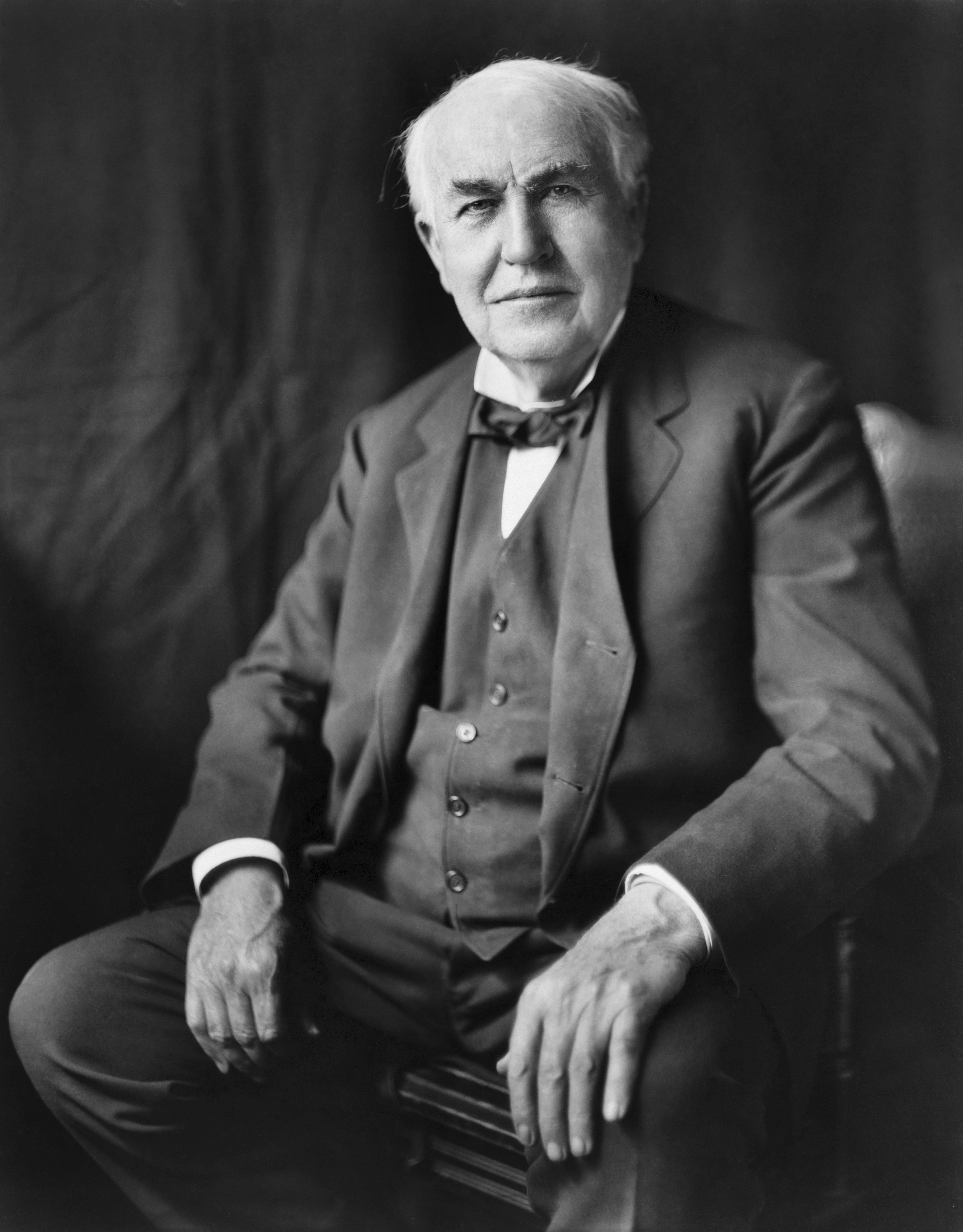 Think about Thomas Edison, inventor of the light bulb, the phonograph and the motion picture camera - among other things.
 He held 1,093 patents, making him the fourth most prolific inventor in history!
And I'll bet there was no such thing as a federal grant back when he was inventing things either.
How could that possibly have happened? How could he come up with so many brilliant contraptions that have so changed the way our world operates without relying first upon government?
Have we come so far from individual liberty and responsibility, as well as responsibility to care for our fellow man, that we cannot do so with an enormous interwoven jungle of government agencies to make it possible?
Or perhaps we've given up on our individual obligations to succeed and use our success to help others less well off in favor of paying taxes to the government so the government can perform those functions for us? Isn't that the core basis of collectivism - at least the kind of collectivism currently being espoused by so many on the left? Isn't that why so many think that research and development can *only* be funded by the government? Or maybe I should say *best funded* by the government?
If Edison were alive today, would he be the great inventor he was able to become before his death in 1931?
Or would he be just another person sitting in the dark waiting for government to invent a light bulb?
Friday, September 16, 2011
Quotes of the Day - political games, emergencies and revolutions
“We’re in a national emergency. We’ve been grappling with a crisis for three years, and instead of getting folks to rise up above partisanship in a spirit that says we’re all in this together, we got folks who are purposely dividing, purposely thinking just in terms of how does this play out just in terms of this election.” ~ President Barack Obama from Politico
"Every collectivist revolution rides in on a Trojan horse of 'emergency'. It was the tactic of Lenin, Hitler, and Mussolini. In the collectivist sweep over a dozen minor countries of Europe, it was the cry of men striving to get on horseback. And 'emergency' became the justification of the subsequent steps. This technique of creating emergency is the greatest achievement that demagoguery attains." ~ Herbert Hoover
The above quote by Pres. Obama also contrasts against his latest move to highlight a bridge between Ohio and Kentucky as part of his 'love me - pass my bill' tour:
"President Obama’s decision to travel next Thursday to the failing Brent Spence Bridge in Cincinnati is a remarkable slap at both House Speaker John Boehner and Senate Minority Leader Mitch McConnell at the very moment Obama says he is trying to work with the GOP leadership to pass a jobs bill.
...
The bridge connects Cincinnati with Covington, Kentucky, making Obama’s highlighting of its disrepair bad public relations for both McConnell – the Republican senator from Kentucky – and Boehner.
...
(White House Press Secretary Jay) Carney denied that the White House had chosen the bridge to slight the Speaker."
Wednesday, June 01, 2011
The Blade vs. The Constitution
Recently, Lucas County commissioners decided to form a storm-water district to address mandates from the U. S. Environmental Protection Agency. The district encompasses several of the county's townships, including Sylvania Township.
The proposal is to charge all the property owners in the district for the costs associated with the EPA requirements - about $48.72 per year for residences with businesses being charged based upon the size of their paved areas, roofs, etc...
The problem is that Sylvania Township has looked at the requirements and determined that it can meet their EPA obligations at less cost, so they don't want to be a part of the district. And why should they? The obligation of Sylvania Township Trustees to represent their residents - and meeting these EPA mandates on their own will cost their residents less. And the EPA doesn't care how the requirements are met - so long as they are.
But that doesn't sit well with the socialists/collectivists at The Blade. They slam Trustee Kevin Haddad for, basically, doing a good job on behalf of Sylvania Township.
In their editorial, they admit that Sylvania Township can perform their EPA obligations at roughly half what they'd pay as part of the district. But that's a bad thing, according to unknown author of the editorial who points out:
There you have it.
The Blade has, for a long time, believed that other communities should subsidize the efforts of the major city, Toledo. And here is another example where it believes that well-run, proportionally-taxed communities should pay for the things other jurisdictions have to do - but have no money with which to pay for them. And, just to be sure we're clear, the reason many of those 'other' communities don't have the funds to do these mandates is because their elected officials are too busy jumping to spend money on things the paper promotes.
The Blade has also been a proponent for regionalism, including a push for a county-wide council to govern the entire 88 square miles of Lucas County. But in their push for uni-gov, they forget a critical component - cost. You see, to the editors at our local daily, the idea is the critical thing and the costs are to be born, regardless.
No community wants to subsidize the outcome of another community's bad fiscal decisions - and they shouldn't!
But that's not the worst of it. The reason they promote these types of illogical ideas is because they start from an incorrect premise. It's no wonder they come to bad conclusions. Here, in their own words, is the problem - their idea of the function of government is not constitutionally based - but rather based upon the failed socialistic perspective:
Note how closely that aligns with Karl Marx's "From each according to his abilities, to each according to his needs."
And compare that to the U.S. Constitution, which explains why we established our government:
Unlike the editors, our founders created our form of government to 'secure the blessings of liberty' not to redistribute the wealth.
The Blade and its editors have a warped sense of government. Even in the clause, providing for the common defense, they are talking about doing so in order to protect the individual liberties of the people within the nation.
If they want to try and twist their position into saying it's to 'establish justice,' they would fail as there is nothing 'just' in taking from one to give to another. In fact, that is routinely called 'theft' when done by anyone but the government these days.
Even if they tried to claim their philosophy was to 'promote the general welfare,' well, perhaps a study of James Madison quotes about that phrase would be educational:
...or Thomas Jefferson:
"Congress has not unlimited powers to provide for the general welfare, but only those specifically enumerated."
The scary part is how close we are today to the warning in the second quote from Madison.
But here we are, with a local paper that clearly has no concept of the proper function of government and is excoriating a local elected official who has the temerity to suggest that bigger is not better simply because it's called 'cooperation' and believes that the overreaching federal government mandates can be met at less cost to his constituents if he doesn't capitulate.
The Blade is on the wrong side in this issue, but when you believe as Marx did, is it any wonder?
The proposal is to charge all the property owners in the district for the costs associated with the EPA requirements - about $48.72 per year for residences with businesses being charged based upon the size of their paved areas, roofs, etc...
The problem is that Sylvania Township has looked at the requirements and determined that it can meet their EPA obligations at less cost, so they don't want to be a part of the district. And why should they? The obligation of Sylvania Township Trustees to represent their residents - and meeting these EPA mandates on their own will cost their residents less. And the EPA doesn't care how the requirements are met - so long as they are.
But that doesn't sit well with the socialists/collectivists at The Blade. They slam Trustee Kevin Haddad for, basically, doing a good job on behalf of Sylvania Township.
In their editorial, they admit that Sylvania Township can perform their EPA obligations at roughly half what they'd pay as part of the district. But that's a bad thing, according to unknown author of the editorial who points out:
It is not known what effect removing the most populous community from the water district would have on the cost in the other six townships.
There you have it.
The Blade has, for a long time, believed that other communities should subsidize the efforts of the major city, Toledo. And here is another example where it believes that well-run, proportionally-taxed communities should pay for the things other jurisdictions have to do - but have no money with which to pay for them. And, just to be sure we're clear, the reason many of those 'other' communities don't have the funds to do these mandates is because their elected officials are too busy jumping to spend money on things the paper promotes.
The Blade has also been a proponent for regionalism, including a push for a county-wide council to govern the entire 88 square miles of Lucas County. But in their push for uni-gov, they forget a critical component - cost. You see, to the editors at our local daily, the idea is the critical thing and the costs are to be born, regardless.
Mr. Haddad has an odd idea of regional cooperation. He says he is all for it — as long as his community doesn’t end up subsidizing work anywhere else. In February, he trashed the county commissioners’ regional refuse-collection plan, calling it a ruse by the City of Toledo to get other municipalities to subsidize its garbage collection.
No community wants to subsidize the outcome of another community's bad fiscal decisions - and they shouldn't!
But that's not the worst of it. The reason they promote these types of illogical ideas is because they start from an incorrect premise. It's no wonder they come to bad conclusions. Here, in their own words, is the problem - their idea of the function of government is not constitutionally based - but rather based upon the failed socialistic perspective:
One of the reasons governments exist is to collect resources from a broad base and redistribute them, not necessarily equally but rather where they are needed most.
Note how closely that aligns with Karl Marx's "From each according to his abilities, to each according to his needs."
And compare that to the U.S. Constitution, which explains why we established our government:
"We the People of the United States, in Order to form a more perfect Union, establish Justice, insure domestic Tranquility, provide for the common defence, promote the general Welfare, and secure the Blessings of Liberty to ourselves and our Posterity, do ordain and establish this Constitution for the United States of America."
Unlike the editors, our founders created our form of government to 'secure the blessings of liberty' not to redistribute the wealth.
The Blade and its editors have a warped sense of government. Even in the clause, providing for the common defense, they are talking about doing so in order to protect the individual liberties of the people within the nation.
If they want to try and twist their position into saying it's to 'establish justice,' they would fail as there is nothing 'just' in taking from one to give to another. In fact, that is routinely called 'theft' when done by anyone but the government these days.
Even if they tried to claim their philosophy was to 'promote the general welfare,' well, perhaps a study of James Madison quotes about that phrase would be educational:
"With respect to the words general welfare, I have always regarded them as qualified by the detail of powers connected with them. To take them in a literal and unlimited sense would be a metamorphosis of the Constitution into a character which there is a host of proofs was not contemplated by its creators."
"If Congress can employ money indefinitely to the general welfare, and are the sole and supreme judges of the general welfare, they may take the care of religion into their own hands; they may appoint teachers in every State, county and parish and pay them out of their public treasury; they may take into their own hands the education of children, establishing in like manner schools throughout the Union; they may assume the provision of the poor; they may undertake the regulation of all roads other than post-roads; in short, every thing, from the highest object of state legislation down to the most minute object of police, would be thrown under the power of Congress... Were the power of Congress to be established in the latitude contended for, it would subvert the very foundations, and transmute the very nature of the limited Government established by the people of America."
"I cannot undertake to lay my finger on that article of the Constitution which granted a right to Congress of expending, on the objects of benevolence, the money of their constituents."
...or Thomas Jefferson:
"Congress has not unlimited powers to provide for the general welfare, but only those specifically enumerated."
The scary part is how close we are today to the warning in the second quote from Madison.
But here we are, with a local paper that clearly has no concept of the proper function of government and is excoriating a local elected official who has the temerity to suggest that bigger is not better simply because it's called 'cooperation' and believes that the overreaching federal government mandates can be met at less cost to his constituents if he doesn't capitulate.
The Blade is on the wrong side in this issue, but when you believe as Marx did, is it any wonder?
Wednesday, May 18, 2011
The fallacy of 'giving back'
While this idea of 'giving back' has long been a pet peeve of mine, I must admit that this particular post was inspired by Walter Williams' column, "Understanding Liberals," where he concludes:
Throughout the column he talks about the liberal concept of 'giving back' - rich people must be forced to 'give back' to the poor, as if what they'd earned had been taken forcibly from someone else. As Williams explains, liberals have a "misunderstanding" of the sources of income:
Williams, in his plain and succinct language, details why this is a fallacy and certainly a wrong assumption to make:
But it's not just in economic terms or redistribution of wealth that this concept exists. It's also routinely espoused by candidates as their reason for running for office, which is where my pet peeve comes in.
Too many candidates have no idea why they're running for office - other than they want to - but they can't come out and say "I just want to be..." a school board member, councilman, mayor, representative, senator, etc... That would be selfish, wouldn't it?
They don't say they're running with specific goals in mind, like reducing taxes, cutting costs, enlarging government, rewarding their friends. Such issues, whether liberal or conservative, don't resonate well with voters and have other, controversial, concepts associated with them.
So rather than tell the truth, they state that they want to 'give back' to the community.
My first thought when hearing such a phrase is: "Give back - what have you taken?!? And if you took something, running for office isn't the way to return it - that just puts you in a position to take more!"
Most who make this claim cannot even explain, when asked, what it means. They'll say that their 'community' has helped them in some way - been good to them, educated them, provided a safe place to grow up, given them an environment of clients for their business, etc...
But those things are 'purchased' - in fact, the education and safe environment are clearly paid for by themselves and their own families through income and property taxes and even fees. As for clients, that's a free exchange of goods - people willingly purchasing a product or service which has been offered. That's not a 'taking' (unless you're bilking them in some way) but an economic transaction.
Of course, in today's world, many people see such transactions as 'gifts of government,' failing to understand the economic principles behind the free exchange of goods, services or products. Too many think that their safety, for example, is not something purchased but something they, as a member of a community, are 'entitled' to without consequence (cost) and must, therefore, be 'repaid' to the community as a collective.
It is the implied collectiveness that so concerns me with this 'giving back' concept. It is as if they are saying that everything you have belongs to the community as a whole and you cannot earn them, as a result of your hard work, labor or ingenuity; they are 'granted' to you by the community as a whole which is responsible for dealing them out, obligating you to 'repay' them at some future date through service to the collective.
This collectiveness approach is clearly anti-American, as it is the opposite of individual liberty with the resulting consequences/rewards.
But there are instances when candidates have been the beneficiaries of charity - either by groups of people coming together in an organization or by individuals. If, in fact, a candidate has been such a recipient of someone else's charitable efforts, the way to 'give back' isn't to run for office, but to serve in a similar capacity, either by repaying to the individual(s) or organization through service or donations, or by 'paying forward' to some other in a similar circumstance.
The fallacy of 'giving back' as a reason for running for office is even more onerous when one considers the authority of such offices sought. Most individuals who are elected do not approach the duty of the office as 'service' to the community but as an authority over the community (or a warped sense of service being to tell others what is best for them despite their own opinions or wishes)- instituting laws, rules, regulations, fees, taxes, etc... to accomplish their own personal goals, even when such goals are contrary to the community as a whole.
So when I hear a candidate/politician say they want to 'give back,' I know two things:
1) They really don't know why they are running for office, or, if they do, they don't want the real reason known, and
2) They aren't going to be the type of representative that I want in a position of authority, as they clearly do not understand freedom versus collectivism and will make decisions based upon their 'misunderstanding.'
When a nation vilifies the productive and makes mascots of the unproductive, it doesn't bode well for its future.
Throughout the column he talks about the liberal concept of 'giving back' - rich people must be forced to 'give back' to the poor, as if what they'd earned had been taken forcibly from someone else. As Williams explains, liberals have a "misunderstanding" of the sources of income:
Suppose the true source of income was a gigantic pile of money meant to be shared equally amongst Americans. The reason some people have more money than others is because they got to the pile first and greedily took an unfair share. That being the case, justice requires that the rich give something back, and if they won't do so voluntarily, Congress should confiscate their ill-gotten gains and return them to their rightful owners.
A competing liberal implied assumption about the sources of income is that income is distributed, as in distribution of income. There might be a dealer of dollars. The reason why some people have more dollars than others is because the dollar dealer is a racist, a sexist, a multinationalist or a conservative. The only right thing to do, for those to whom the dollar dealer unfairly dealt too many dollars, is to give back their ill-gotten gains. If they refuse to do so, then it's the job of Congress to use their agents at the IRS to confiscate their ill-gotten gains and return them to their rightful owners.
Williams, in his plain and succinct language, details why this is a fallacy and certainly a wrong assumption to make:
Who should give back? Sam Walton founded Wal-Mart, Bill Gates founded Microsoft, Steve Jobs founded Apple Computer. Which one of these billionaires acquired their wealth by coercing us to purchase their product? Which has taken the property of anyone?
Each of these examples, and thousands more, is a person who served his fellow men by producing products and services that made life easier. What else do they owe? They've already given.
If anyone is obliged to give something back, they are the thieves and recipients of legalized theft, namely people who've used Congress, including America's corporate welfare queens, to live at the expense of others.
But it's not just in economic terms or redistribution of wealth that this concept exists. It's also routinely espoused by candidates as their reason for running for office, which is where my pet peeve comes in.
Too many candidates have no idea why they're running for office - other than they want to - but they can't come out and say "I just want to be..." a school board member, councilman, mayor, representative, senator, etc... That would be selfish, wouldn't it?
They don't say they're running with specific goals in mind, like reducing taxes, cutting costs, enlarging government, rewarding their friends. Such issues, whether liberal or conservative, don't resonate well with voters and have other, controversial, concepts associated with them.
So rather than tell the truth, they state that they want to 'give back' to the community.
My first thought when hearing such a phrase is: "Give back - what have you taken?!? And if you took something, running for office isn't the way to return it - that just puts you in a position to take more!"
Most who make this claim cannot even explain, when asked, what it means. They'll say that their 'community' has helped them in some way - been good to them, educated them, provided a safe place to grow up, given them an environment of clients for their business, etc...
But those things are 'purchased' - in fact, the education and safe environment are clearly paid for by themselves and their own families through income and property taxes and even fees. As for clients, that's a free exchange of goods - people willingly purchasing a product or service which has been offered. That's not a 'taking' (unless you're bilking them in some way) but an economic transaction.
Of course, in today's world, many people see such transactions as 'gifts of government,' failing to understand the economic principles behind the free exchange of goods, services or products. Too many think that their safety, for example, is not something purchased but something they, as a member of a community, are 'entitled' to without consequence (cost) and must, therefore, be 'repaid' to the community as a collective.
It is the implied collectiveness that so concerns me with this 'giving back' concept. It is as if they are saying that everything you have belongs to the community as a whole and you cannot earn them, as a result of your hard work, labor or ingenuity; they are 'granted' to you by the community as a whole which is responsible for dealing them out, obligating you to 'repay' them at some future date through service to the collective.
This collectiveness approach is clearly anti-American, as it is the opposite of individual liberty with the resulting consequences/rewards.
But there are instances when candidates have been the beneficiaries of charity - either by groups of people coming together in an organization or by individuals. If, in fact, a candidate has been such a recipient of someone else's charitable efforts, the way to 'give back' isn't to run for office, but to serve in a similar capacity, either by repaying to the individual(s) or organization through service or donations, or by 'paying forward' to some other in a similar circumstance.
The fallacy of 'giving back' as a reason for running for office is even more onerous when one considers the authority of such offices sought. Most individuals who are elected do not approach the duty of the office as 'service' to the community but as an authority over the community (or a warped sense of service being to tell others what is best for them despite their own opinions or wishes)- instituting laws, rules, regulations, fees, taxes, etc... to accomplish their own personal goals, even when such goals are contrary to the community as a whole.
So when I hear a candidate/politician say they want to 'give back,' I know two things:
1) They really don't know why they are running for office, or, if they do, they don't want the real reason known, and
2) They aren't going to be the type of representative that I want in a position of authority, as they clearly do not understand freedom versus collectivism and will make decisions based upon their 'misunderstanding.'
Subscribe to:
Posts (Atom)

