Showing posts with label Lucas County. Show all posts
Wednesday, May 21, 2014
Lucas County sees lower unemployment rate, but what's the rest of the story?
The headlines read:
"Lucas County unemployment rate dropping"
"April’s jobless rates at lowest in over 10 years"
Yes, the unemployment rate in the county dropped to 5.7 percent, but that's not the lowest it's been and the drop really isn't due to people finding jobs.
The county is facing the same issue as the state, as I wrote at Ohio Watchdog. The statistic is easily manipulated by changing the number in the workforce.
As a commissioner, I rarely looked at the unemployment rate. Instead, I tracked employment - the number of people actually working - as I thought it a much better gauge of the health of the economy.
The last time Lucas County saw an unemployment rate this low was October 2006 when the rate was 5.4 percent. It was 5.6 percent in September and November that year.
But here's the catch: the number of people employed in October 2006 was 214,400.
The number of people with jobs in April 2014 was 192,400 - 22,000 less!
The loss of people in the workforce is even greater. In October 2006, there were 226,700 people counted. But in April 2014, there were only 204,100. That's a difference of 22,600.
To put that in perspective, that's more people than live in the cities of Maumee (pop. 14,129) or Oregon (pop. 20,291) or Sylvania (pop. 18,892).
So even though the unemployment is down, it's not because there are more people employed - it's because we have 22,600 who aren't being counted in the workforce. And the number of people with jobs is actually less.
Here's a chart showing the declining workforce and the historical employment numbers from January 2006 to April 2014:
As you can see, the number of people in the workforce has steadily declined, even as the number of employed fluctuates up and down, though still not reaching pre-recession numbers.
Certainly, loss of population, retiring baby boomers and others who are no longer counted in the workforce contribute to the declining numbers - but they cannot account for all of the drop. At least some of the loss of workforce is due to individuals who are no longer seeking work because they don't believe there are any opportunities for them.
The key is to understand how much of the loss of workforce is due to what factor.
So rather than celebrate or tout the declining unemployment rate, elected officials, policy makers and citizens should insist on good analysis to find out why the number of employed people has not returned to historic levels. This is a critical factor as the cities make long-term decisions about taxation and services.
Thursday, April 17, 2014
Non-existent address on Stainbrook voter registration raises too many questions
When it comes to getting your address correct, you'd think most people would be pretty good at it.
Admittedly, there are some people who are dyslexic and might have trouble writing down their own address, but they at least know what it is and take steps to make sure they are accurate when communicating it.
Apparently, that's not the case with Robert C. Stainbrook II and the forms that have been submitted to the Board of Elections in his name.
Robert is the brother of Jon Stainbrook, chairman of the Lucas County Republican Party and a member of the Board of Elections. He moved from Ottawa County and registered to vote in Lucas last year.
He's not registered to vote in both places, which is a good thing.
He's registered to vote at 2526 Amara Drive, Toledo, 43615.
But there's a problem: there is no such address, according to the Auditor's AREIS system:
If you drive down the street, you won't find a house or dwelling - or a part of a house or dwelling - with that address on it.
When you register to vote, the BOE sends you a postcard telling you the ward and precinct numbers and your polling location. The postcard they sent to Robert was returned as undeliverable.
That wasn't the only one.
The Fallen Timbers Republican Club invited all candidates for precinct committee to attend a training/educational session. Their postcard to him was also returned.
Trying to give Robert the benefit of the doubt that perhaps he had the numbers mixed up, the FTRC reversed the numbers and sent a notice to 2625 Amara, which is in the Auditor's AREIS system. That didn't work. That postcard was also returned.
The returned mail isn't enough to make a fuss over, as there are many reasons such items are returned. However, combine the returned mail with the fact that no such number exists in the AREIS system and there is no such number on any dwelling and now you have too many questions with not enough answers.
The range of possibilities go from innocent to nefarious.
On the innocent side, Robert made a mistake when he put his address on his registration card. That's simple enough to fix - he just corrects it with the Board of Elections.
On the nefarious side, he doesn't live on the street and is fraudulently registered - with or without his knowledge.
To complicate matters, I've been told that the handwriting on Robert's voter registration card and his petition for precinct committee belongs to Meghan Gallagher.
Gallagher is the former executive director of the BOE who was recently removed. She is also known as a 'sometime' girlfriend of Jon Stainbrook.
Now, it's not too uncommon to have someone else fill out your forms so they're ready for your signature. But then there are what appear to be discrepancies in the signatures themselves.
Here is the signature on the voter registration card:
Here is the signature on Robert's petition for central committee:
And here is his signature on his voter registration card in Ottawa County:
I'm not a handwriting expert but I think there are enough differences to raise the question of whether or not all three are really Robert's.
Combining the signature discrepancy with the non-existent address, the information that the handwriting on the registration and petition forms is Meghan Gallagher's and even non-doubting people might begin to wonder.
I share this information not to cast dispersions on Robert Stainbrook II, but to ensure that the correct address is recorded for him and that he votes in the correct precinct.
And if the worse case scenario is true and the voter registration card and petition were NOT signed by him, the person who did so can be held accountable.
Friday, March 14, 2014
Public records raise questions about employee fired by BOE
![]() |
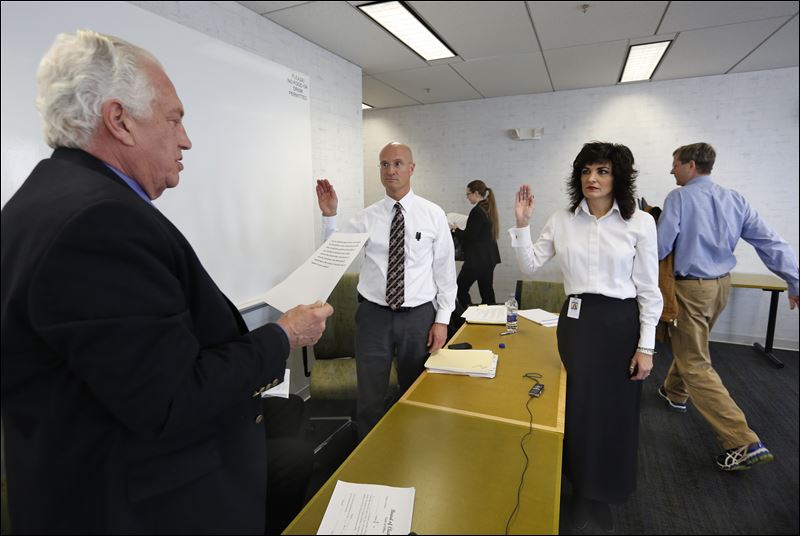
| Gina Kaczala being sworn in as the new executive director of the Lucas County Board of Elections. Her first act: fire one of the temporary employees in the office. (Toledo Blade photo) |
The Blade has the story about Republican booth official Melissa Brogan being fired by the new Republican executive director, Gina Kaczala, and Democrat deputy director Dan DeAngelis.
She was a temporary employee, subject to employment "at will," so she could be let go without any cause or reason.
Jon Stainbrook, Lucas County Republican Party Chairman and one of three members of the BOE, strongly objected, as the news story reported:
“The only reason they did it is because they don’t like it, and they don’t like her,” Mr. Stainbrook said. “She did an exemplary job for more than two years and was an intricate part of the election process. They are abusing their new-found authority right off the bat.”
But public records tell a different story.
![]() |
| Brogan's time sheet |
That's not an unusual event, but that's only part of the story.
On Feb. 5th, nominating petitions for five candidates were turned in to the BOE. The circulator was Melissa Brogan.
In total, she collected 25 signatures on the petitions - all on Feb. 3rd.
![]() |
| One of the petitions Brogan turned in. |
Now, it is conceivable that she gathered these signatures after she was feeling better, but if you're going to take a sick day and then turn in petitions all signed on the day you call off sick, you should expect questions to be raised.
In fact, I'm surprised that no one asked about it at the time the petitions were filed.
Certainly others in the office would have known she'd gone home sick. At the very least, the director and deputy director should have asked for an explanation.
Perhaps, though, such 'oversights' in managing the staff are what contributed to the Board deciding to fire Meghan Gallagher and replace her with Kaczala? Who knows?
One insider commented that they wouldn't be surprised if the whole thing had been coordinated by Gallagher. But that speculation is probably more indicative of the lack of trust in Gallagher and Stainbrook, than of the truth.
Regardless, the existence of the questionable circumstances definitely belie Stainbrook's comment that she did an "exemplary job."
Wednesday, October 02, 2013
How money walks - Lucas County and Ohio both lose billions
We all know that people will flee high-tax areas and relocate to low-tax areas, a fact that too many politicians ignore. But the same applies to counties and cities and now we know how much.
"How Money Walks," by Travis Brown, takes a look at data from the Internal Revenue Service and then examines how wealth and people move between states. His website maps the data with numbers. The correlation is clear, he says: the key to accumulating wealth in your state is to have a pro-growth tax policy that does not tax personal income.
Nationally, Ohio fairs poorly.
The state lost $18.39 billion in annual Adjusted Gross Income from 1992-2010.
To be fair, we did gain income from some states:
- $323.51 million New York
- $218.36 million West Virginia
- $205.12 million New Jersey
- $112.16 million Pennsylvania
- $15.20 million Connecticut
But here is who we lost to - and how much:
- $6.46 billion Florida
- $1.51 billion North Carolina
- $1.18 billion South Carolina
- $1.16 billion Texas
- $1.09 billion Arizona
In Lucas County, as in all the other large metropolitan areas, the story is the same:
Lucas County lost $1.82 billion in AGI. Here is where we lost to - and gained from:
Gained Wealth From:
- $8.27 million Allen County, OH
- $5.95 million Erie County, OH
- $5.25 million Lorain County, OH
- $5.08 million Seneca County, OH
- $4.86 million Trumbull County, OH
Lost Wealth To:
- $219.39 million Wood County, OH
- $204.14 million Monroe County, MI
- $100.26 million Franklin County, OH
- $60.18 million Fulton County, OH
- $42.49 million Lee County, FL
In both the state and county data, you can see that we're losing far, far more than we're gaining.
There are lessons here, especially in light of Toledo's income tax - but is anyone paying attention?
Friday, April 19, 2013
Why the need for a second DeGidio residency hearing?
Lucas County Board of Elections member, Anthony DeGidio has been disciplined by the Supreme Court for co-mingling a client's trust account with his own funds. He was given a two-year suspension of his law license which could be reduced to one year if he completes a continuing education course on the proper handling of client trust accounts.The Blade has the full story, but what is most interesting are the last two paragraphs of the article:
Mr. DeGidio last month survived an attempt by fellow Republicans in Lucas County to remove him from the elections board, but the effort is being renewed.
Ron Rothenbuhler, chairman of the four-person elections board as well as chairman of the Lucas County Democratic Party, said the board has been advised by its attorney that it must hold a second hearing on the question of whether Mr. DeGidio is a legal resident and a legal voter in Lucas County. He said the date for that second hearing will be set when the board meets on Tuesday.
I thought this was very odd considering that the license suspension has nothing to do with his residency. After some checking around I learned that John Marshall filed a second challenge to DeGidio's residency because he 'forgot' to subpoena DeGidio the first time around.
I guess I didn't know there were do-overs to such challenges because - oh, yeah, I forgot...
In case you need a re-cap,
Marshall files a challenge to DeGidio's eligibility to vote in Lucas County. He produces, according to The Blade, hundreds of pages of so-called 'proof' that DeGidio doesn't reside in Lucas County. Some of the 'proof' was before DeGidio was even on the elections board, so it was irrelevant to the challenge.
But all the so-called evidence was not enough to overcome a Supreme Court ruling about residency that says regardless of where you might stay/live on a temporary basis, it is your intent to be a voting resident of your home county that matters. (The Court said a lot more, but you get the drift.)
Accordingly, the BOE voted 2-1 against the challenge, with the two Democrats voting to dismiss it and only Stainbrook voting to uphold it. DeGidio wasn't present - and couldn't have voted anyway - though he was represented by an attorney for the hearing.
In the same post I also highlighted this hypocrisy:
In reporting on the hearing, The Blade wrote:
Attorney James Perlman, who represented Mr. DeGidio at the hearing, tried to cross-examine Mr. Marshall and the legitimacy of the documents several times, but Mr. Marshall refused to answer any of the attorney's questions. Mr. DeGidio did not attend the hearing. "I'm not going to talk to you anymore," Mr. Marshall said when asked how he obtained such things as Mr. DeGidio's insurance records.
When Mr. Rothenbuler explained that cross-examination is part of the hearing process, Mr. Marshall told him, "I'm not going to answer his questions."
Mr. Marshall did acknowledge to Mr. Perlman that he launched an investigation of Mr. DeGidio after speaking with Mr. Stainbrook and Meghan Gallagher, the Board of Elections' director.
Further down in the article, is this:
Mr. Stainbrook expressed frustration with the board's decision. He said Mr. DeGidio's absence from the hearing undermined the proceedings because Mr. Marshall couldn't question him.
So it was Stainbrook who wanted DeGidio present ... and obviously that means Marshall, an FoS (Friend of Stainbrook), files another challenge claiming 'do-over.'
Get it?
And what about those subpoenas?
According to the Ohio Revised Code, the Board (defined as the four appointed members) has the ability to issue subpoenas for the purpose of residency hearings. But do they have to actually vote on that or can they delegate that authority? If they have to vote, would all members have voted to subpoena records and information about DeGidio PRIOR to his time on the board?
I know - there I go asking good questions again....
But here's the bigger issue: the board has decided that DeGidio's intent to retain residency in Lucas County is valid and that is all that is needed under Ohio law. What's DeGidio going to say if he is subpoenaed and required to appear: "I've changed my mind"???
And if DeGidio has to answer questions, doesn't Marshall realize that he'll have to answer questions too?
That might prove to be very embarrassing if he tells the truth about how he ended up making the challenge in the first place.
And then what happens?
If the BOE again votes to uphold DeGidio's residency, will someone else come forward to challenge it? And how many more after that? Will it be a never-ending series of challenges until DeGidio throws up his hands and goes away as Stainbrook would like?
More importantly, will the two Democrat members of the BOE stand for that?
Only time will tell. Until then, we'll wait to see what happens at Tuesday's BOE meeting.
Stay tuned....
Saturday, March 30, 2013
Blade bias, Board of Elections and abuse of process
or otherwise titled:
Everything you didn't want to know about what's going on at the Lucas County Board of Elections
Alas, it should come as no surprise that news coverage of the recent brouhaha at the Board of Elections is biased. The Blade, for whatever reason, continues to support Lucas County Republican Chairman and BOE board member Jon Stainbrook.
People have wondered for years what Stainbrook might have on publisher John Robinson Block to make the man so supportive of Stainbrook, who some go so far as to call a sociopath.
Sadly, the voters of Lucas County - all of them, regardless of political affiliation or lack thereof - are the ones to suffer.
Let's recap, in case you've been otherwise occupied...
Jon Stainbrook engineers a majority of central committee members and gets himself elected as chairman of the Lucas County GOP. After years of struggle (I'm not exaggerating), he manages to finally get himself appointed to the Board of Elections. He also gets someone he believes will be his crony, Anthony DeGidio, appointed as the second Republican on the four-member board.
Along the way, he tries to fire everyone at the BOE he deems an enemy. Several individuals were his victims. Then he gets his 'sometimes girlfriend' (as The Blade identified her numerous times) appointed at the director of the BOE. No conflict of interest there, I'm sure (which is important as you will read in a moment).
Together, they announce they're going to 'clean up the board.' But that's hardly what is happening.
Instead, they're using the BOE and its resources to continue to go after those Stainbrook has deemed 'enemy.' And Stainbrook loves to hold a grudge, never forgetting a perceived slight or wrong.
But then comes the Secretary of State who oversees all the voting - and the local Boards of Election - in the state. They realize things are amiss in Lucas County and send in a Republican and a Democrat to take a look and make recommendations.
Not surprisingly, the report they issued calls for Gallagher and the Democratic assistant director to be fired.
This does not sit well with Stainbrook - for without his FoS (friend of Stainbrook) in the director position, how can he fulfill his vendettas? Plus, if rumor is to be believed, she shares income and earnings with him and I'm sure neither of them want to go without her $85,000+ salary.
What did surprise everyone, though, including his fellow Republican board member DeGidio, was Stainbrook's motion when the SoS report came before the full board.
Stainbrook made a motion to fire everyone at the board EXCEPT the two recommended by the report.
Seriously.
The motion did not get a second, but discussion did follow. After a brief recess, the board returned and no other action regarding the report was taken.
I can only imagine the conversation - more likely bullying - Stainbrook did during that recess to try to get DeGidio to second his motion.
I also presume that was the point at which DeGidio stopped being a FoS and became an enemy - and a target.
Suddenly, DeGidio is persona non grata and must be removed from the Board of Elections.
He doesn't live in the county.
He has a young, Filipino girlfriend.
He has an ethics complaint against him at the Supreme Court (which has nothing to do with his eligibility to serve on the BOE, but is apparently just cause for removal in Stainbrook's eyes).
And in case you missed it, let's repeat all those things until you believe DeGidio is an evil, evil man who must be removed from the BOE so we can avoid the zombie apocalypse.
Enter John Marshall, another FoS and failed candidate for Lucas County Commissioner.
Marshall files a challenge to DeGidio's eligibility to vote in Lucas County. He produces, according to The Blade, hundreds of pages of so-called 'proof' that DeGidio doesn't reside in Lucas County. Some of the 'proof' was before DeGidio was even on the elections board, so it was irrelevant to the challenge.
But all the so-called evidence was not enough to overcome a Supreme Court ruling about residency that says regardless of where you might stay/live on a temporary basis, it is your intent to be a voting resident of your home county that matters. (The Court said a lot more, but you get the drift.)
Accordingly, the BOE voted 2-1 against the challenge, with the two Democrats voting to dismiss it and only Stainbrook voting to uphold it. DeGidio wasn't present - and couldn't have voted anyway - though he was represented by an attorney for the hearing.
Here's where The Blade comes in, right on cue to join with the character assassination so desired by Stainbrook.
First came the article that Stainbrook wanted DeGidio off the Board, alleging all sorts of evil things (see list above).
Then came the story about the official complaint by Marshall.
Then came two stories (here and here) about the board's vote to dismiss the complaint.
Then, despite a rather firm decision, The Blade attempts to make readers 'question' the decision with yet another article raising - you guessed it - 'questions.'
It's a long sordid story, but necessary to go over the details so you can see why various information being omitted in the Blade coverage is vital to truly understanding what is going on in this most important government agency.
In reporting on the hearing, The Blade wrote:
Attorney James Perlman, who represented Mr. DeGidio at the hearing, tried to cross-examine Mr. Marshall and the legitimacy of the documents several times, but Mr. Marshall refused to answer any of the attorney's questions. Mr. DeGidio did not attend the hearing. "I'm not going to talk to you anymore," Mr. Marshall said when asked how he obtained such things as Mr. DeGidio's insurance records.
When Mr. Rothenbuler explained that cross-examination is part of the hearing process, Mr. Marshall told him, "I'm not going to answer his questions."
Mr. Marshall did acknowledge to Mr. Perlman that he launched an investigation of Mr. DeGidio after speaking with Mr. Stainbrook and Meghan Gallagher, the Board of Elections' director.
Further down in the article, is this:
Mr. Stainbrook expressed frustration with the board's decision. He said Mr. DeGidio's absence from the hearing undermined the proceedings because Mr. Marshall couldn't question him.
Did reporter Federico Martinez bother to ask Stainbrook why he didn't then object to Marshall refusing to answer questions from DeGidio's attorney? Isn't that a double standard for Stainbrook? Where is that coverage?
Then there is this, from the 'questions' article that says the decided residency issue isn't over (though I'm pretty sure it is).
Evidence produced by Mr. Marshall, through subpoenas issued by the elections board...
"Subpoenas" - plural???
Since when do staff members at the Board of Elections have the authority - without direction from the board itself - to issue subpoenas???
Why isn't this questioned by DeGidio's attorney and the Democrat members of the board - and The Blade?
Mr. Stainbrook, a former ally of Mr. DeGidio, said he felt it was his duty to tell Mr. DeGidio to move back to Lucas County.
I understand that Stainbrook has known all along about DeGidio's back and forth between Lucas County and his parents due to his parents' age and health. Why doesn't the reporter ask Stainbrook how long he's known about this issue and why it's just now an issue? Why doesn't the reporter ask Stainbrook if all this is just being brought up because DeGidio wouldn't second his motion to fire the entire staff rather than Gallagher and the Democrat assistant director.
Aren't those very valid questions to ask and extremely pertinent to the story?
The article references log-ins to DeGidio's BOE email, with only six of the 88 being from an Internet address within Lucas County. Did Marshall file a public records request to obtain that information or did BOE staff provide it to him in an effort to get rid of one of their bosses?
How much time did BOE staff spend on assisting Marshall with his challenge?
If the reporter is going to list all the documents and say they 'raise questions' why didn't he also ask how much BOE time employees and resources were used?
The challenge was by Marshall not the BOE. Because of this, the BOE is limited by statute to investigating only whether or not DeGidio was on the records at a proper address. The rest is supposed to be prepared by Marshall as the challenger to the voting eligibility.
Why doesn't The Blade mention that Marshall was assisted throughout the hearing by Kelly Bensman, another FoS? In fact:
Turns out Marshall was responsible for almost nothing. Someone else had assembled all the information he was presenting and was sitting next to him handing it to him.
Clearly it would not do for Bensman to have filed the challenge - that would be too obvious.
In fact, Marshall even said during the hearing that he didn't care about challenging DeGidio's right to vote but just wanted to get DeGidio off the board.
But that presents another serious problem for Marshall: abuse of process.
Abuse of process is where a legal process is used for an unlawful purpose.
Doesn't using a residency challenge to someone's right to vote in order to get them thrown off a Board of Elections because they won't agree with another board member fit that description?
And if Stainbrook has known all along about DeGidio's care of his parents and that it didn't have anything to do with voting residency but instructed Marshall to file the challenge, is Stainbrook also not guilty of abuse of process? What did he know and when did he know it?
What about BOE staff improperly using subpoena authority to get rid of one of their bosses?
I know I've developed a reputation for asking good questions, but why isn't anyone else asking about these things?
Clearly, we can't expect The Blade to do so, but surely the Secretary of State should be wondering.
There's another matter as well: Gallagher's grievance complaint with the local Bar Association against DeGidio, her attorney on a injury lawsuit.
Apparently, DeGidio, who has represented Gallagher, Stainbrook and Bensman in various lawsuits in the past - hence the title FoS - had filed suit on behalf of Gallagher over a car accident where she was hit from behind. The suit for $25,0000 claims:
* Gallagher has suffered - and continues to suffer -" headaches, numbness, stiffness, limitations in movement and pain with movement" as a result of injuries to her shoulder, neck and head in the accident.
* Gallagher has suffered "permanent physical injury and will continue to experience severe pain and suffering for the rest of her normal life."
* Gallagher will "suffer life-long pain and suffering and will require life long medical treatment."
One wonders how she can manage to work at the BOE?
Interestingly, on March 5th, DeGidio requested to withdraw as her attorney. His filing says notified her three times - in March 2012, November 2012 and January, 2013 - that he needed to withdraw and that she needed to find a new attorney to represent her in the case. On March 3rd, he emailed her and told her that he could no longer wait for her to find a new attorney, filing the motion to withdraw two days later.
The nature of the grievance against DeGidio is confidential, but the effect is very public. With DeGidio facing a grievance, he has a conflict of interest with Gallagher and cannot ethically vote to fire her.
What I want to know is this: when did Gallagher learn the SoS report was going to recommend her firing and when did she file the grievance against DeGidio to 'conflict him out' of the vote? I'm certain the two directors were notified before the report was made public so they would not be surprised by the findings and the recommendation. Is this another abuse of process?
And if DeGidio has a conflict of interest because of the grievance complaint, doesn't Stainbrook also have a conflict of interest if Gallagher is his 'sometimes girlfriend' and if he accepts monetary support from her as is rumored?
See, told you that conflict of interest would be important, especially because Stainbrook and Gallagher have denied a relationship, but no one at The Blade chose to research what they previously had documented about the two.
Clearly, there are conflicts all around.
The bottom line
Stainbrook should be removed from the BOE. DeGidio, with his on-going health problems and need to care for his parents and himself, should probably step down. But he shouldn't do so when Stainbrook will be responsible for naming his replacement.
The SoS recommendation to fire Gallagher and the Democrat assistant direct needs to accepted and the two need to go.
The SoS needs to bypass the local GOP in order to name two new Republican board members.
Stayed tuned...there is certainly more to come!
Tuesday, February 26, 2013
Stainbrook's reaction to Sec of State report: Fire everyone except the two named in report
The SoS report recommended firing the top two administrators, Republican Director Meghan Gallagher and Democrat Dan DeAngelis.
Stainbrook's solution: keep them and fire everyone else instead!
Talk about 'stuck-on-stupid' ...
The motion by Stainbrook to do just that was not seconded, but discussion ensued, so the board called a brief recess and, upon returning, ended all discussion due to a lack of second on the motion.
No other action regarding the report was taken.
Interestingly, after having had issues with the lack of public comment previously, the BOE still has not developed a policy for accepting public comment on board matters or items on the agenda. As a result, John Mac Avoy, a member of the Northwest Ohio Conservative Coalition, was prevented from speaking or asking questions during the meeting about the report and its recommendations.
Considering this latest, perhaps the county would be better served by firing Stainbrook from the BOE.
Wednesday, October 31, 2012
Why is Lucas County early vote center in one of the highest crime neighborhoods in Toledo?
There was much to-do between Republicans and Democrats on the Lucas County Board of Elections when it came to selecting a location for the early voting center.
They finally decided on an area in the old Riverside Hospital building at the corner of Summit and Bush streets in downtown Toledo, despite the fact that the geographical center of the county was closer to the Village of Holland while the center of population is somewhere around the University of Toledo.
Democrats wanted the center to be in the central city area of Toledo. Republicans wanted it to be in the county Rec Center, despite the fact that the Rec Center was already under a lease agreement.
Democrats emphasized that it needed to be on a bus line, and I think that was probably a good idea. Republicans wanted it to be a relatively inexpensive place and I think that was probably a good idea as well.
But in all the discussions about where to locate the early vote center, did anyone bother to think about safety?!?
I guess not, because the Lucas County early vote center is located in one of the highest crime areas of the city.
Neighborhoodscout.com provides a crime map for various jurisdictions and it shows that the area bounded by Summit Street, I-280, the Buckeye Basin Greenbelt Parkway and Elm Street is one of the highest crime areas, as are two of the four sections that border it.
Not content with just the website information, I contacted the Toledo Police Department. They provided me with January to June 2012 crime statistics in their Beat #220 Areas 358, 359. The beat includes the same area as above, but goes all the way to the back of Point Place, over to Cherry St. and then to 1-75. The areas match the ones from Neighborhoodscout.com
Here's what the crime data looks like on a map:
View TPD Crime - Beat 220, area 358 Jan 2012 to Jun 2012 in a larger map
And where is the early vote center? Right on the corner of Bush and North Superior - the edge of all this crime.
And these aren't traffic violations.
The offenses include robbery, burglary, theft, larceny, car theft, sex offenses, family and child offenses, narcotics, intoxication, conveying contraband, and assault - both felony and misdemeanor. And they occurred at all times - including many in the middle of the afternoon.
This is not minor. The BOE placed the early vote center next to a half-mile area that is riddled with crime. I was shocked when I mapped it all.
But is it one of the highest crime areas in the city? NeighborhoodScout.com says it is, but just to be sure, I asked for a comparison from TPD of the other beats they have. They sent me another 60 pages of data and it will take me a long time to map all of it, but the area just to the north of the early vote center (about the size as the area already mapped) had about 200 reports of crime between January and June this year - more than already mapped.
But that's not all. Not only is the area riddled with crime, it's quite a distance for some voters in the county.
It will take some voters in the Providence Township area 45 minutes just to get there - that's an hour-and-a-half round trip to vote. Here I thought we were all about making it easy to vote.
Oh - and the preferred route Google Maps recommends is via the turnpike because it's the shortest in terms of time - and that would require a toll!
Where are the Democrat cries about poll taxes for that?!?
Democrats in Cleveland think a billboard that warns against voter fraud is intimidating. Isn't it more intimidating and closer to voter suppression to expect voters to travel through one of the highest crime neighborhoods in the city just to cast a ballot? Especially at night in the dark?
In their effort to not disenfranchise some, the Lucas County Board of Elections will disenfranchise others and place all who go to the early vote center in a really bad crime area of the city.
So much for a fair and balanced approach to running our elections.
Monday, October 22, 2012
Township officials urge 'NO' on all county levies
Here is a copy of the letter that 14 elected officials in eight of Lucas County's 11 townships have signed. I think the letter says it all, especially this point:
We believe one questions must be asked by the Commissioners prior to putting any levy on the ballot, and each individual voter prior to casting their vote on a property tax levy: “Is this levy so important that someone should lose their home if they cannot afford to pay it?”
I think this also applies to city and school levies, too. Did Toledo City Council ask themselves this question before they decided they just had to have a brand new tax levy for recreation in the city?
You might not have your home, but you can have 'recreation' ... what a bargain!
Did Toledo Public School board members ask themselves this question before they decided they just had to have a brand new tax levy - on top of their multiple other levies - for a school system that has a budget carryover and health care savings that total a couple of million dollars MORE than the levy will give them in the next year?!?
As if more money will reverse their five-year trend of spending more than take in or help Pickett Elementary which has been in academic emergency for 12 years!
Here is the letter:
We, the undersigned Elected Officials in Lucas County do hereby state:
1) We believe our County Representatives are not acting like responsible leaders in placing numerous levies on the ballot.
2) We believe that the residents in our jurisdictions are becoming overburdened by the numerous “quality of life” levies that are already included in their property tax bills.
3) We believe that by placing these numerous “quality of life” levies on the ballot, the Lucas County Commissioners are jeopardizing our chances of getting any future levies passed for essential services such as Roads, Police, Fire and Schools.
4) We do not want to see our residents become financially burdened by their property taxes and potentially face losing their homes if they become unable to pay.
5) We believe that all of the levy requests that will be on the November Ballot are not “needs” for our community, but “wants” by these organizations.
6) We believe that it is irresponsible for our County Officials to allow the “wants” of these various organizations to become such a burden to the property owners of Lucas County that they can no longer afford to pay for the “needs”.
7) We believe one questions must be asked by the Commissioners prior to putting any levy on the ballot, and each individual voter prior to casting their vote on a property tax levy: “Is this levy so important that someone should lose their home if they cannot afford to pay it?”
As such, we are asking the voters not just in our jurisdictions, but in all of Lucas County to vote “NO” on every county wide levy request that is on the your ballot in November. We must take a stand to get the attention of our County Commissioners. We must make them realize that we want the process to get a property tax levy on the ballot in Lucas County to be extremely difficult, not just a rubber stamp.
And that new levy review committee which I fought when I was a commissioner has 'recommended' all these levies and others in the past. Do the commissioner have nothing to fear from constituents because they hide behind individuals unaccountable to the public to decide if a levy is 'worth it'? I think so.
We'll talk about this today when I fill in for Brian Wilson on 1370 WSPD from 3-6 p.m. Eastern.
Wednesday, July 11, 2012
If you can't get petitions right, why should we trust you to get a county charter government right?
The paper has another article about changing the form of county government - surprise!
After previously covering the fact that Better Lucas County (what a misnomer!) failed to submit enough valid petition signatures to put the measure on the ballot, they have today's story telling us they're going to try to get more signatures.
But we already knew that.
From the first article comes this lead paragraph:
It’s back to the streets for petitioners hoping to spur change in Lucas County’s government.
If that doesn't tell us the group is going to try to get more signatures, we also have this:
Thomas Palmer, a Toledo lawyer involved in the county reform effort, said the group will meet Tuesday to decide whether to appeal the elections board’s conclusions, and to decide how to make up the signature deficit.
Note that Palmer said "how" to make up the deficit. They were going to decide "whether" to appeal, but the decision to get more signatures was a given - the only question was "how" to get them.
That's twice in the earlier story that we're told they're going to collect more signatures in their effort to put the measure on the ballot.
But in traditional Blade style of pushing their agenda in what is supposed to be an unbiased and objective news report, they do today's story telling us what we already know.
Better Lucas County, the volunteer group trying to put a proposed county charter on the Nov. 6 ballot, plans to stay together after a disappointing attempt to collect nearly 14,500 signatures.
Robert Reinbolt, a group co-leader, said the group met Tuesday and agreed to continue the effort.
As if there was any doubt.
I could go on and on about the emotionally-laden and non-objective descriptive words and phrases used in the articles, but here are just a few that they are using to manipulate the perspective:
* hoping to spur change
* all is not lost
* important step
* disappointing attempt
* educate voters
The bigger point - and one most people may miss - is what Reinbolt says about their failure to ensure a very basic requirement on the petitions: having the circulators state the exact number of signatures they witnessed.
Most petitions include a blank space that needs to be filled in as part of the witness statement the circulator needs to sign. It's hard to miss, but that's exactly what Better Lucas County did:
Mr. Reinbolt said Better Lucas County focused on verifying registered voters' names and overlooked double-checking the circulators' signature counts.
As a result, over 4,000 valid signatures of the 22,195 total that they submitted were thrown out. But even if they had counted the 42 petitions with the fatal flaw, they were still short of the required number for making the ballot.
If this is the level of incompetence exhibited by Better Lucas County in just the petition process, it doesn't give you much confidence in their ability to 'reform' county government.
If my previous posts (see below) about the inaccurate assumptions, comparisons and conclusions in their study wasn't enough to have you reject the idea, certainly their inability to follow such basic requirements for the petitions will make you think twice about their aptitude, expertise and fitness to design a new form of government.
Previous posts:
Asking the wrong questions about a county charter form of government for Lucas County
The Blade is wrong about charter county government
Konop forces failed ideas into his county charter proposal
Another blatant attempt to push Lucas into a charter form of government
Next public meeting on county council issue scheduled
Initial thoughts - report on restructuring Lucas County government
Detailed look at report on changing Lucas County government
Konop admits that I am right
Citizens Review Committee makes my argument for me
Post Office closings show defect of district council seats
Deconstructing The Blade's drug-pusher mentality on changing county government
Wednesday, December 07, 2011
Is The Blade complicit or ignorant
I've previously written about the illegality of Lisa Sobecki, a civil service employee, seeking partisan office.
My friend and fellow blogger, Tom Blumer, in mentioning the situation, asks a very pertinent question:
You would think that the paper's 'politics writer' would know the law and at least mention it in covering the candidates in the Democrat primary for 2012 - but apparently not.
So - is the paper complicit in purposefully not bringing to the attention of the public the fact that civil service employees in the state are prohibited from partisan political activity, including running for office under a party affiliation? Or is he ignorant, as Blumer questions.
Inquiring minds....
Oh - and if you think the Commissioners should enforce Ohio law and treat all county employees equally, you can call them to see if they plan to uphold their oaths of office and follow the law - or let their political loyalties rule the day. Their phone number is 419-213-4500.
My friend and fellow blogger, Tom Blumer, in mentioning the situation, asks a very pertinent question:
Based on his coverage at this story, Tom Troy at the Toledo Blade, which says that it wants “to be the premier source of news and information about northwest Ohio and southeast Michigan,” is either too ignorant to know or doesn’t care about Sobecki’s clearly illegal candidacy. Which is it, Tom?
You would think that the paper's 'politics writer' would know the law and at least mention it in covering the candidates in the Democrat primary for 2012 - but apparently not.
So - is the paper complicit in purposefully not bringing to the attention of the public the fact that civil service employees in the state are prohibited from partisan political activity, including running for office under a party affiliation? Or is he ignorant, as Blumer questions.
Inquiring minds....
Oh - and if you think the Commissioners should enforce Ohio law and treat all county employees equally, you can call them to see if they plan to uphold their oaths of office and follow the law - or let their political loyalties rule the day. Their phone number is 419-213-4500.
Labels:
2012 Election,
Lisa Sobecki,
Lucas County
Friday, November 04, 2011
Revised Ohio Congressional District maps - again
The Ohio House has *again* revised the Congressional redistricting map and I hope to have a new map I can post here. Until then, a copy of the new revisions can be viewed here.
The process of getting to the required redistricting has been a complicated one.
Ohio passed, and Governor John Kasich signed, H.B. 194 which moved our primary from March to May. This was to address a delay in the creation of a database of election history, census data, and geographic data that was to be used in congressional map creation. This was agreed to by Republican and Democrat leadership in Columbus.
However, in response to the change, the Ohio Democratic Party along with the group Ohioans for Fair Elections submitted sufficient signatures to send the bill to a citizen referendum during the 2012 elections.
So the House passed H.B. 318 - a bipartisan bill jointly sponsored by Reps. Lou Blessing (R) and Sean O’Brien (D). This bill, which also moved the primary to May, contained an emergency clause, ensuring the bill would take effect immediately if passed with the emergency clause.
On September 1, 2011, Speaker William Batchelder and Minority Leader Armond Budish released a joint statement, committing their unconditional support for House Bill 318 to avoid the legal chaos that would ensue if the primary was not moved. Leader Budish gave his word to the Speaker on this issue.
But, less than 24 hours before the vote, Leader Budish publicly announced he would no longer lend his caucus’ support for the bill because “House Republicans were moving too fast on passing Congressional Redistricting." It should be noted that this issue was never part of the agreement and had no correlation to the primary date change.
As a result, the Democrats failed to support the necessary emergency clause during the House vote, subsequently killing any chance for the problem to be fixed immediately.
The third attempt came with H.B. 319 which was signed into law by Gov. Kasich on Sept. 26th. This bill avoided the problem by having the new Congressional districts take effect immediately rather than 90 days after signature by the Governor; bills with an appropriation take effect immediately. The Ohio Senate attached an appropriation of $2.75 million to H.B. 319 to assist with the implementation of the map. An appropriation also prevents bills from being subject to a referendum.
Remember, the Democrats, despite having allocated funds to do so, did NOT produce any map for consideration.
In response to H.B. 319, Democrats sued in the Ohio Supreme Court, seeking the right to subject the bill to a referendum. The Ohio Supreme Court agreed that the bill would be subject to a referendum if enough signatures were gathered. Ohio Democratic Party Chairman Chris Redfern has threatened such action.
So now we have H.B. 369 which
Of particular interest to us, H.B. 369 makes changes in Erie and Lucas County. Rather than being split into three congressional districts, both counties are split between only two congressional districts. Wood County, which was previously split between two districts, is now entirely in one.
One of the complaints about the H.B. 319 district was that it split the City of Toledo. H.B. 369 moves 76.6% of Toledo into CD9. CD9 now contains about 56% of Lucas County.
Additionally, from what I can tell from the map as well as from the summaries I've read, it appears that they kept the Kaptur/Kucinich combination in the Cleveland area as one of the consolidated districts due to our decreased representation.
As soon as I get a map that is in a format I can post here, I will do so.
The process of getting to the required redistricting has been a complicated one.
Ohio passed, and Governor John Kasich signed, H.B. 194 which moved our primary from March to May. This was to address a delay in the creation of a database of election history, census data, and geographic data that was to be used in congressional map creation. This was agreed to by Republican and Democrat leadership in Columbus.
However, in response to the change, the Ohio Democratic Party along with the group Ohioans for Fair Elections submitted sufficient signatures to send the bill to a citizen referendum during the 2012 elections.
So the House passed H.B. 318 - a bipartisan bill jointly sponsored by Reps. Lou Blessing (R) and Sean O’Brien (D). This bill, which also moved the primary to May, contained an emergency clause, ensuring the bill would take effect immediately if passed with the emergency clause.
On September 1, 2011, Speaker William Batchelder and Minority Leader Armond Budish released a joint statement, committing their unconditional support for House Bill 318 to avoid the legal chaos that would ensue if the primary was not moved. Leader Budish gave his word to the Speaker on this issue.
But, less than 24 hours before the vote, Leader Budish publicly announced he would no longer lend his caucus’ support for the bill because “House Republicans were moving too fast on passing Congressional Redistricting." It should be noted that this issue was never part of the agreement and had no correlation to the primary date change.
As a result, the Democrats failed to support the necessary emergency clause during the House vote, subsequently killing any chance for the problem to be fixed immediately.
The third attempt came with H.B. 319 which was signed into law by Gov. Kasich on Sept. 26th. This bill avoided the problem by having the new Congressional districts take effect immediately rather than 90 days after signature by the Governor; bills with an appropriation take effect immediately. The Ohio Senate attached an appropriation of $2.75 million to H.B. 319 to assist with the implementation of the map. An appropriation also prevents bills from being subject to a referendum.
Remember, the Democrats, despite having allocated funds to do so, did NOT produce any map for consideration.
In response to H.B. 319, Democrats sued in the Ohio Supreme Court, seeking the right to subject the bill to a referendum. The Ohio Supreme Court agreed that the bill would be subject to a referendum if enough signatures were gathered. Ohio Democratic Party Chairman Chris Redfern has threatened such action.
So now we have H.B. 369 which
* enacts 16 new Congressional districts in Ohio;
* repeals the map as enacted in H.B. 319;
* reinstates one primary date for all elections: March 6, 2012;
* Saves taxpayers $15 million in previously appropriated money that will now be un-appropriated and also reinstates the August 2012 special election; and
* declares an emergency for all portions of the bill.
Of particular interest to us, H.B. 369 makes changes in Erie and Lucas County. Rather than being split into three congressional districts, both counties are split between only two congressional districts. Wood County, which was previously split between two districts, is now entirely in one.
One of the complaints about the H.B. 319 district was that it split the City of Toledo. H.B. 369 moves 76.6% of Toledo into CD9. CD9 now contains about 56% of Lucas County.
Additionally, from what I can tell from the map as well as from the summaries I've read, it appears that they kept the Kaptur/Kucinich combination in the Cleveland area as one of the consolidated districts due to our decreased representation.
As soon as I get a map that is in a format I can post here, I will do so.
Tuesday, September 13, 2011
Why doesn't the Lucas County BOE just de-certify Webb?
The Court of Appeals has ruled that the time frame has passed for the Lucas County Board of Elections to hold a protest hearing on District 6 Councilwoman Lindsay Webb's late filing of her acceptance of nomination.
This means that the BOE cannot hold a protest hearing. But is that the end of the issue?
As I've said in the past, I blame the members of the BOE - especially the two new Republicans (one of whom was appointed supposedly because of his vast experience in election law) - for not knowing what was required and ensuring that all criteria were met PRIOR to voting to certify candidates to the ballot. Had our Republican representatives on the board made a checklist of items needed for certification, they would have known that Webb didn't meet the filing deadline for her acceptance letter and would have questioned that at the certification vote, no matter what the BOE staff had done.
But because of the ruling, the BOE should now be researching how they can de-certify a candidate without a protest being filed. They should be having conversations with the Secretary of State and their legal representative about what their options are. They messed up and it should be up to them - not a protest by another candidate - to fix the problem.
They've de-certified candidates in the past (most recently Neal Mahoney this year) as have other elections boards across the state, so it wouldn't be a first time or even an unusual action for them to take. In the case of Mahoney, they de-certified him after they improperly certified him - so how would that be different from Lindsay Webb's case?
So if they haven't asked this question, they should. And if they've asked it, they should share the answer with the public.
Inquiring minds....
This means that the BOE cannot hold a protest hearing. But is that the end of the issue?
As I've said in the past, I blame the members of the BOE - especially the two new Republicans (one of whom was appointed supposedly because of his vast experience in election law) - for not knowing what was required and ensuring that all criteria were met PRIOR to voting to certify candidates to the ballot. Had our Republican representatives on the board made a checklist of items needed for certification, they would have known that Webb didn't meet the filing deadline for her acceptance letter and would have questioned that at the certification vote, no matter what the BOE staff had done.
But because of the ruling, the BOE should now be researching how they can de-certify a candidate without a protest being filed. They should be having conversations with the Secretary of State and their legal representative about what their options are. They messed up and it should be up to them - not a protest by another candidate - to fix the problem.
They've de-certified candidates in the past (most recently Neal Mahoney this year) as have other elections boards across the state, so it wouldn't be a first time or even an unusual action for them to take. In the case of Mahoney, they de-certified him after they improperly certified him - so how would that be different from Lindsay Webb's case?
So if they haven't asked this question, they should. And if they've asked it, they should share the answer with the public.
Inquiring minds....
Labels:
Board of Elections,
Jon Stainbrook,
Lindsay Webb,
Lucas County
Wednesday, August 03, 2011
Lucas County levies and a warped sense of 'necessary'
We'll decide on at least two county-wide levies in November, thanks to the Lucas County Commissioners who voted to put them on the ballot.
The Zoo will request approval of a .85 mill 5-year renewal levy for their operating expenses. It will generate approximately $6.4 million and cost the owner of a $100,000 home about $26 each year. If approved, the levy would be collected in the years 2012 through 2016.
The County will request approval of a renewal of the 9-1-1 and Communications System levy. It is a .70 mill 5-year levy that will generate just under $5.6 million and cost the owner of a $100,000 home about $21.45 each year. It, too, would be collected in the years 2012 through 2016.
These are renewal levies, which mean they will collect the same amount of money as the current levies do.
Something many people don't realize, though, is that state law limits taxation within counties to ten mills. But Section 5705.19 of the Ohio Revised Code provides authority to the Board of County Commissioners (and other governmental entities) to levy a tax in excess of the ten-mill limitation for various purposes. Those 'excess' taxes go to the voters for approval.
What is interesting is the actual language of the law which says (emphasis added):
It then gives a list of things for which taxes can be imposed and the list is so long it goes through the alphabet just 3 letters short of twice! Of course, many of the items on the list are far from 'necessary.'
This law actually says that Ohio governmental entities (except schools) should live within a ten-mill taxation budget. But if they don't - or if they want to spend money outside that limit - they can vote to put levies on the ballot to pay for everything from parks, to emergency services, to air pollution, to regional planning, to wetlands and green space, to 'free' museums of art or science or history.
Are all of these things "necessary requirements" of a government? I don't think so.
In fact, I couldn't find anything that governmental entities couldn't tax for, as I'm certain politicians would be able to find permission under one - if not multiple - sections of this law for any whim or desire.
Certainly, some of the projects on the permissions list are necessary. If a local governmental entity is ordered by the state or federal government to implement flood protections or waste/sewer projects, they would need the ability to pay for such mandates and a tax (preferably temporary) would be a proper way to do so. (Though such mandates from the federal government are questionable in their Constitutional authority - but that's a post for another time.)
A valid argument can even be made for the 9-1-1 Communications levy being a 'necessary requirement.' I'm certain individuals who have called 9-1-1 and had their lives saved as a result would agree.
But no amount of twisted logic or faulty reasoning can make me believe that a zoo is a necessary requirement of any area. It may be 'wanted' or 'desired' and people can even present rationalizations about how it is an 'economic development driver' or 'money-making tourist attraction.' But it's not necessary, as many areas without zoos can attest.
The problem is that granting entities the ability to tax above and beyond the ten-mill limitation means that elected officials are free to spend their ten-mill monies on all kinds of 'unnecessary' items because they can always find a way to fund other expenses through the excess taxing authority of ORC 5705.19.
And, over time, the list of items for which we can be taxed has grown far beyond 'necessary requirements.' Just for reference, my taxation for Lucas County's general fund is only 10% of the total amount of taxes I pay for county-wide items - $62.83 of the $613.11 total.
(You can check your own rates by going to the Auditor's AREIS website, putting in your name or address, clicking on the 'data' tab above your name/address, and then selecting 'tax distribution' which is highlighted in red on the left. Be sure to add up the 'Lucas County,' 'other countywide levies' and 'other' sections.)
Clearly, I'm being taxed for unnecessary items simply because the commissioners (in the case of county-wide levies) have decided to put these things on the ballot. Just because we 'can' tax for all kinds of things, it doesn't mean we 'should.'
Sadly, the commissioners - and the politicians in Columbus who keep expanding the taxing authority - have a warped sense of what 'necessary' really means.
And all of us are paying for it.
NOTE: The local paper is reporting that a third levy request (1.4 mills renewal for Children Services Board) wasn't voted upon, but the Commissioner's website Resolution Report for yesterday shows three 'yes' votes on that resolution.
The Zoo will request approval of a .85 mill 5-year renewal levy for their operating expenses. It will generate approximately $6.4 million and cost the owner of a $100,000 home about $26 each year. If approved, the levy would be collected in the years 2012 through 2016.
The County will request approval of a renewal of the 9-1-1 and Communications System levy. It is a .70 mill 5-year levy that will generate just under $5.6 million and cost the owner of a $100,000 home about $21.45 each year. It, too, would be collected in the years 2012 through 2016.
These are renewal levies, which mean they will collect the same amount of money as the current levies do.
Something many people don't realize, though, is that state law limits taxation within counties to ten mills. But Section 5705.19 of the Ohio Revised Code provides authority to the Board of County Commissioners (and other governmental entities) to levy a tax in excess of the ten-mill limitation for various purposes. Those 'excess' taxes go to the voters for approval.
What is interesting is the actual language of the law which says (emphasis added):
The taxing authority of any subdivision at any time and in any year, by vote of two-thirds of all the members of the taxing authority, may declare by resolution and certify the resolution to the board of elections not less than ninety days before the election upon which it will be voted that the amount of taxes that may be raised within the ten-mill limitation will be insufficient to provide for the necessary requirements of the subdivision and that it is necessary to levy a tax in excess of that limitation...
It then gives a list of things for which taxes can be imposed and the list is so long it goes through the alphabet just 3 letters short of twice! Of course, many of the items on the list are far from 'necessary.'
This law actually says that Ohio governmental entities (except schools) should live within a ten-mill taxation budget. But if they don't - or if they want to spend money outside that limit - they can vote to put levies on the ballot to pay for everything from parks, to emergency services, to air pollution, to regional planning, to wetlands and green space, to 'free' museums of art or science or history.
Are all of these things "necessary requirements" of a government? I don't think so.
In fact, I couldn't find anything that governmental entities couldn't tax for, as I'm certain politicians would be able to find permission under one - if not multiple - sections of this law for any whim or desire.
Certainly, some of the projects on the permissions list are necessary. If a local governmental entity is ordered by the state or federal government to implement flood protections or waste/sewer projects, they would need the ability to pay for such mandates and a tax (preferably temporary) would be a proper way to do so. (Though such mandates from the federal government are questionable in their Constitutional authority - but that's a post for another time.)
A valid argument can even be made for the 9-1-1 Communications levy being a 'necessary requirement.' I'm certain individuals who have called 9-1-1 and had their lives saved as a result would agree.
But no amount of twisted logic or faulty reasoning can make me believe that a zoo is a necessary requirement of any area. It may be 'wanted' or 'desired' and people can even present rationalizations about how it is an 'economic development driver' or 'money-making tourist attraction.' But it's not necessary, as many areas without zoos can attest.
The problem is that granting entities the ability to tax above and beyond the ten-mill limitation means that elected officials are free to spend their ten-mill monies on all kinds of 'unnecessary' items because they can always find a way to fund other expenses through the excess taxing authority of ORC 5705.19.
And, over time, the list of items for which we can be taxed has grown far beyond 'necessary requirements.' Just for reference, my taxation for Lucas County's general fund is only 10% of the total amount of taxes I pay for county-wide items - $62.83 of the $613.11 total.
(You can check your own rates by going to the Auditor's AREIS website, putting in your name or address, clicking on the 'data' tab above your name/address, and then selecting 'tax distribution' which is highlighted in red on the left. Be sure to add up the 'Lucas County,' 'other countywide levies' and 'other' sections.)
Clearly, I'm being taxed for unnecessary items simply because the commissioners (in the case of county-wide levies) have decided to put these things on the ballot. Just because we 'can' tax for all kinds of things, it doesn't mean we 'should.'
Sadly, the commissioners - and the politicians in Columbus who keep expanding the taxing authority - have a warped sense of what 'necessary' really means.
And all of us are paying for it.
NOTE: The local paper is reporting that a third levy request (1.4 mills renewal for Children Services Board) wasn't voted upon, but the Commissioner's website Resolution Report for yesterday shows three 'yes' votes on that resolution.
Thursday, July 07, 2011
Citizens Review Committee makes my argument for me
I just listened to the interview WSPD's Fred Lefebvre did with Olivia Summons and Thomas Killam, members of the Lucas County Citizen Review committee, which has recommended that we change our county government structure. You can listen to the interview here.
I have great respect for their dedication and interest as well as their emphasis on keeping the study objective and non-partisan. But even in this interview, they've confirmed what I've said all along: changing the structure will not give us different people, different philosophies or different decisions; we have to change the people (their philosophy and approach to governance) if we're going to have the future we'd like.
Throughout the interview, they emphasized that they didn't want to exceed their scope of looking at county government. They said they didn't look at other Ohio counties that are successful (like Wood County); they only looked to see if there were structural issues that could make our government more efficient. They said they didn't look at the politics of the governments - just the structure.
In the end, though, Killam said (paraphrased because I was trying to type as fast as he spoke): 'you can devise the greatest government ever conceived and it will still depend upon who is in office.'
They also stated, as they do in the study itself, that the committee believes a single person (in the role of the county executive) can "transcend local politics and unite the area."
But if their recommendation relies upon such a person, we're back to the individual in office.
And that has nothing to do with the structure.
Their argument today in favor of changing the structure came down to the fact that it is a person who is needed, regardless of structure. This is what I've said all along.
Certainly, there are ways county government can be more efficient and we should never stop the efforts of providing the most cost-effective government for the citizens served while keeping within the legal mandates/restrictions of county government.
But based upon the comments made by Ms. Summons and Mr. Killam, the structure isn't anywhere near as important as the people we elect.
Labels:
charter form of government,
Lucas County,
unigov
Friday, June 24, 2011
Detailed look at report on changing Lucas County government
I've begun my review of the Lucas County Citizen Review report and their recommendation that Lucas County change to a home-rule, charter county form of government with an elected county executive and legislative county council. Below are my initial thoughts on what I've read so far.
The first glaring issue that hits you in the executive summary is the fact that they start with an incorrect premise:
They write:
So why must government lead? Why don't we let businesses lead with government reacting to the needs of the job creators? Why do they assume that a single leader needs to be a government official rather than, say, a chamber of commerce? If the issue is truly economic standing, there is nothing government can do, by itself, to 'give' us that. They can provide an environment for job growth, but that environment is determined by the businesses located here - or considering us - and what THEY need to succeed, rather than some bureaucrat's idea of what's good for business even when business is telling them differently.
They don’t start with what the problems are and how government can help in solving them – they are looking at the structure of county government – and they haven’t yet concluded that there is anything wrong with what 86 other counties are doing with their structure.
They state that they interviewed elected county officials, but I wasn’t interviewed. I know that I've been vocal in the past about the fact that changing our structure isn't going to give us different decisions, but as the only Republican commissioner in the last 20 years with a dedication to limited government and ideas on reducing the cost of county government (which never got a proper hearing due to my minority status on the 3-member board), you'd think this bi-partisan, objective committee would have like to know my thoughts on what I saw and observed while in county government.
***Side Note:
In fact, I wonder if any of them remembered when I suggested that if we wanted to reduce our sales tax, making us more attractive to companies, we had to start immediately to identify ways to reduce the cost of government so we could live with less revenue? I was crucified for even suggesting such a thing! That idea went nowhere fast, but taxation, including sales tax, is certainly a factor in our economic condition. I mention this because you would think that having input from someone who thought there were things we could do to address the problem without having to change county government structure might be valuable for the committee to hear.
End Side Note***
Lest you think I'm somehow 'offended' at not being interviewed, it's not just me. They also don't say anything about interviewing former candidates for the county public offices. As campaigns are all about drawing a contrast, it would seem that candidates who had ideas about how to improve the office they were seeking would have had valuable input as well.
They say they didn’t conduct an efficiency study of the various offices and departments – that such a review was beyond the scope. So they don’t know if county government can be more efficient and more responsive under the current structure.
They incorrectly summarize that there is a leadership problem because no single person is in charge of the entire county. They conclude that the county needs a single unifying leader without first having identified the problems that are leading to our current economic condition.
The Committee reached this major conclusion:
They also don’t ask if the various jurisdictions agree that they need to subordinate their economic development efforts to a single leader.
Furthermore, they don’t compare Lucas to Wood County which is having remarkable economic success without changing its structure.
So, because they go into the ‘study’ with the idea that the problem is the government structure, they come out with a new structure.
They also conclude:
But they fail to acknowledge the regional cooperation that already exists in multiple areas – from the jail, the correctional facility, the courts, purchasing and yes, even economic development – efforts which also reduce costs for all the jurisdictions participating.
Funny, though, they even admit that they cannot attribute cost savings in Summit County, the other Ohio county that instituted a similar change years ago, to the restructuring – so they don’t even know that their claim of ‘reducing costs’ will be achieved through the restructuring they recommend.
As part of the report, they even tell us the type of ‘leader’ we’re supposed to elect:
As if the majority of Lucas County voters would recognize such an individual and actually put them in office.
One of the biggest problems immediately with the study and the suggestion that we move to a county council is the fact that doing so would give us a new legislative body.
Right now, the county elected officials (commissioners) are administrative offices carrying out the state mandated functions at a local level. Making this change means that the council has the ability to write laws – something the current commissioners cannot do. Can you imagine Toledo’s living wage law applied to the county as a whole? How about the county’s disastrous Project Labor Agreement mandate applied to everyone?
They suggest that the sheriff be appointed – but who will be the responsible party for investigating the appointers? The same goes for the Clerk of Court. There’s a reason why municipal clerks in large population centers are elected and not appointed by the judges – and I can tell you that independence is a requirement as a check and balance on tomfoolery in the courthouse.
They claim that citizens will be able to elect their own representatives on the council – but that just leads to the balkanization of the county. Look at how it works in Toledo: my district council member ‘fights’ for her district to get a larger piece of the pie – as do all the other district people. They’re not looking out for what’s in the best interest of the city as a whole – but what’s in the best interest of the district they represent. How, exactly, will that give us ‘better leadership’??? That ‘theory’ hasn’t proven true in Toledo.
They also say:
But such measures can be put into place by the commissioners today if they wanted. There is nothing to prohibit the commissioners from instituting financial measures on the various county offices as part of the budgetary process. As the controller of the budget, commisioners can certainly require the other elected officials to detail certain performance measures and how those are reflected in the budget requested and modify funding accordingly. If there is the will to do so.
The study also cites other areas that have made such changes - they included:
But they fail to recognize that copying the governmental structure of other areas isn’t going to give us the same results. Too many seem to think that if we just copy some of the things other areas have done, we’ll be successful. What they fail to realize is that our area has its own unique problems and the solutions to our problems aren’t necessarily the same solutions that other communities found.
Additionally, by their own admission, they didn’t look at other counties (in Ohio and outside) that HAVEN’T changed their structure, yet do well. Again, can you say Wood County?
Since the study doesn’t look at WHY we’re having a hard time economically, they cannot come up with solutions that will put us on the path to economic prosperity. What they won’t find out, as a result of this failure, is that many of the economic problems are CAUSED by government – and that has nothing whatsoever to do with the structure.
They limited themselves:
Note the use of the term ‘might.’
But think about it – since they don’t know what barriers to economic development the government is causing, they cannot even create a structure that prohibits or inhibits such problems from happening in the future, thereby forcing us into the likelihood that a structural change won’t give us the desired results we’re seeking.
Bottom line – which even Ben Konop agreed with me on – changing the structure will not give us different people, different philosophies or different decisions. If they are successful in promoting such a change, we’ll find we’ve gone through all the work and effort only to have the same names/same approaches in charge and we’ll still be doomed.
The first glaring issue that hits you in the executive summary is the fact that they start with an incorrect premise:
“Simply put, we believe government must lead.”
They write:
The Committee recognizes that renewal of this region is not solely dependent on the public sector. The business, educational, arts, and social service constituencies of the region are equally responsible. However, the focus of this study is the structure of Lucas County government. We leave the remaining arenas for other citizens and other studies.
So why must government lead? Why don't we let businesses lead with government reacting to the needs of the job creators? Why do they assume that a single leader needs to be a government official rather than, say, a chamber of commerce? If the issue is truly economic standing, there is nothing government can do, by itself, to 'give' us that. They can provide an environment for job growth, but that environment is determined by the businesses located here - or considering us - and what THEY need to succeed, rather than some bureaucrat's idea of what's good for business even when business is telling them differently.
They don’t start with what the problems are and how government can help in solving them – they are looking at the structure of county government – and they haven’t yet concluded that there is anything wrong with what 86 other counties are doing with their structure.
They state that they interviewed elected county officials, but I wasn’t interviewed. I know that I've been vocal in the past about the fact that changing our structure isn't going to give us different decisions, but as the only Republican commissioner in the last 20 years with a dedication to limited government and ideas on reducing the cost of county government (which never got a proper hearing due to my minority status on the 3-member board), you'd think this bi-partisan, objective committee would have like to know my thoughts on what I saw and observed while in county government.
***Side Note:
In fact, I wonder if any of them remembered when I suggested that if we wanted to reduce our sales tax, making us more attractive to companies, we had to start immediately to identify ways to reduce the cost of government so we could live with less revenue? I was crucified for even suggesting such a thing! That idea went nowhere fast, but taxation, including sales tax, is certainly a factor in our economic condition. I mention this because you would think that having input from someone who thought there were things we could do to address the problem without having to change county government structure might be valuable for the committee to hear.
End Side Note***
Lest you think I'm somehow 'offended' at not being interviewed, it's not just me. They also don't say anything about interviewing former candidates for the county public offices. As campaigns are all about drawing a contrast, it would seem that candidates who had ideas about how to improve the office they were seeking would have had valuable input as well.
They say they didn’t conduct an efficiency study of the various offices and departments – that such a review was beyond the scope. So they don’t know if county government can be more efficient and more responsive under the current structure.
They incorrectly summarize that there is a leadership problem because no single person is in charge of the entire county. They conclude that the county needs a single unifying leader without first having identified the problems that are leading to our current economic condition.
The leadership problem is easy to see but not so simple to correct in the current governmental structure. For example, economic leadership in Lucas County is presently shared by eleven elected county officials, four elected city mayors, six elected village mayors and the elected trustees of eleven townships. Each of these is independent and can affect some aspect of Lucas County’s economic performance. The committee recognized that each jurisdiction possesses its own sense of pride in its community. But all of this begs the question, “who is in charge?”
The Committee reached this major conclusion:
Lucas County needs a single unifying leader. The absence of such an office and such a person makes reversing our condition more difficult and perpetuates a fragmented decision-making environment.
They also don’t ask if the various jurisdictions agree that they need to subordinate their economic development efforts to a single leader.
Furthermore, they don’t compare Lucas to Wood County which is having remarkable economic success without changing its structure.
So, because they go into the ‘study’ with the idea that the problem is the government structure, they come out with a new structure.
They also conclude:
Armed with this knowledge, the Committee believes the County needs to embrace a political structure that can contribute to reversing our economic decline – a structure that facilitates concerted, collaborative efforts to reduce costs, eliminate duplication, and encourage regional cooperation.
But they fail to acknowledge the regional cooperation that already exists in multiple areas – from the jail, the correctional facility, the courts, purchasing and yes, even economic development – efforts which also reduce costs for all the jurisdictions participating.
Funny, though, they even admit that they cannot attribute cost savings in Summit County, the other Ohio county that instituted a similar change years ago, to the restructuring – so they don’t even know that their claim of ‘reducing costs’ will be achieved through the restructuring they recommend.
As part of the report, they even tell us the type of ‘leader’ we’re supposed to elect:
…a visionary individual with the ability to lead and bring divergent groups together.
As if the majority of Lucas County voters would recognize such an individual and actually put them in office.
One of the biggest problems immediately with the study and the suggestion that we move to a county council is the fact that doing so would give us a new legislative body.
Right now, the county elected officials (commissioners) are administrative offices carrying out the state mandated functions at a local level. Making this change means that the council has the ability to write laws – something the current commissioners cannot do. Can you imagine Toledo’s living wage law applied to the county as a whole? How about the county’s disastrous Project Labor Agreement mandate applied to everyone?
They suggest that the sheriff be appointed – but who will be the responsible party for investigating the appointers? The same goes for the Clerk of Court. There’s a reason why municipal clerks in large population centers are elected and not appointed by the judges – and I can tell you that independence is a requirement as a check and balance on tomfoolery in the courthouse.
They claim that citizens will be able to elect their own representatives on the council – but that just leads to the balkanization of the county. Look at how it works in Toledo: my district council member ‘fights’ for her district to get a larger piece of the pie – as do all the other district people. They’re not looking out for what’s in the best interest of the city as a whole – but what’s in the best interest of the district they represent. How, exactly, will that give us ‘better leadership’??? That ‘theory’ hasn’t proven true in Toledo.
They also say:
A County Executive can develop enhanced financial and performance measures to further reduce expenses to taxpayers.
But such measures can be put into place by the commissioners today if they wanted. There is nothing to prohibit the commissioners from instituting financial measures on the various county offices as part of the budgetary process. As the controller of the budget, commisioners can certainly require the other elected officials to detail certain performance measures and how those are reflected in the budget requested and modify funding accordingly. If there is the will to do so.
The study also cites other areas that have made such changes - they included:
Review of, and comparison to, regions outside of Lucas County that have undertaken structural change.
But they fail to recognize that copying the governmental structure of other areas isn’t going to give us the same results. Too many seem to think that if we just copy some of the things other areas have done, we’ll be successful. What they fail to realize is that our area has its own unique problems and the solutions to our problems aren’t necessarily the same solutions that other communities found.
Additionally, by their own admission, they didn’t look at other counties (in Ohio and outside) that HAVEN’T changed their structure, yet do well. Again, can you say Wood County?
Since the study doesn’t look at WHY we’re having a hard time economically, they cannot come up with solutions that will put us on the path to economic prosperity. What they won’t find out, as a result of this failure, is that many of the economic problems are CAUSED by government – and that has nothing whatsoever to do with the structure.
They limited themselves:
(The) goal of the study was to assess and determine whether changes in the structure of Lucas County government might afford opportunities to improve economic conditions in Lucas County.
Note the use of the term ‘might.’
But think about it – since they don’t know what barriers to economic development the government is causing, they cannot even create a structure that prohibits or inhibits such problems from happening in the future, thereby forcing us into the likelihood that a structural change won’t give us the desired results we’re seeking.
Bottom line – which even Ben Konop agreed with me on – changing the structure will not give us different people, different philosophies or different decisions. If they are successful in promoting such a change, we’ll find we’ve gone through all the work and effort only to have the same names/same approaches in charge and we’ll still be doomed.
Labels:
charter form of government,
Lucas County,
unigov
Thursday, June 23, 2011
Initial thoughts - report on restructuring Lucas County government
Well, the whole idea of a county council is now down in paper thanks to the hard work of some dedicated volunteers.
While I appreciate their efforts and commitment to helping make the area better, I'm not sure the information in the news reports so far has convinced me that changing our form of government will give us any different results.
I do intend to read the entire 88-page report and will document my comments and concerns here. The most important thing I'm going to look for is how they prove that changing the form of government - including giving the county more authority to implement law - will give us a 'better' county.
Under the current structure, county elected officials have no ability to pass laws - the commissioners are administrative offices, not legislative ones. They are, technically, the arm of the state - implementing, on a local level, the duties and responsibilities of the state government. That is why they oversee/appoint such agencies and offices as job and family services (welfare and food stamps), child support, mental health board, etc...
As such, their duties are specifically limited in the Ohio Revised Code (ORC) and, because they have no independent rule-making authority, they can only do what is required or permitted by law. For instance, the ORC mandates a dog warden but is silent on the issue of cats. As a result, the commissioners must have a person to address the duties and responsibilities of the dog warden, but cannot order him to deal with cats.
A 'home-rule' county council, however, would have such authority and could, by virtue of the new structure, expand the scope of county government far beyond what it is now.
This is a serious issue, as the last thing an economically-depressed area needs is more government, and none of our communities want to have more laws and regulations they have to deal with.
The initial news coverage by our local paper, long a supporter of uni-gov and such a restructuring, contains information about how Summit County (Akron/Canton area) has a lower cost per person for their county government. But it's critical to note this key statement:
This, too, is critical - citing the difference in costs is a red herring designed to get us to think that we'll save money if we change our form of government. However, even the study said they cannot attribute the lower costs to the structure, so no conclusion is possible and this is an 'educational item' that the public must learn if it is to make a good decision on the matter.
It's also been claimed, so far, that a new structure will give us more accountability. But accountability isn't a matter of structure so much as it's a matter of an involved electorate who holds the power over the elected officials. But no change in structure can address the strong-publisher form of government and the strong and unequal influence of public-sector unions, so 'accountability' cannot be assured.
Besides, that's the line we were given in 1993 when we changed from a city-manager to strong-mayor form of government in Toledo. That change in structure did not give us the promised benefits - but a string of the same names/same families and same-old perspectives as we had all along. Even with a mayor like Mike Bell, we've got a city council that couldn't get out of its own way when it came to an important economic development deal (see here and here on how they almost lost the Dashing Pacific/Marina District deal).
There are a lot of unanswered questions and I don't really think that the document I'll be reading will answer them all.
If you'd like some background, here are some earlier posts I did on the issue of a charter county government:
Asking the wrong questions about a county charter form of government for Lucas County
The Blade is wrong about charter county government
Next public meeting on county council issue scheduled (this post contains some specific questions that should be asked in terms of how a structural change addresses the economic problems in the county)
Konop admits that I am right
While I appreciate their efforts and commitment to helping make the area better, I'm not sure the information in the news reports so far has convinced me that changing our form of government will give us any different results.
I do intend to read the entire 88-page report and will document my comments and concerns here. The most important thing I'm going to look for is how they prove that changing the form of government - including giving the county more authority to implement law - will give us a 'better' county.
Under the current structure, county elected officials have no ability to pass laws - the commissioners are administrative offices, not legislative ones. They are, technically, the arm of the state - implementing, on a local level, the duties and responsibilities of the state government. That is why they oversee/appoint such agencies and offices as job and family services (welfare and food stamps), child support, mental health board, etc...
As such, their duties are specifically limited in the Ohio Revised Code (ORC) and, because they have no independent rule-making authority, they can only do what is required or permitted by law. For instance, the ORC mandates a dog warden but is silent on the issue of cats. As a result, the commissioners must have a person to address the duties and responsibilities of the dog warden, but cannot order him to deal with cats.
A 'home-rule' county council, however, would have such authority and could, by virtue of the new structure, expand the scope of county government far beyond what it is now.
This is a serious issue, as the last thing an economically-depressed area needs is more government, and none of our communities want to have more laws and regulations they have to deal with.
The initial news coverage by our local paper, long a supporter of uni-gov and such a restructuring, contains information about how Summit County (Akron/Canton area) has a lower cost per person for their county government. But it's critical to note this key statement:
The study said it didn't have enough information to attribute the lower costs to the difference in government structure, but didn't rule it out.
This, too, is critical - citing the difference in costs is a red herring designed to get us to think that we'll save money if we change our form of government. However, even the study said they cannot attribute the lower costs to the structure, so no conclusion is possible and this is an 'educational item' that the public must learn if it is to make a good decision on the matter.
It's also been claimed, so far, that a new structure will give us more accountability. But accountability isn't a matter of structure so much as it's a matter of an involved electorate who holds the power over the elected officials. But no change in structure can address the strong-publisher form of government and the strong and unequal influence of public-sector unions, so 'accountability' cannot be assured.
Besides, that's the line we were given in 1993 when we changed from a city-manager to strong-mayor form of government in Toledo. That change in structure did not give us the promised benefits - but a string of the same names/same families and same-old perspectives as we had all along. Even with a mayor like Mike Bell, we've got a city council that couldn't get out of its own way when it came to an important economic development deal (see here and here on how they almost lost the Dashing Pacific/Marina District deal).
There are a lot of unanswered questions and I don't really think that the document I'll be reading will answer them all.
If you'd like some background, here are some earlier posts I did on the issue of a charter county government:
Asking the wrong questions about a county charter form of government for Lucas County
The Blade is wrong about charter county government
Next public meeting on county council issue scheduled (this post contains some specific questions that should be asked in terms of how a structural change addresses the economic problems in the county)
Konop admits that I am right
Wednesday, June 22, 2011
Cheers and Jeers - Zoo's levy request for Wood County
Cheers - in fact, BIG cheers to the Wood County Commissioners who said no to placing a levy for the Toledo Zoo on the ballot. They listened to their constituents, performed their duty to make a decision, looked at the bigger picture (the impact of additional taxes on their county) and said no. Oh, to have such vision and responsibility in Lucas County.
Jeers - to the Toledo Zoo for thinking that simply because people from an area visit their location that they should tax themselves to pay for the entity. Zoo officials could have done multiple things before seeking a levy, but they didn't bother. They didn't:
Instead of taking such steps, the Zoo is choosing to force people (through taxation) to fund an organization they don't want to support with membership dollars.
Jeers - to the woman who, at the hearing yesterday (as heard on WSPD this morning), said not putting the levy on the ballot was acting like Hitler. As one Wood County resident said:
Cheers - to David McClough for such clarity of position!
Cheers - to the commissioners for taking the position that 'letting the people decide' would have been the abdication of their responsibilities. Under state law, boards of commissioners have the obligation to decide whether or not to put levies on the ballot. They should certainly heed the input from their constituents, but the decision is still theirs to make. In Lucas County, the commissioners set up a 'citizen levy review committee' to do such work for them - abdicating their responsibility to an unelected committee and pushing the accountability off to them.
Jeers - to the distortion of the concept of a 'regional attraction.' Yes, the Zoo is a regional attraction. People come from all over the region to attend it and some will come for the sole purpose of visiting the Zoo and its special events/exhibits. But being a regional attraction does not mean you get to mandate money from the entire region. Just because people are willing to come and pay admission to the Zoo doesn't mean that everyone in a specific county (or multiple counties) should be taxed to maintain/operate it. If this logic were to hold, there would be no limits whatsoever on taxation for any entity that could claim such a description.
Cheers and Jeers - to The Blade for a similar distortion of 'regionalism.' I say 'jeers' because they continue to advance the distortion as described in the above point, and because they believe, as explained in this editorial, that the Commissioners should have punted the issue to the voters. There's a reason we're not a democracy, but a representative government. It prevents the tyranny of the majority, which is what all levy requests end up being: a majority of people deciding that others should pay for what they don't support simply because the majority wants it.
But I say 'cheers' because they have revealed, for all to see, that The Blade's concept of 'regionalism' means that others need to pay for the failures (fiscal and otherwise) of Toledo and Lucas County governments and entities.
Their editorial uses the Zoo's excuse that "dwindling revenue from a deteriorating Lucas County tax base" is cause enough to seek funding from non-Lucas County tax bases - as if it is somehow the fault and/or responsibility of surrounding communities to solve the problems of Toledo, which is quickly gaining the reputation of 'little Detroit.'
This issue alone is a perfect example of the paper's concept that successful communities should bear the brunt of the bad decisions made by the paper's hand-picked politicians in Toledo and Lucas County government. Fortunately, the other communities have been immune to this redistributionist perspective and have soundly rejected it.
Finally, cheers - to Wood County residents who took the time to attend the hearing, write or call their commissioners to express their opinions. It is their involvement which made the decision for the commissioners so clear - and defensible.
Jeers - to the Toledo Zoo for thinking that simply because people from an area visit their location that they should tax themselves to pay for the entity. Zoo officials could have done multiple things before seeking a levy, but they didn't bother. They didn't:
* start a membership drive: A single membership is only $42, a family membership is $71. At least then they'd have people who WANTED to support the zoo, rather than taxing people who have no interest in supporting them.
* raise prices: The current admission is $11 for adults, $8 for children & seniors. They could have raised the rates for non-Lucas County residents (who already support the Zoo via a tax levy) and generated more income to help address their financial issues. The last time they raised prices was in 2009 and most people would find a three-year time frame to the next increase quite reasonable, even in this economy. But Zoo Director Anne Baker has said in the past that it was 'too much work' to try and determine Lucas residents from other residents at the admission gate. That's easily solved. All they need to do is put a notice on all admission notices that Lucas County residents should present their ID for their discounted price. Obviously, any person presenting an ID is a Lucas County resident who should be charged the lower rate. No additional work required.
Additionally, there is a serious contradiction in Baker's logic/position on the issue. If it's too hard to determine the residency of the visitors, how in the world can she state that a significant number of Wood County residents visit the Zoo each year? Both cannot be true.
* do a host of other drives (sponsorships, estate planning bequests, etc...) before deciding to come to voters.
Instead of taking such steps, the Zoo is choosing to force people (through taxation) to fund an organization they don't want to support with membership dollars.
Jeers - to the woman who, at the hearing yesterday (as heard on WSPD this morning), said not putting the levy on the ballot was acting like Hitler. As one Wood County resident said:
"If there's so many supporters of the zoo out there that want to vote, here's the way you vote. Pick up the phone and donate more money to the zoo," suggested David McClough, a father of two and a zoo member.
Cheers - to David McClough for such clarity of position!
Cheers - to the commissioners for taking the position that 'letting the people decide' would have been the abdication of their responsibilities. Under state law, boards of commissioners have the obligation to decide whether or not to put levies on the ballot. They should certainly heed the input from their constituents, but the decision is still theirs to make. In Lucas County, the commissioners set up a 'citizen levy review committee' to do such work for them - abdicating their responsibility to an unelected committee and pushing the accountability off to them.
Jeers - to the distortion of the concept of a 'regional attraction.' Yes, the Zoo is a regional attraction. People come from all over the region to attend it and some will come for the sole purpose of visiting the Zoo and its special events/exhibits. But being a regional attraction does not mean you get to mandate money from the entire region. Just because people are willing to come and pay admission to the Zoo doesn't mean that everyone in a specific county (or multiple counties) should be taxed to maintain/operate it. If this logic were to hold, there would be no limits whatsoever on taxation for any entity that could claim such a description.
Cheers and Jeers - to The Blade for a similar distortion of 'regionalism.' I say 'jeers' because they continue to advance the distortion as described in the above point, and because they believe, as explained in this editorial, that the Commissioners should have punted the issue to the voters. There's a reason we're not a democracy, but a representative government. It prevents the tyranny of the majority, which is what all levy requests end up being: a majority of people deciding that others should pay for what they don't support simply because the majority wants it.
But I say 'cheers' because they have revealed, for all to see, that The Blade's concept of 'regionalism' means that others need to pay for the failures (fiscal and otherwise) of Toledo and Lucas County governments and entities.
Their editorial uses the Zoo's excuse that "dwindling revenue from a deteriorating Lucas County tax base" is cause enough to seek funding from non-Lucas County tax bases - as if it is somehow the fault and/or responsibility of surrounding communities to solve the problems of Toledo, which is quickly gaining the reputation of 'little Detroit.'
This issue alone is a perfect example of the paper's concept that successful communities should bear the brunt of the bad decisions made by the paper's hand-picked politicians in Toledo and Lucas County government. Fortunately, the other communities have been immune to this redistributionist perspective and have soundly rejected it.
Finally, cheers - to Wood County residents who took the time to attend the hearing, write or call their commissioners to express their opinions. It is their involvement which made the decision for the commissioners so clear - and defensible.
Labels:
county commissioners,
Lucas County,
The Blade,
Toledo Zoo,
Wood County
Wednesday, June 01, 2011
The Blade vs. The Constitution
Recently, Lucas County commissioners decided to form a storm-water district to address mandates from the U. S. Environmental Protection Agency. The district encompasses several of the county's townships, including Sylvania Township.
The proposal is to charge all the property owners in the district for the costs associated with the EPA requirements - about $48.72 per year for residences with businesses being charged based upon the size of their paved areas, roofs, etc...
The problem is that Sylvania Township has looked at the requirements and determined that it can meet their EPA obligations at less cost, so they don't want to be a part of the district. And why should they? The obligation of Sylvania Township Trustees to represent their residents - and meeting these EPA mandates on their own will cost their residents less. And the EPA doesn't care how the requirements are met - so long as they are.
But that doesn't sit well with the socialists/collectivists at The Blade. They slam Trustee Kevin Haddad for, basically, doing a good job on behalf of Sylvania Township.
In their editorial, they admit that Sylvania Township can perform their EPA obligations at roughly half what they'd pay as part of the district. But that's a bad thing, according to unknown author of the editorial who points out:
There you have it.
The Blade has, for a long time, believed that other communities should subsidize the efforts of the major city, Toledo. And here is another example where it believes that well-run, proportionally-taxed communities should pay for the things other jurisdictions have to do - but have no money with which to pay for them. And, just to be sure we're clear, the reason many of those 'other' communities don't have the funds to do these mandates is because their elected officials are too busy jumping to spend money on things the paper promotes.
The Blade has also been a proponent for regionalism, including a push for a county-wide council to govern the entire 88 square miles of Lucas County. But in their push for uni-gov, they forget a critical component - cost. You see, to the editors at our local daily, the idea is the critical thing and the costs are to be born, regardless.
No community wants to subsidize the outcome of another community's bad fiscal decisions - and they shouldn't!
But that's not the worst of it. The reason they promote these types of illogical ideas is because they start from an incorrect premise. It's no wonder they come to bad conclusions. Here, in their own words, is the problem - their idea of the function of government is not constitutionally based - but rather based upon the failed socialistic perspective:
Note how closely that aligns with Karl Marx's "From each according to his abilities, to each according to his needs."
And compare that to the U.S. Constitution, which explains why we established our government:
Unlike the editors, our founders created our form of government to 'secure the blessings of liberty' not to redistribute the wealth.
The Blade and its editors have a warped sense of government. Even in the clause, providing for the common defense, they are talking about doing so in order to protect the individual liberties of the people within the nation.
If they want to try and twist their position into saying it's to 'establish justice,' they would fail as there is nothing 'just' in taking from one to give to another. In fact, that is routinely called 'theft' when done by anyone but the government these days.
Even if they tried to claim their philosophy was to 'promote the general welfare,' well, perhaps a study of James Madison quotes about that phrase would be educational:
...or Thomas Jefferson:
"Congress has not unlimited powers to provide for the general welfare, but only those specifically enumerated."
The scary part is how close we are today to the warning in the second quote from Madison.
But here we are, with a local paper that clearly has no concept of the proper function of government and is excoriating a local elected official who has the temerity to suggest that bigger is not better simply because it's called 'cooperation' and believes that the overreaching federal government mandates can be met at less cost to his constituents if he doesn't capitulate.
The Blade is on the wrong side in this issue, but when you believe as Marx did, is it any wonder?
The proposal is to charge all the property owners in the district for the costs associated with the EPA requirements - about $48.72 per year for residences with businesses being charged based upon the size of their paved areas, roofs, etc...
The problem is that Sylvania Township has looked at the requirements and determined that it can meet their EPA obligations at less cost, so they don't want to be a part of the district. And why should they? The obligation of Sylvania Township Trustees to represent their residents - and meeting these EPA mandates on their own will cost their residents less. And the EPA doesn't care how the requirements are met - so long as they are.
But that doesn't sit well with the socialists/collectivists at The Blade. They slam Trustee Kevin Haddad for, basically, doing a good job on behalf of Sylvania Township.
In their editorial, they admit that Sylvania Township can perform their EPA obligations at roughly half what they'd pay as part of the district. But that's a bad thing, according to unknown author of the editorial who points out:
It is not known what effect removing the most populous community from the water district would have on the cost in the other six townships.
There you have it.
The Blade has, for a long time, believed that other communities should subsidize the efforts of the major city, Toledo. And here is another example where it believes that well-run, proportionally-taxed communities should pay for the things other jurisdictions have to do - but have no money with which to pay for them. And, just to be sure we're clear, the reason many of those 'other' communities don't have the funds to do these mandates is because their elected officials are too busy jumping to spend money on things the paper promotes.
The Blade has also been a proponent for regionalism, including a push for a county-wide council to govern the entire 88 square miles of Lucas County. But in their push for uni-gov, they forget a critical component - cost. You see, to the editors at our local daily, the idea is the critical thing and the costs are to be born, regardless.
Mr. Haddad has an odd idea of regional cooperation. He says he is all for it — as long as his community doesn’t end up subsidizing work anywhere else. In February, he trashed the county commissioners’ regional refuse-collection plan, calling it a ruse by the City of Toledo to get other municipalities to subsidize its garbage collection.
No community wants to subsidize the outcome of another community's bad fiscal decisions - and they shouldn't!
But that's not the worst of it. The reason they promote these types of illogical ideas is because they start from an incorrect premise. It's no wonder they come to bad conclusions. Here, in their own words, is the problem - their idea of the function of government is not constitutionally based - but rather based upon the failed socialistic perspective:
One of the reasons governments exist is to collect resources from a broad base and redistribute them, not necessarily equally but rather where they are needed most.
Note how closely that aligns with Karl Marx's "From each according to his abilities, to each according to his needs."
And compare that to the U.S. Constitution, which explains why we established our government:
"We the People of the United States, in Order to form a more perfect Union, establish Justice, insure domestic Tranquility, provide for the common defence, promote the general Welfare, and secure the Blessings of Liberty to ourselves and our Posterity, do ordain and establish this Constitution for the United States of America."
Unlike the editors, our founders created our form of government to 'secure the blessings of liberty' not to redistribute the wealth.
The Blade and its editors have a warped sense of government. Even in the clause, providing for the common defense, they are talking about doing so in order to protect the individual liberties of the people within the nation.
If they want to try and twist their position into saying it's to 'establish justice,' they would fail as there is nothing 'just' in taking from one to give to another. In fact, that is routinely called 'theft' when done by anyone but the government these days.
Even if they tried to claim their philosophy was to 'promote the general welfare,' well, perhaps a study of James Madison quotes about that phrase would be educational:
"With respect to the words general welfare, I have always regarded them as qualified by the detail of powers connected with them. To take them in a literal and unlimited sense would be a metamorphosis of the Constitution into a character which there is a host of proofs was not contemplated by its creators."
"If Congress can employ money indefinitely to the general welfare, and are the sole and supreme judges of the general welfare, they may take the care of religion into their own hands; they may appoint teachers in every State, county and parish and pay them out of their public treasury; they may take into their own hands the education of children, establishing in like manner schools throughout the Union; they may assume the provision of the poor; they may undertake the regulation of all roads other than post-roads; in short, every thing, from the highest object of state legislation down to the most minute object of police, would be thrown under the power of Congress... Were the power of Congress to be established in the latitude contended for, it would subvert the very foundations, and transmute the very nature of the limited Government established by the people of America."
"I cannot undertake to lay my finger on that article of the Constitution which granted a right to Congress of expending, on the objects of benevolence, the money of their constituents."
...or Thomas Jefferson:
"Congress has not unlimited powers to provide for the general welfare, but only those specifically enumerated."
The scary part is how close we are today to the warning in the second quote from Madison.
But here we are, with a local paper that clearly has no concept of the proper function of government and is excoriating a local elected official who has the temerity to suggest that bigger is not better simply because it's called 'cooperation' and believes that the overreaching federal government mandates can be met at less cost to his constituents if he doesn't capitulate.
The Blade is on the wrong side in this issue, but when you believe as Marx did, is it any wonder?
Labels:
collectivism,
Karl Marx,
Kevin Haddad,
Lucas County,
socialism,
The Blade,
U.S. Constitution
Subscribe to:
Posts (Atom)