Showing posts with label public records request. Show all posts

Friday, March 14, 2014

Public records raise questions about employee fired by BOE


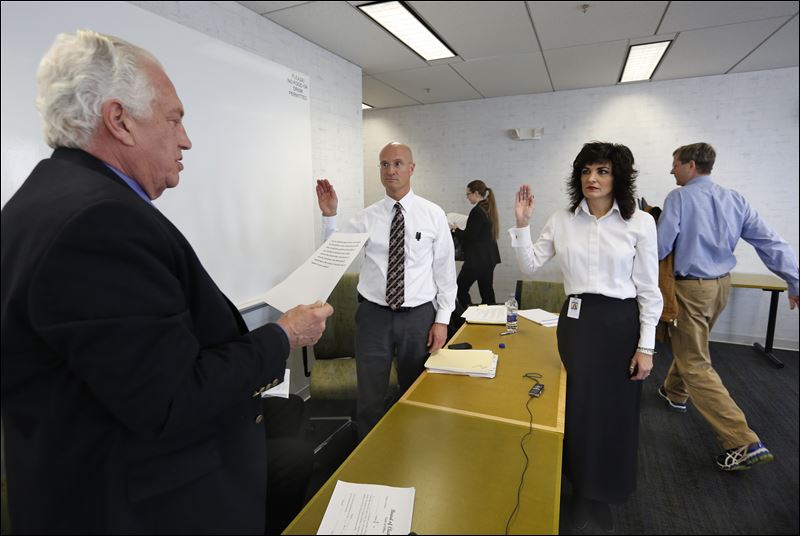
Gina Kaczala being sworn in as the new
executive director of the Lucas County
Board of Elections. Her first act: fire one
 of the temporary employees in the office.
(Toledo Blade photo)
You might have heard about the recent shake-up in staff at the Lucas County Board of Elections, but you probably didn't know some of the details ... details revealed by a public records request.

The Blade has the story about Republican booth official Melissa Brogan being fired by the new Republican executive director, Gina Kaczala, and Democrat deputy director Dan DeAngelis.

She was a temporary employee, subject to employment "at will," so she could be let go without any cause or reason.

Jon Stainbrook, Lucas County Republican Party Chairman and one of three members of the BOE, strongly objected, as the news story reported:

“The only reason they did it is because they don’t like it, and they don’t like her,” Mr. Stainbrook said. “She did an exemplary job for more than two years and was an intricate part of the election process. They are abusing their new-found authority right off the bat.”

But public records tell a different story.

Brogan's time sheet
According to her time sheets, Brogan reported for work on Monday, Feb. 3rd, at 8:30 a.m. She signed in the time, but then crossed it out and wrote "sick" in the comments.

That's not an unusual event, but that's only part of the story.

On Feb. 5th, nominating petitions for five candidates were turned in to the BOE. The circulator was Melissa Brogan.

In total, she collected 25 signatures on the petitions - all on Feb. 3rd.
One of the petitions
Brogan turned in.

Now, it is conceivable that she gathered these signatures after she was feeling better, but if you're going to take a sick day and then turn in petitions all signed on the day you call off sick, you should expect questions to be raised.

In fact, I'm surprised that no one asked about it at the time the petitions were filed.

 Certainly others in the office would have known she'd gone home sick. At the very least, the director and deputy director should have asked for an explanation.

Perhaps, though, such 'oversights' in managing the staff are what contributed to the Board deciding to fire Meghan Gallagher and replace her with Kaczala? Who knows?

One insider commented that they wouldn't be surprised if the whole thing had been coordinated by Gallagher. But that speculation is probably more indicative of the lack of trust in Gallagher and Stainbrook, than of the truth.

Regardless, the existence of the questionable circumstances definitely belie Stainbrook's comment that she did an "exemplary job."

Tuesday, August 13, 2013

Toledo files motion to dismiss 'gang map' lawsuit


From The Blade
The City of Toledo filed a motion today asking for a dismissal of their appeal of the lower court decision regarding a map depicting the territory of gangs. They say in their filing that the publication of the map renders the question moot.

The Toledo Blade maintained that the map was a public record subject to disclosure. The city maintained that it was a confidential investigatory item which is exempt from disclosure under Ohio public records law.

The Blade filed a writ a mandamus asking that the city be ordered to release the map. The court ruled 2-1 that the map was a public record and the city appealed.

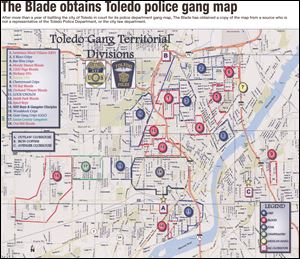
However, the paper published a copy of the map it says it was given by someone not in the city law department nor in the police police department.

Here is the press release:

City files motion to dismiss in “Gang Map Case”

The City of Toledo today filed a motion to dismiss in the case of State, ex rel The Toledo Blade Company. The motion stated the following:

“This case is before this Court as an appeal of right as it originated in the court of appeals as an original action seeking a writ of mandamus. At issue was the City’s refusal to provide the Relator-Appellee with a document prepared by a Toledo police detective and referred to as a “gang map.” The City refused to provide the map as it believed the map was a confidential law enforcement investigatory record and, thus, not a public record under Ohio law.

“In a 2-1 decision the Sixth District Court of Appeals granted the requested writ and this appeal was taken. On or before August 12 the Relator was provided with a copy of the requested “gang map” by an undisclosed source. The map was published in the Relator’s newspaper on August 13, 2013.

“While, arguably, important legal questions remain that are capable of repetition yet evading review, Respondent-Appellant believes that the publication of the requested record moots the underlying issue before this Court.

“Accordingly, dismissal of this action is appropriate at this time.”

###

Tuesday, April 30, 2013

What The Blade didn't tell its readers about their 'gang map' public records lawsuit


Ohio's Sixth District Court of Appeals
Yesterday I wrote an explanation of why the Toledo Police Department's 'gang map' is NOT a public record, despite what the Toledo Blade wrote in their editorial signed by John Robinson Block.

One of the things the paper said was that they were engaged in a legal battle over the issue. Ohio allows individuals (and media) to file a request for mandamus with a court to force the release of public records.

Interestingly, the Blade didn't explain any details of the lawsuit, so I decided to look it up.

Case number CL-2012-01183 was filed with the Sixth District Court of Apeals on July 11, 2012.

Here's a summary of the mandamus request:

* Reporter Taylor Dungien was told on three occasions that TPD maintains a gang map or "gang territories map" on a wall and electronically in the computer.

* She asked to view the map.

* Sgt. Heffernan, the individual responsible for handling public records requests, told her no because it is an "intelligence piece and we're using it to do our enforcement; it's actively being used."

* She made another request and the city's law director told her it was exempt from Ohio's public records law because it was a confidential law enforcement investigatory record.

(this is exactly the point I made in my post yesterday)

* The Blade maintains that it is a public record because it's a "compilation based on ongoing monitoring of of gang activity in the city" (yes, a lot of typos in the filing...) Accordingly, they claim, it can't be a 'investigatory' record.

* They claim the release of the map will not endanger an officer, victim, witness or informant - nor will it disclose the identity of a suspect.

* They also claim it won't reveal any "specific confidential investigatory techniques or specific investigatory work product."

(Interestingly, this claim that it isn't a work product directly contradicts their story about how long it took them to create their own map and how hard it was to do so, considering the lack of openness the gangs displayed.)

* They also claim that if portions of the map are exempt, the map should be redacted to give them the portions that aren't.

* They finally make the normal arguments that it's in the public interest and request compensation under the public records law.

The Court ordered the city to either release the map or show cause why they didn't have to.

Not surprisingly, the City responded and denied the Blade's claims, stating their original position that the map is exempt. They did admit to not offering a redacted version because it was "not capable of being redacted without becoming completely meaningless."

They also state that, to the point there is a public interest in the map, the "interest favors the effective pursuit of criminal investigations without interference" from the Blade.

The case followed the normal rules of Civil Procedure so after the initial filings, the discovery process would begin. However, on Sept. 20, the paper and the city filed a joint request for a pre-hearing conference because they couldn't agree upon discovery issues.

The court agreed to have them submit the issue - and their respective positions on the issue - to the court. This is where it gets interesting....

The Blade proposed that their attorney be allowed to view the map in confidence, agreeing not to reveal anything of it to the paper, so he could understand the legal basis for the refusal to release it. The city said no. Depositions began.

The paper again requested that the attorney be allowed to view the map under a protective order. The city again said no.

But as the deposition proceeded, the Blade attorney again asked to see it and promised not to reveal any part of it to his client. The city again refused and they agreed to go to the court for resolution of this dispute.

To recap: Having failed to get the map released, the Blade's attorney asked to view it and promised not to tell the paper anything about it. The city, maintained it was not a public record but a confidential record and not subject to discovery. And who could blame them?

You can't insist that an item be revealed in discovery when the item is the very subject of the mandamus action. But the city agreed that the court (judge) could view the document under seal and that they would make it available to the court.

Three judges signed the decision that said the law provided for no "hybrid" form of disclosure that would allow "attorneys eyes only" for the viewing of the map. The judges ruled that either the map was a public record subject to release and viewable by all, or it wasn't. They agreed with the city's position that the court should view the document, consistent with case law. That was December of 2012.

Following extensions of time and depositions, the Blade asked for a summary judgment in their favor, the reasons they believed they proved the record was a public one and asked for the order to release the map.

The city filed their request for summary judgment in their favor, setting out further arguments that supported their position that the map was a confidential law enforcement investigatory record (CLEIR). They also provided a copy of the map to the court.

Following that, the city filed a response objecting to the paper's request for summary judgment. In that response, they reveal various items of information from the deposition: that the map has been actively used as part of criminal investigations and some court cases are pending; the map was compiled for a specific investigatory purpose, but has since been maintained as an investigatory tool and nothing in Ohio law says a CLEIR can only be used once; revealing the map would tip off gangs and reveal the scope of TPD's knowledge about them; and (I love this one) that what other cities do with their crime maps has no relevance whatsoever to what Toledo is doing with theirs.

In accordance with the rules of civil procedure, the paper filed their objection to the city's motion for summary judgment. They claim that the map doesn't show specific crimes, just geography; it doesn't reveal specific techniques, just boundaries; release of the map wouldn't disclose specific houses or locations of suspected gang activity; that the law favors disclosure and that the burden of proof limiting disclosure lies on the part of the city; it doesn't relate to a "specific" investigation and doesn't reveal any specific technique, both of which are required in order to maintain an exemption under the law.

Those objections to the summary judgment were filed on April 18th.

Now it is up to the court to read the positions and arguments and make their decision.

Monday, April 29, 2013

Why The Blade is wrong about Toledo's 'gang map'


The Toledo Blade is doing a series on gangs in the city, which is a good public-interest story and certainly relevant news. It's called "Battle lines; Gangs of Toledo."

But they're not happy with the Toledo Police Department or Mayor Mike Bell because they won't release the map they have showing the territories of the various gangs.

Publisher and Editor-in-Chief John Robinson Block took the unusual action of writing - and signing - an editorial titled "On gang map, Mayor Bell ignores the public's right to know."

He writes:

The people of Toledo have a right to know about gang activity in this city. They have a right to know where it is. They are entitled to see the “gang map” that tells where gang activity is most dangerous and intense.

Many months ago, The Blade asked for that map, which is a public document under Ohio law. The mayor refused to release it. He has persisted in this refusal, even in the abse
nce of legal authority. This refusal is illegal and unjustified.

Except, the refusal is legal.

Ohio Revised Code 149.43 details the state's law about open records, access and penalties for failure to comply. It's one of the best public records laws in the country, generously favoring the public's right to know.

But there are numerous exemptions - items specifically designated as NOT a public record. Section (1) defines what a public record is and also says "Public record" does not mean any of the following: The following list includes this exemption

(h) Confidential law enforcement investigatory records;

The only way the Blade can maintain that the release of the gang map is a public record is to claim that it is not a confidential law enforcement investigatory record. That's also the only way the Mayor can maintain its secrecy.

Block also writes:

One consolation is that The Blade’s map is almost certainly more accurate than the city’s because gang members were naturally more willing to talk with our reporters than police officers.

Well if their map is more accurate, why are they still quibbling with TPD over theirs?

Block then writes:

Our motive is not to defame anyone or to depress readers but to show what is — to tell the truth.

In the final analysis, the gang map is not a matter of the newspaper’s right to know, but the people’s right to know. The Blade is merely the surrogate and servant of the people of Toledo. For only an informed public can govern itself.

For those of you who have followed my writing over the years, you'll know that I gave up coming up with headlines on the Blade's bias and just started numbering them. The local daily has a reputation - deservedly so - for being more of the dictator than the servant and for telling people what they want the people to know - rather than the truth. To say that hysterical laughter followed when I read this sentence, first to myself and then to a group of others, would not do justice to the hysterical laughter that actually followed.

But I digress - so back to the map as a public record...

TPD probably does not have a single map, but a series of maps over time, likely showing the various gang territories and how they have changed over time. Such a map could very legitimately be a confidential investigatory record showing which gangs are expanding, which are declining, which are combining and which are new. How they interact within their territories and with/against each other based upon those territories is an investigatory tool that could help TPD monitor and predict their activities and likely conflicts.

If the maps show disputed territory, it could influence such things as where TPD is placing their (highly controversial) monitoring cameras as well as the routes of their road patrols.

Additionally, if the gangs know what it is that the police know about their territories, it could cause them to change certain behaviors, putting the public further at risk.

If I can come up with such reasons and explanations as for why the TPD gang map is not a public record, I'm certain the mayor, having all the information, can as well. In fact, that's exactly what happened and the Blade promptly sued the city over the issue.

Contrary to what the editor claims in his editorial, the issue is not clear-cut and the public's 'right to know' isn't always outweighed by the public's own safety, or the safety of our police officers, through the protection of confidential investigatory records.

For more information, check out: What The Blade didn't tell its readers about their 'gang map' public records lawsuit

Wednesday, March 13, 2013

Ohio has mediation program for disputes on public records requests


As I talk to bloggers and citizen activists in other states, they are continually amazed at how easy it is for Ohioans to gain access to public records. Our laws are definitely skewed in favor of release of records and are written to ensure public access.

But even so, we run into trouble getting documents or information we want. So the Attorney General's office has a program to help: the Public Records Mediation Program.

Under Ohio Revised Code 149.43, if you request public records and don't get them, your recourse is to seek mandamus action in court. An entity that failed to follow the public records' law may be liable for a fine (though it's not called that in the law) as well as your attorney fees.

But turning to a court process isn't a step many people have the time or inclination to take. Enter the Mediation Program.

The AG's website explains:

The Mediation Program is a voluntary and confidential process in which a mediator who is well-versed in Ohio’s public records laws helps the disputing parties through a process to identify the parties’ issues and interests, with the goal of finding a mutually acceptable solution.

They even provide a form online that you can submit electronically or print and mail or fax.

If your think that your request for records was denied incorrectly or if it's taking too long to get the records, you can request assistance through this mediation process.

Additionally, if a public body thinks a request is too broad or ambiguous - or just wants helps meeting a public records request - they can request assistance through the program as well.

The key is that both the public body and the requester must agree. And since the goal is the proper release of public records, there's really no reason for either side to object.

The mediations are private and confidential - and free!

Since the program began less than a year ago, 59 requests for mediation have been made. Of those, 23 were resolved prior to mediation.

Think about that - sometimes, just requesting the mediation is enough to get compliance from the public entity.

The AG's office has completed seven mediations, though one was not successful. And it's not sure-fire way to get what you're looking for - they report an 84% success rate with 32 of 38 disputes fully resolved, so there is room for improvement.

But still, if it can help you resolve your public records request without going to court, it's definitely worth a try.

If you'd like to know more about Ohio's public records or open meetings laws, you can attend a Sunshine Law training. It's a three-hour session and required for elected officials and/or their designee, but also open to the public. They're free as well!


With the law and the state AG on your side, there's no excuse NOT to make a public records request.

So - what have you always wanted to know?

Sunday, March 10, 2013

Sunshine Week 2013


Hey - it's Sunshine Week!


Yes, despite the prediction of rain for today, it is the start of Sunshine Week, where we celebrate and embrace our right to know things about our governments.

It's made possible due to support from Bloomberg LP and the John S. and James L Knight Foundations. It's a national initiative to promote the importance of open government and freedom of information.

In Ohio, we're very fortunate to have one of the best public records laws in the country. Just about anything you'd want to know about what's going on in your township, city, county, state, school, or other public entity, is covered and your access to that information is a priority.

It's all right there in Ohio Revised Code 149.43, but in case reading codified law isn't your thing, there is the Ohio Sunshine Book.

For years, Attorneys General and State Auditors of Ohio have jointly published this handy reference guide that tells you, in plain language, what the law says; it also includes information about open meetings laws that public bodies must follow. The book is available on line, or you can order a printed copy or CD for free from the AG.

Take a moment to check it out. Know what the requirements are for Ohio public bodies and then make sure your *favorite* entity is following the rules. Also, make a public records request. It's pretty easy and you may be surprised what you find out.

It's your government - using public records laws to hold it accountable is your responsibility!

So, let the sun shine in!

Thursday, November 08, 2012

Open Meetings and Public Records training in Toledo


How do you hold elected officials accountable? You keep track of what they're doing and making sure they're doing things correctly.

But how do you do that? You know the law and take advantage of public records to find out what's going on and who is doing what.

And where do you learn how to do that? By attending training.

The Ohio Attorney General will conduct Sunshine Law training here in Toledo on Wednesday, Nov. 14th.

All elected officials are required to attend such training on a yearly basis, but members of the public are invited and encouraged to attend.

The training is free, but the AG requests registration. You can register here.

It will take place at the McMaster Center in the Toledo Lucas-County Public Library (325 Michigan Street in downtown Toledo). It runs from 1 to 4:15 p.m.

Please take advantage of this opportunity. Ohio has one of the best laws in favor of disclosure and some of the best protections for citizen access to public information. You never know when you'll need to know your rights.

Wednesday, June 20, 2012

New mediation program for Ohio public records disputes


Press release:

Attorney General DeWine Announces Public Records Mediation Program

(COLUMBUS, Ohio)—Ohio Attorney General Mike DeWine has announced the start of a mediation program to resolve disputes between local governments and persons requesting public records. The Ohio Attorney General's Public Records Mediation Program will be available to governments and requesters starting today.

"The Ohio Public Records Act is one of the most comprehensive open government laws in the nation," said Attorney General DeWine. "The Ohio Attorney General's Public Records Mediation Program will protect the rights and interests of both Ohioans and their local officials by helping resolve disputes before parties turn to time consuming and costly litigation."

The Ohio Attorney General's Public Records Mediation Program will be open to any party in a dispute over local government public records. The mediation may be requested by the records requestor or the local government. Both parties must consent to the mediation.

The Ohio Attorney General's Public Records Mediation Program will seek to resolve disputes over public records requests that have been alleged to be improperly denied or not responded to in a reasonable period of time. The mediation will be conducted by a member of the Ohio Attorney General's Public Records Unit. The cost of the program will be free to both parties.

To be eligible for the Ohio Attorney General's Public Records Mediation Program, the party involved must be a local government entity, such as county and city governments, township boards of trustees, school boards, and village councils, among others.

"The attorneys in my office spend a considerable amount of time and energy ensuring that State entities fully comply with their public records obligations and resolve public records disputes without the need for litigation," said Attorney General DeWine. "My hope is that this Mediation Program will provide local government entities and records requesters a similar opportunity to resolve public records disputes quickly and easily and without the need for litigation."

To request mediation, parties should complete and submit an intake form online at www.OhioAttorneyGeneral.gov/PublicRecordsMediation, or contact the Ohio Attorney General's Public Records Unit at 1-888-958-5088.

To learn more about Ohio's public records laws, please review the Ohio Sunshine Laws Manual at www.OhioAttorneyGeneral.gov/YellowBook.

-30-

Friday, September 25, 2009

FOIA Friday - September 5, 2009

It's been a while since I've done a FOIA Friday - for a number of reasons - but my friend and fellow blogger, Bob Weeks, who writes at Wichita Liberty, has a post worthy of a FOIA Friday highlight.

You see, Wichita is in the process of selecting a firm to plan its downtown development. Now, Toledo could teach Wichita a thing or two about what NOT to do when it comes to downtown development, but that's not the point.

They've set public meetings during which the final four firms will make their presentations. Wanting to be prepared for the public meeting, Bob asked for copies of the proposals. He was told he couldn't have them, even though a select group of citizens had already received them.

And Bob's point was critical: how could citizens provide input about the selection process and the best company to hire if they couldn't read the proposals ahead of time - especially when the price tag for the plan was $475,000?

Bob wasn't the only one denied access to the records. As the Wichita Eagle reported:

"Bob Weeks, a blogger who runs WichitaLiberty.org, asked for the proposals more than two weeks ago.

The city denied his request, saying the proposals wouldn't be public until the City Council accepted one or rejected them all.

The Eagle got the same response and began questioning why the proposals that had already been circulated to non-city employees would be sealed.

The Eagle contended that the proposals should be public and that releasing them fits with the city's stated mission to be more transparent and make downtown's future a public process.

Layton said the city was concerned that releasing the proposals before the consultants gave presentations Tuesday and Wednesday could interfere with the competitive process since each would have access to the other's proposal.

But he agreed that making the proposals public could improve the process by giving more people a chance to review them and give informed opinions.

Weeks said he wanted to review the proposals before the presentations in public meetings Tuesday and Wednesday.

He got to see them Wednesday afternoon, about an hour before the second meeting."

The Eagle later opined:

"They can choose, as the city has now done, to release the information. And they should realize that doing so is in their best interests, as it can lead to better results.

By being open, governments allow the public to be part of the process and provide input. When that happens, the public tends to have more support for and confidence in the final decisions. Without such openness, the opposite tends to happen."

Because of the efforts of a Bob Weeks, and the support of the local paper, all the citizens in Wichita finally got access to the public records and were able to provide direction to their public servants - and that's the way it should be.

Thanks, Bob, for your continued efforts!

Thursday, April 23, 2009

Why Finkbeiner thinks he can withhold public records

It should come as no surprise to The Blade that Toledo Mayor Carty Finkbeiner is withholding a public record detailing the reorganization plans for the Police Department. They even did an editorial on the subject - the same day of the news coverage rather than a day or two later as is their normal practice.

This has been a standard of the Finkbeiner administration for several years now.

Despite a prior reputation of aggressiveness on the issue of public records, The Blade was strangely silent when it came to coverage of citizens who tried repeatedly to gain information from the city.

Whether it was the Erie Street Market, red light cameras (here and here), the number of vacant but funded positions, or more on the Erie Street Market, I and others have tried to get public records from the city - and most of these efforts got little or no coverage from the daily paper.

But I didn't expect them to. You see, The Blade has supported the red light cameras and the Erie Street Market, so why would they provide any coverage of citizens who were questioning the spending or efficacy of these pet projects?

But the police reorganization is important to them, and they were the ones being refused requested documents this time around.

Last night, an emailer to Eye On Toledo took exception to a caller who said Carty was the worst thing that had ever happened to Toledo. He wrote:

"I disagree with the last caller.

Carty has been and is a blight on this city, but he’s not the number one offender. That honor goes to JRB (John Robinson Block, publisher) and the editorial board at the Blade. Carty, if left to his own devises, is not bright enough to cause serious harm. The same can be said of Young Ben (Konop, Lucas County Commissioner). What makes these buffoons dangerous is the support and cover they get from the local paper. The list of problems with Toledo and Lucas County can all be traced back to the agenda pushed by the Blade. Commodore Perry, Hillcrest, Steam Plant, Erie St. Market, the ambulances, tow lots, etc, etc, etc, are all ideas first brought forth and championed by the Blade. Carty and Ben are just the most recent incarnations of the Blade's puppets.

Getting rid of Carty will help, but as long as that building on the Left Side of Superior is still calling the shots, Toledo will never be prosperous."

When the area's (supposed) primary 'watchdog' on public officials ignores the practice of refusing to release, in a timely manner and according to law, records that are public, it emboldens those officials to continue the practice, as they see no negative consequences from doing so.

In their editorial, they state:

"Refusing to release a clearly public record of such import to the citizens of Toledo at this crucial point in the city’s history is yet another example of the arrogance and imperiousness Mr. Finkbeiner has shown over the years that has caused citizens to line up to sign recall petitions."

Where was this opinion on all the other refusals to release public records?

It didn't exist and it was the lack of holding such officials accountable that caused them to think they could continue. Of course, The Blade now finds itself on the receiving end of what has become a pattern of behavior and so they're making it a major news story.

If they'd paid a bit more attention to the difficulties in getting public records in the past, they wouldn't be having this issue today.

Friday, September 19, 2008

FOIA Friday - September 19, 2008

One of the biggest frustrations in trying to get public records is when a government entity doesn't want to give you the information. Despite the fact that the information is there, it might not already be in a form that makes it easy to hand out.

Each state has its own laws and in Ohio, governments are not required to create a record in order to provide it to you. While this makes sense on the one hand, it can become a way for entities to hide information they don't want you to know.

When I was the Clerk of Toledo Municipal Court, the city of Toledo, through which our budget was processed, periodically issued a report that listed how many employees were in each department (by classification) and how many of those budgeted positions were vacant. Figuring that if the report existed in the past, it should be able to be produced in the present, I asked for the information.

Apparently, they no longer do the report on a regular basis, hence, the answer I got from the city was that no such report exists. Could it easily be produced? Probably, considering that they haven't changed the computer systems since I was in office.

But, if the city doesn't want people to know this information, they can just say that they have no such report, and the logic of 'you used to have it so please produce it' just doesn't resonate with them.

As a citizen, I should be able to know, at any given point in time, how many employees the city has on the payroll, and how that number differs from what was budgeted. The mayor, facing budget deficits, has said that he believes there are positions in each department that are not necessary and could be eliminated in order to reduce those deficits.

Um...if the positions are not necessary, why are they there in the first place????

But if you're getting ready to lay off people, wouldn't it be logical to think that you already know how many of the budgeted positions are not filled? Either you do, and you just don't want to share that information with the public, or you don't, which makes you a less-than-competent mayor.

He who controls the information controls the world...

Thursday, August 28, 2008

FOIA Friday - August 29, 2008

The City of Toledo still can't get it right when it comes to the Erie Street Market. Yesterday, I requested a public record - a copy of the rental agreement for Bay 4 of the ESM for the event scheduled this weekend. Robert Croak is running the event, but the rental agreement is a simple letter, hand delivered and signed by him and Connie Hoffman, the manager of the Market.


Here is a copy of the agreement for the Chiodos Concert scheduled for 4 p.m. - 1 a.m. But note the text of the letter says the rent is for the date of August 16, 2008, even though the money is due the day of the event, August 29, and the bay has to be cleaned up the following day, August 30.

With all the attention focused on the mismanagement and mishandling of the renovations to Bay 4, you'd think they'd be extra careful to ensure that all things were done correctly. But since they're not using any type of normal contract for the 'rental' of this area, it should come as no surprise that they're just inserting each week's event into a form letter and printing it out. However, they've obviously missed changing one of the dates...and neither Hoffman nor Croak noticed the error. Croak also didn't mind that his company name became 'Enterproses.'

Sometimes, having access to public records tells you more than you want to know.

Friday, August 15, 2008

FOIA Friday - August 15, 2008

Earlier this week, I blogged about the Buckeye Institute's new transparency in government initiative. As part of that initiative, they've launched OhioSunshine.org, a website about all things 'public' in Ohio.

If you've never edited a wiki, now is the time to learn. OhioSunshine is a wiki, an on-line encyclopedia, if you will, that allows any user to add or edit content. I'd never contributed to a wiki before, but I wanted the link to Toledo's public record policy to be on the page. So I went to the help page, read the instructions, created a Toledo page and added a link to the city's policy. I was also able to put a comment about who to contact for public records requests.

This new website is going to be a terrific tool for increasing our ability to monitor and track what government does. Since the content is user generated, we can add pages for taxing jurisdictions likes schools and agencies, add budgets, provide information and then have discussion about the data.

I encourage you to contribute to and use this new portal so we will have, as their subheading says:

11 million pairs of eyes ensuring good government in Ohio

Wednesday, August 13, 2008

Mandamus filed against City of Toledo

We've been following GraphicsGuy's seemingly perpetual efforts to get information on the red light/speed cameras from the City of Toledo. Unfortunately, he still does not have the information requested.

A while back he sent a letter to the acting law director asking for attention to his request. He expected a response of some kind to his communication, but was disappointed yet again. I guess the lack of response was the final straw.

Today he filed a mandamus action against the city, asking for the records, attorney fees and the $100 per day 'compensation' provided for under Ohio law.

Stay tuned!!!

Friday, August 08, 2008

Friday FOIA - August 8, 2008

In my Friday FOIA posts, I've talked about how important it is to know your state's laws regarding public records and I've encouraged you to make your public records requests accordingly.

But sometimes, no matter how prepared you think you are, you're just not comfortable with going through the process or with wording your request in a way to ensure you get the records and information you're seeking.

I came across the Student Press Law Center which has a Fully Automated, Fill-in-the-Blanks State Open Records Law Request Letter Generator, available for anyone.

After filling out a form detailing the specifics of your request, it will generate a letter for you to copy&paste or print out. It will include (1) the specific citation for your state's open records law, (2) how much time the law allows for an agency to respond and (3) any specific penalties provided for by the law should government officials fail to comply with your request. You have the ability to modify the letter to your own style.

They also have a form for the federal government, and both are free, though they do include links to make donations.

So, if you're even remotely concerned that your request isn't worded in such a way to ensure a quick response, try these tools to help you get started. You'll soon be a pro!

Friday, August 01, 2008

FOIA Friday - August 1, 2008

Several items for today's FOIA Friday:

This past week I saw a couple of unusual items on the Toledo City Council agenda, so I made a request for the particular ordinance and got the documents the next business day. It's a pleasure making public records requests of the Clerk of Council and I appreciate his prompt responses.

Here's what I found out: the city of Toledo is going to request donations from individuals seeking approval of their work from the Building Inspections Department and permit offices to help fund a 'It Pays To Hire a Licensed Contractor' ad campaign. The ordinance passed by council on Tuesday allows them to create a fund to receive the donations and then expend money from the fund. I spoke to the staff member in charge of the program and he insisted that the only money to be spent will be the donations received - no money from the city will be used for the program.

I've got a problem with a regulatory office asking for donations from individuals/businesses seeking approval of their work from that same office. It seems to me to be the appearance of an impropriety, if not an outright impropriety. Would there be any concern from people seeking inspection approvals that a lack of a donation might put them at risk of not being approved - or of going to the bottom of the schedule for the inspection?

I don't think the employees in this office would do such things, but I wouldn't put it past the mayor to suggest such a tactic. Regardless, it's not whether or not the 'retaliation' would actually occur - it's whether or not the people doing business with the office would perceive that such retaliation is possible.

And why does the city need to do this in the first place? Is it really the role of city government to collect donations to run an advertising campaign telling the public that hiring a licensed contractor to do work on their homes is a good idea????

******

We've been following the public records requests from Mayor Carty Finkbeiner to the Toledo-Lucas County Port Authority and the subsequent letter from District 2 Councilman D. Michael Collins - and the frustration these individuals have over not getting their documents in a short period of time.

We've also been following GraphicsGuy's request from two months ago - and his righteous indignation that his public records request seems to be ignored while the mayor and the city law department go about their own personal vendettas.

As of today (less than weeks from the first request), Collins has received a paper with some information on the Erie Street Market financials, but it was far from a complete accounting. Mayor Carty Finkbeiner has received over 1,000 pages of documents in response to his request, though it appears more is still to come.

But GraphicsGuy hasn't even gotten a response to his letter to the law director.

Guess we know the priorities of the elected officials - and it isn't in following the state law or in what concerns the citizens.

******

As a result of some new information about the Erie Street Market, I made another public records request to obtain any documents/contracts/agreements which detail the relationship between Rob Croak and the City of Toledo and/or the Erie Street Market. Croak was selected by Carty to run concerts in the newly renovated (at a cost of $80,000 without council approval) Civic Theater. Apparently, Croak is also the general contractor for the renovations and is reported to be getting 40% of the profits from liquor sales, although today's paper says he's getting 100% of the gate receipts and no proceeds from the alcohol. We'll see...

As the mayor said in his records request, these documents should be readily available so I'll expect them today. Again, we'll see....

Saturday, July 26, 2008

Dueling public records requests

Isn't it ironic that a public records request from GraphicsGuy from June 6th still hasn't been filled, but Mayor Carty Finkbeiner issued this press release last last night?

FOR IMMEDIATE RELEASE:
Friday, July 25, 2008

CONTACT:
Elizabeth Phillips
419-245-1016
419-261-3875

###

CITY OF TOLEDO ISSUES LETTER REGARDING PUBLIC INFORMATION REQUEST

The City of Toledo requests that the Port Authority should produce the documents requested, as the Port Authority investigation is close to completion.

Below is copy of a letter sent to Port Authority Board Chairman William J. Carroll:


July 25, 2008

William J. Carroll
Chairman, Board of Directors
Toledo Lucas County Port Authority
One Maritime Plaza
Toledo, Ohio 43604

VIA HAND DELIVERY

Re: City’s Document Request of July 21st

Dear Mr. Carroll:

This letter is to inquire as to the status of the documents requested by the City on July 21st. We are disappointed by the lack of response to date. While the City acknowledges that a “reasonable” time is allowed for a public entity to make copies of documents requested, the City would point out that given the “investigation” being undertaken by the Port Authority and reports that that investigation is nearing finality, these records should have already been gathered for purposes of the Port’s investigation. Further, the law does require that documents be made available for prompt inspection. Accordingly, the City of Toledo believes that a reasonable time for record production has already expired. This is especially evident by the fact that you have been quoted as describing the City’s fact gathering as being “redundant”.

To the extent, however, that the Port’s investigator has requested any records that have not been sought by the City, the City now requests copies of any of those additional records. Further, the City would request all minutes, notices, notes, memoranda, correspondence, or documents related to the closed-door meeting conducted by the Port’s Board on July 24, 2008. These records should include any documents that explain the basis for such an executive session, describe the purpose of the executive session, and identify all attendees of the executive session.

If the Port is unable to produce the requested documents by the end of the day today, we will appear at the Port Authority’s offices at 1:00 P.M. on Monday, July 28th to inspect the requested information.

Please call me if you have any questions or concerns. I look forward to hearing from you at your earliest possible convenience.

Respectfully,

Adam Loukx
Acting Director

Side note: The acting director of the City of Toledo Law Department should know better than to request such information about an executive session. The only information that is public relating to the executive session is the vote of the individuals who decided to go into the session and the reason, which was to discuss personnel matters. No other information relating to an executive session is public. Maybe Acting Director Loukx should read the exclusions to the state's public records law.
**************

Of course, District 2 Councilman Michael Collins, who's been waiting for financials for the Erie Street Market for quite some time, had a reaction and shared it with the entire press release mailing list:

Dear Mr. Loukx,

I read with great interest your letter dated July 25, 2008 to William J. Carroll, Director of the Toledo Lucas County Port Authority, wherein you demanded public records based upon a document request of July 21, 2008. Please be advised that on July 21, 2008 I also made a public records request for the financials for the Erie Street Market, from the period of January 1, 2008 thru June 30, 2008.

The specific records I requested consisted of a balance sheet and a profit and loss statement. These records, as part of a normal business practice, should have been available within 24 hours. The crux of my concern is your position, as it relates to documents in which YOU requested, (and now protest), and the fact that you have not received them.

Obviously, my request does not carry the same level of importance to the Mayor and his Administration when it comes to due diligence to the taxpayers of The City of Toledo, albeit, it deals with the financial status of the Erie Street Market at this time, and in my opinion is of far greater importance than your efforts to duplicate an ongoing investigation.

I fully expect the documents requested will be in my office no later than 9am on Monday July 28, 2008.

Respectfully,

D. Michael Collins
Councilman, District 2

Funny how important timely responses to public records requests become when it's the mayor making the request. They seem to think that 2-3 days is plenty of time for the three page/16 item request that they made for records - some going back as far as 10 years. I can't help but wonder why Acting Law Director Adam Loukx isn't jumping up and down over the nearly two months that GraphicsGuy has been waiting for a simple administrative policy...talk about something that should be readily available! Perhaps if GraphicsGuy were to file his mandamus action while news of Carty's demand was still fresh, the point might be made in a very public way???

The mayor, instead of worrying so much about his 'demand' for documents (which is to conduct a so-called 'investigation' that he has no authority to conduct), ought to pay more attention to his own administration and their habitual obstruction of access to public documents. Additionally, kudos to Collins who chose to take advantage of the mayor's impatience to make similar demands for his own request for information.

People who live in glass houses....

Friday, June 27, 2008

FOIA Friday - May 27, 2008

I missed my FOIA Friday last week as we celebrated the wedding of Cindy and Patrick. It was a very good reason to miss a FOIA post, but I'm back this week with a story about a friend who just wanted something simple.

My friend Twila sent an email to Commissioner Ben Konop to request a listing of all boards and commissions, the members, their terms and mission statements. As she stated in her email, she knew she was not required to provide a reason for the request, but she did so anyway. She chose Comm. Konop, as she explained, because of his "attempt to bring honest and open government to Toledo." She sent this email on June 11 and followed up with his assistant on the 13th to make sure he had gotten the email. He had.

On June 20, she sent a follow-up email because she hadn't heard anything at all in terms of a response. She even included this statement, which is so correct:
"Please respond with either the information or the reason why the information can not be provided, because silence is just not the appropriate answer."

What Twila didn't know is that the County Commissioners have a book that lists all the boards and commissions to which they appoint members. That book, a large three-ring binder, includes the names and addresses of all appointees, their terms, their 'category' if they represent a particular group or fulfill a particular legal requirement, and the pertinent Ohio Revised Code reference for the board or commission. If there are specific requirements for the board, those requirements are listed in the book as well.

It's a pretty thick book, but it's easy to go through. It should have only taken a few minutes to send a reply email that the book was available for inspection in the Commissioner's Office.

Twila also didn't have the County's public records policy when she sent the email, but she does now. That policy says that replies need to be prompt - and I can't help but believe that two weeks is less than prompt.

I know all this because she copied me on her public records request (which is a public record in and of itself), and I gave her some advice on how to proceed. I told her that if she's just interested in the information, she could contact the specific individual who was (and, I believe, still is) in charge of keeping the book current and make arrangements to view the information. If she wants to teach elected officials a lesson, she could file the mandamus action in Common Pleas Court, asking the court to compel the production of the data.

I also told her about Ohio's special little clause that allows individuals to be compensated for the lack of timely response to public records requests. Under Ohio law, individuals can get $100 a day - it's not a penalty, but an 'incentive' for elected officials to respond appropriately. However, individuals are only eligible for this fee if they have hand-delivered their written request or sent it via certified mail, return receipt requested - in order to prove that the request was actually received on a particular date to start the tolling of the days.

I haven't yet heard what Twila plans to do, but knowing the tenacity of my friend, heaven help anyone who stands in her way of accessing public information. And shame on any elected official who doesn't promptly respond to a request for information!

Friday, June 13, 2008

FOIA Friday - June 13, 2008

In Point Place, we have a couple of roads that have boulevards and one of them is 119th Street - just a few streets from me. It's a beautiful road with trees and flowering bushes in the median - maintained nicely by the neighbors. At the end of the street is a public access to Maumee Bay. The neighbors have put a bench out there so you can sit and enjoy the view.

This idyllic street is in need of repairs. It's a concrete street that was put down about 57 years ago, so I guess it's time. In order to do the repairs and to provide clear passage for fire and garbage trucks around the vehicles which park in the street, the city is reducing the size of the median and is cutting down the trees.

The neighbors learned of the project and the plans at the last minute, primarily prompted by phone calls to ask why the trees were getting marked by the city. A series of miscommunications and a public meeting to explain the project still didn't produce answers to the questions.

One couple, Mr. & Mrs. Nearhood, wanted some specific data regarding the process by which the city made the decision to use a black top instead of replace the concrete. They sent an email to their district council rep, Lindsay Webb, asking rather specific questions about the cost of blacktop versus concrete, the life expectancy of the two products, long-term maintenance of each surface option and the life expectancy of the entire street.

Councilwoman Webb forwarded the email to Don Moline, Commissioner of the Dept. of Public Utilities, who responded with an email explaining the difference between reconstruction, resurfacing and preventive maintenance on streets. This response did not answer the questions and so Mr. & Mrs. Nearhood made the request again.

"These are not the questions that we presented to Miss Webb. Since the one gentleman at the meeting in May brought up that 119th was set in concrete 57 years ago, we asked to see the studies that the City of Toledo has done for cost, effectiveness; repairs; trends, etc. What we are trying to understand is how the City made the decisions do this project. We are keenly aware that current cost tends seem to weigh heavily in making the decisions but, in respect of financial responsibility to the taxpayers, we would like to see more data than that. When we make decisions to purchase something or change something at our home, we look at many factors i.e. quality; cost; potential for replacement, shot term value vs. long term value.

With that in mind, what we asked Miss Webb for, and we can scan a copy of the original e-mail if you would like is; what are the studies that the City has done on repair costs for concrete street vs. asphalt over the last 50 years; what is the projected repair costs for concrete vs. asphalt; with asphalt being a crude oil product (and with respect that asphalt can be recycled) what is the projected cost trends for repair for both products. Now, we did hear at the meeting that the City was projecting the asphalt to last 20 to 40 years and if we understand this statement, that is the potential life of the street as a whole. As anyone who deals with asphalt knows the trend to repair, replace, re-seal is no where near that mark. We would think 7 years would be a high mark for that. What are the City's projected budget for those trends? One has to be cautious in what information is presented and given and this is an area wherein the City needs to clarify as we all need to be good stewards, especially if the City is to grow. We have read the potential for what asphalt vs. concrete will cost in the real time, but we have grave concerns that in the long run, it will cost much more to the City (taxpayers) to perform this task in asphalt. Another point is potential for the trends of time frame and inconvenience for the residents for each of these projects including current and long term potential. We would also like to see studies that the City has done as to the cost of heating and cooling homes when asphalt vs. concrete is used, especially since many trees are being removed."

While the Nearhoods may not think of it this way, they're making a request for public records. Ohio law and city policy govern the time frame in which a response should be made, but Mr. Moline is usually pretty responsive to requests.

The problem I fear the Nearhoods face is that such analysis has not been done - or, if it was, it was such a long time ago as to be irrelevant. That they are asking for the information which guided the decision is a problem for the city, if they cannot produce documents or analysis which show that their decision was based on long-term savings rather than short-term costs.

The Nearhoods and their neighbors on 119th Street are holding their local government accountable - and are using access to public information to do so. I hope they get the answers they are seeking. However, if it turns out that the city hasn't done their homework on the questions, I hope the residents of 119th Street will use their public information requests and lack of analysis to influence the choices for restructuring this road.

Other FOIA Friday posts:
Freedom of Information suits CAN win

Friday, June 06, 2008

FOIA Friday - June 6, 2008

Whenever you're about to embark into the morass that is government in order to gain information (which shouldn't be hard, but often is), it's nice to have some hints or guidelines to help along the way.

In my FOIA Friday posts, I've tried to give some examples of public records requests and also some assistance to those who want information. Today, I want to list several websites that either cover the issue of public access or provide information about how to get the data you're seeking.

Wikifoia is a website that gives the same type of information as Wikipedia about all things having to do with public access. It's allows users to add content, has 'how to' guides, interviews, blog links and links to other FOIA groups and resources.

If you're new to such requests, this is the place to start.

Sunlight Foundation is a non-profit using the Internet and new information technology to enable citizens to learn more about what Congress and their elected representatives are doing.

"Sunlight’s work is committed to helping citizens, journalists and bloggers be their own best watchdogs, both by improving access to existing information and digitizing new information, and by creating new tools and websites to enable all of us to pool our intelligence in new, and yet to be imagined, ways."

Two of their current projects are Fortune 535 which is tracking the wealth of members of Congress, and Public Markup, where they seek online, public review of pending legislation.

Then there is the John E. Moss Foundation. In case you're wondering, Moss represented the Third Congressional District of California in the U.S. House of Representatives for 13 terms from 1953 until he retired in 1978. He died in San Francisco, California on December 5, 1997. He is the author and sponsor of the Freedom of Information Act (FOIA) and their Freedom of Information Page details the original law, comments from legislators at the time and some commentary through the history of the law.

The National Freedom on Information Coalition protects the public's right to oversee its government, offers grants to help foster the creation and growth of state FOI coalitions and assists with projects furthering public access to government records and meetings. One of their goals is to "start up and support citizen-driven state FOI and First Amendment organizations."

These links should provide plenty of reading for one day and a lifetime of resources for anyone willing to take advantage of their information to help hold elected officials accountable for what they do. So exercise your rights and file a FOIA request today - and then share with us your experience!
Google Analytics Alternative