Showing posts with label taxation. Show all posts

Wednesday, October 02, 2013

How money walks - Lucas County and Ohio both lose billions


We all know that people will flee high-tax areas and relocate to low-tax areas, a fact that too many politicians ignore. But the same applies to counties and cities and now we know how much.

"How Money Walks," by Travis Brown, takes a look at data from the Internal Revenue Service and then examines how wealth and people move between states. His website maps the data with numbers. The correlation is clear, he says: the key to accumulating wealth in your state is to have a pro-growth tax policy that does not tax personal income.

Nationally, Ohio fairs poorly.


The state lost $18.39 billion in annual Adjusted Gross Income from 1992-2010.

To be fair, we did gain income from some states:

  • $323.51 million New York
  • $218.36 million West Virginia
  • $205.12 million New Jersey
  • $112.16 million Pennsylvania
  • $15.20 million Connecticut

But here is who we lost to - and how much:

  • $6.46 billion Florida
  • $1.51 billion North Carolina
  • $1.18 billion South Carolina
  • $1.16 billion Texas
  • $1.09 billion Arizona

In Lucas County, as in all the other large metropolitan areas, the story is the same:


Lucas County lost $1.82 billion in AGI. Here is where we lost to - and gained from:

Gained Wealth From:

  • $8.27 million Allen County, OH
  • $5.95 million Erie County, OH
  • $5.25 million Lorain County, OH
  • $5.08 million Seneca County, OH
  • $4.86 million Trumbull County, OH

Lost Wealth To:

  • $219.39 million Wood County, OH
  • $204.14 million Monroe County, MI
  • $100.26 million Franklin County, OH
  • $60.18 million Fulton County, OH
  • $42.49 million Lee County, FL

In both the state and county data, you can see that we're losing far, far more than we're gaining.

There are lessons here, especially in light of Toledo's income tax - but is anyone paying attention?

Tuesday, May 07, 2013

Arguments in favor of Internet Sales Tax are all wrong


I've been listening to the arguments being made in favor of the Internet sales tax - a bill passed by the Senate and now headed to the House that would mandate the collection of sales tax for any on-line purchases from a company with more than $1 million in gross sales.

The claim by large, national corporations is that it will 'level the playing field' when it comes to collection of the tax because most of them already do this.


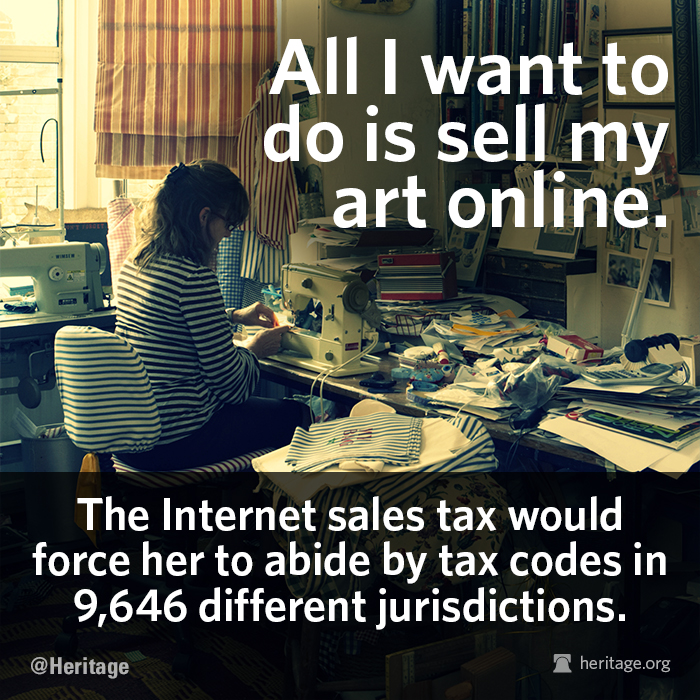
The problem is that the sales tax varies by jurisdiction with 9,646 different jurisdictions and a tax that is dependent upon where the purchaser lives.

Under current law, sales tax is collected by the merch ant based upon where the merchant is physically located and charged on on-line purchases only when a merchant has a physical location in a state.

It's a regulatory nightmare and companies with $1 million in GROSS sales might not have the NET profit to be able to afford the cost of the mandate. Then is also the possibility of purchasers giving a friend or relative's address in order to avoid paying a higher tax rate. What's to prevent someone from Toledo (with a 6.75% sales tax) from using an Erie, Michigan address (6%) in order to save the .75% difference?

The bigger question that bypasses all the arguments is this: why are merchants being used as a tax collector for the government?

The government is the person to whom the tax is owed. They are the ones who want the money and they are the ones who have the authority for penalizing the non-payment. Why is there even a middle-man in the first place?

Many entities use a company that specializes in collecting past-due bills. Those companies are paid for their services, either in a set fee or contract or by a percentage of what is collected.

But merchants don't get paid or compensated for collecting the government's bill of sales tax.

Ohio has a law that requires individuals to report on-line orders and then pay the appropriate sales tax on them. The state uses the yearly income tax form for doing this.

So why not just expand that procedure to all purchases?

Clearly, it's because government can't rely upon self-reporting of purchases and it may be unrealistic to expect individuals to keep track of the taxable vs. non-taxable purchases they make.

In fact, it's because the government doesn't trust individuals to self-report that they're not trying to expand their tax collection to entities that don't even live within the state.

Because certainly if individuals can avoid paying taxes, they do, regardless of how much they may support taxation in general or additional taxation on 'the rich.'

So we have a conversation about how merchants can be forced to be bill collectors for the state.

Anyone else see anything wrong with this?

Tuesday, December 04, 2012

Ohio is a shrinking state


You probably knew this based upon our loss of two congressional seats, but maybe you didn't realize it - and what it means.

ResidencyHQ tracks migratory patterns through their residency product data and their recent article at the Financial Times details the five states residents are fleeing. Ohio is #5 in the countdown with New Jersey, California, New York and Illinois rounding out the list.

The Buckeye State is one of the few around that actually has a balanced budget. One of the reasons is because they tax their residents so well. The interesting part about Ohio though, is that a constant stream has always existed out of the state. Some of the migration is probably due to weather, but they also have very strict well-defined rules surrounding residency. Ohio’s Bright-Line Test names the specific number of days over, under, and in between that dictate someone as resident, non-resident, or other (the burden of proof is on the resident in question for ‘other’). These rules make it simple for an Ohioan to decide whether to stay put or make a run for it.

Why should you care, other than the general image this has for our state?

Cities and states always have an ebb and flow in population, but if you are in a state with a decreasing population it could impact you in the way of higher taxes (to make up for lost revenues), a less healthy economy (less people to buy stuff), and possibly less pay in your pocket (as a result of shrinking business revenues). This ‘sucking effect’ of residents flowing out of the state can be a self-fulfilling feedback loop that decimates a region. The analogy of rats jumping off a sinking ship might come to mind.

We definitely experience this in Toledo with local politicians always asking for more while telling us there's nothing left to cut. It's a double whammy when it's happening state-wide as well.

On a side note, I came across this article on countries with no income taxes. I'm not saying I'd want to live in the Middle East, but an island like Bermuda, in The Bahamas, in the Caribbean or even Vanuatu might be nice. I'd rule out the Maldives regardless of how beautiful because there are pirates in that part of the world.

The problem is that in a global society, we're not limited to where we live and that is a factor too many politicians and taxing authorities fail to consider. Yes, there are other important things to consider in terms of where you live (type of government, access to health care - especially if you're older, general freedom), but if those other criteria are equal, or nearly so, taxation ends up as the deciding factor.

And sadly for the people making the tax decisions, those who choose to pick up and leave aren't going to call the taxers and tell them about it ahead of time. They're just going to go leaving the politicians scratching their heads wondering what's going on.

Friday, October 12, 2012

Difference between Rs and Ds on charity in 4 lines


The striking difference between Republicans and Democrats (or conservatives and liberals, if you prefer) when it comes to charity was on display last night in the Vice Presidential debate between V.P. Joe Biden and Rep. Paul Ryan.

As the discussion on unemployment, jobs and the economy progressed, Biden brought up the 47% comment Romney made at a fundraising event.

In response, Ryan tells a touching story about Mitt Romney designed to show Romney's compassion, kindness and how he lives the principles of his faith in caring for others. It is also a perfect set-up for Ryan's zinger on the 47% comment.

Here is the transcript:

RYAN: He talks about Detroit. Mitt Romney’s a car guy. They keep misquoting him, but let me tell you about the Mitt Romney I know. This is a guy who I was talking to a family in Northbourough, Massachusetts the other day, Sheryl and Mark Nixon. Their kids were hit in a car crash, four of them. Two of them, Rob and Reed, were paralyzed. The Romneys didn’t know them. They went to the same church; they never met before.

Mitt asked if he could come over on Christmas. He brought his boys, his wife, and gifts. Later on, he said, “I know you’re struggling, Mark. Don’t worry about their college. I’ll pay for it.”

When Mark told me this story, because, you know what, Mitt Romney doesn’t tell these stories. The Nixons told this story. When he told me this story, he said it wasn’t the help, the cash help. It’s that he gave his time, and he has consistently.

This is a man who gave 30% of his income to charity, more than the two of us combined. Mitt Romney’s a good man. He cares about 100% of Americans in this country. And with respect to that quote, I think the vice president very well knows that sometimes the words don’t come out of your mouth the right way.

(LAUGHTER)

Biden's response:

BIDEN: The idea — if you heard that — that little soliloquy on 47% and you think he just made a mistake, then I think you’re — I — I think — I got a bridge to sell you.

Look, I don’t doubt his personal generosity. And I understand what it’s like. When I was a little younger than the congressman, my wife was in an accident, killed my daughter and my wife, and my two sons survived. I have sat in the homes of many people who’ve gone through what I get through, because the one thing you can give people solace is to know if they know you’ve been through it, that they can make it. So I don’t doubt his personal commitment to individuals. But you know what? I know he had no commitment to the automobile industry. He just — he said, let it go bankrupt, period. Let it drop out. All this talk — we saved a million jobs. Two hundred thousand people are working today.

And I’ve never met two guys who’re more down on America across the board. We’re told everything’s going bad. There are 5.2 million new jobs, private-sector jobs. We need more, but 5.2 million — if they’d get out of the way, if they’d get out of the way and let us pass the tax cut for the middle class, make it permanent, if they get out of the way and pass the — pass the jobs bill, if they get out of the way and let us allow 14 million people who are struggling to stay in their homes because their mortgages are upside down, but they never missed a mortgage payment, just get out of the way.

Stop talking about how you care about people. Show me something. Show me a policy. Show me a policy where you take responsibility.

There was some more and GM did go bankrupt, but never mind that fact...

It is the last four sentences that really struck me and it perfectly epitomizes the difference between the parties and their two philosophical positions.

Stop talking about how you care about people. Show me something. Show me a policy. Show me a policy where you take responsibility.

Biden thinks that charity should be a government policy.

He also thinks charity should be seen, preferably in a law or bill.

He obviously believes that something you do individually should be transported into government doing it too - or instead. He seems to be saying that unless you make your personal commitment to charity (or caring for others) into a government policy, it doesn't mean anything.

He's completely wrong, but too many people seem to agree with him.

As I always say when people challenge me and others on government charity, in my Christian faith, Jesus commanded each of us to care for the poor. He didn't tell us to pay taxes so the government could care for the poor instead. He gave the instruction to us as individuals.

And He certainly didn't tell us to force other people to be charitable, which is what results when such thinkers impose taxes on all to pay for the charity they personally believe is needed or desired.

Additionally, Jesus teaches us that our charity is not something to be done in public and bragged about. In Matthew 6: 1-4 He says:

"Take heed that you do not do your charitable deeds before men, to be seen by them. Otherwise you have no reward from your Father in heaven. Therefore, when you do a charitable deed, do not sound a trumpet before you as the hypocrites do in the synagogues and in the streets, that they may have glory from men. Assuredly, I say to you, they have their reward. But when you do a charitable deed, do not let your left hand know what your right hand is doing, that your charitable deed may be in secret; and your Father who sees in secret will Himself reward you openly."

This is exactly opposite of what politicians do. They take our money and then brag about all the 'good' they're doing and all the help they're giving to the poor, underserved and needy.

That's not charity.

And people who believe the Democratic position - or advocate it, as some preachers today are doing - are not only abdicating their obligation to care for others, they're expecting you to do the same.

I don't believe God is pleased by this.

Sunday, April 22, 2012

Quote of the Day - taxation


Oh look, even on the subject of a complicated tax code, our Founders had wisdom.  Turns out, they were wise enough to anticipate many of the issues we face today.  It's too bad that too many individuals, including our elected officials, think their wisdom is antiquated, outdated and no longer relevant to our modern world.  They're seriously wrong.


"Would it not be better to simplify the system of taxation rather than to spread it over such a variety of subjects and pass through so many new hands."  ~  Thomas Jefferson


Thursday, April 21, 2011

Quotes of the Day - taxation

"If I have worked harder and built myself a good house while you have been content to live in a hovel, the tax gatherer now comes annually to make me pay a penalty for my energy and industry by taxing me more than you. If I have saved while you wasted, I am [taxed] while you are exempt. If a man built a ship, we make him pay for his temerity as though he had done injury to the state; if a railroad be opened, down comes the tax collector upon it as though were a public nuisance.... We punish with a tax the man who covers barren fields with ripening grain; we fine him who puts up machinery and him who drains a swamp. To abolish these taxes would be to lift the whole enormous weight of taxation from productive industry.... The state would say to the producer, 'Be as industrious, as thrifty, as enterprising as you choose. You shall have your full reward!' " ~ Henry George

"[D]ecade after decade, through taxes and regulations, governments at all levels took ever-increasing control over people’s lives, wealth, and property. The control grew exponentially, decade after decade. The rationale was that the control was necessary -- for society, for the poor, for the nation, even for freedom itself. Americans continued living their life of the lie: they continued believing that the more control government exercised over their lives and property, the freer they became." ~ Jacob G. Hornberger

Sunday, July 05, 2009

New catch phrase for our time

Paul Miller has a great op-ed piece that looks at what our founders fought for 233 years ago.

We're all familiar with 'no taxation without representation' and today many justify outrageous taxation on the grounds that it's okay simply because our 'representatives' have approved it.

I like the phrase 'no taxation without information,' which Miller, and others, use. But he gives us an additional one that I think will get much more play:

Stop ramming it through before the people can review.

It's a message all in Congress need to hear - loudly!

Thursday, May 14, 2009

Democracy or tyranny?

"The government of the absolute majority is but the government of the strongest interests; and when not effectively checked, is the most tyrannical and oppressive that can be devised... [To read the Constitution is to realize that] no free system was ever farther removed from he principle that the absolute majority, without check or limitation, ought to govern." ~ John C. Calhoun

Lately I've been hearing all kinds of arguments about majority votes being the 'will of the people' and, therefore, justification for all types of actions that appear contrary to what our founders intended.

Primarily, these discussions are over such issues as tax levies or other taxation for which the public gets a vote. The concept being that if a majority vote to take away part of your income for something, then it must be okay because a vote was held and the majority ruled.

However, such discussions fail to ask a fundamental question, which is whether or not a vote should even be held.

You've heard the adage that democracy is two wolves and a sheep voting on what's for dinner? A republic is when the sheep has a gun... The fear of our founders was that a majority can impose its will on the minority, leading to tyranny by those in power/control.

Over time, the idea of majority rule has turned into tyranny - especially when the majority can decide that your property (money earned) gets to be taken forcibly from you in order to fund things that the majority want. This is especially true when it comes to certain property taxes for items like zoos or science museums.

These issues get on the ballot and then the majority gets to decide if everyone is going to pay for them - whether or not they're ever used. This is especially onerous when most people who pay for these items through their taxes are not able to take advantage of the limited 'free admission' times and end up paying a second time whenever they want to visit these publicly-funded institutions.

One of the reasons given for supporting such items is because they enhance the community. That may be true, to some people. Others will be of the opinion that they enhance the community so long as they are self-supporting. But then comes the argument that if the 'public' doesn't support them, they won't be able to provide access at reduced rates for people who are too poor to afford them on their own.

This is where the Marxist perspective comes into play: from each according to their means to each according to their needs. If the 'poor' cannot afford these things on their own, then those with money must have their money taken away from them to subsidize these ventures so that the poor can benefit from them as well. This is certainly not what our founders intended.

But, Maggie, don't we have an obligation to help the poor? Didn't our Christian-influenced founders support the idea that we need to help those less fortunate than us?

Of course - but that requirement of the Christian faith (and many others) is a personal one. It is incumbent upon each of us as individuals to do this - not the government. In fact, many teach that it's an abdication of your responsibility if you turn over your obligation to the government. And certainly, no religion teaches that you must force others to abide by your beliefs - or that charity that is mandated through laws or other means is really 'charity.'

But somehow, it has become accepted thinking that a majority gets to decide the confiscation of private property for a purported 'public' means and that those who object to such confiscation are morally bad because they don't want to 'help' those who will benefit from such confiscation.

In my ideal world, such funding votes would have different rules than they do now. If an item was on the ballot for funding, people voting 'yes' would be agreeing to split the needed amount of funding among themselves, while those voting 'no' would not be charged. This way, the vote is not to forcibly confiscate funds from everyone, but only to determine who is agreeing to let the government facilitate their 'donations' to a particular entity.

Of course, under such a rule, I doubt that we'd see so many levies and tax issues appear on the ballot because such a system is just a different method of fundraising - and if the entity was successful at fundraising (either through donations or fees charged) they wouldn't have a need for a levy or tax. Additionally, entities wouldn't be able to rely upon a very small number to support their confiscation of funds from everyone, especially when you consider that they only need a majority of people who actually come out to vote, which rarely reaches 50% eligible voters these days.

Sadly, I don't see the system changing any time soon - if ever. It's too easy to convince a minority that they can benefit at the expense of others, and make them feel okay about doing so by calling it 'democracy.'

Wednesday, January 30, 2008

Quote of the Day

In light of the so-called stimulus plan (which I don't think will 'stimulate' anything positive), I thought this quote from The Patriot Post particularly timely:

"There is no part of the administration of government that requires extensive information and a thorough knowledge of the principles of political economy, so much as the business of taxation. The man who understands those principles best will be least likely to resort to oppressive expedients, or sacrifice any particular class of citizens to the procurement of revenue. It might be demonstrated that the most productive system of finance will always be the least burdensome." ~ Alexander Hamilton (Federalist No. 35, 1788)
Google Analytics Alternative