Tuesday, September 12, 2006

The capital - Budapest

We left Szeged at 8:30 this morning and arrived at our hotel in Budapest around 11 a.m. Traffic in Budapest is MUCH heavier than in Szeged – this is a bustling city full of people and energy, old buildings and new.

Our hotel used to be a workers’ dormitory. The elevator has enough room for three people – if they’re close. Interestingly, you open a swinging door and the elevator doors then slide open. The elevator doors don’t close if the swinging door is not closed. Our rooms are very clean, but sparse. The room itself if about 10x10 with a twin bed, two chairs and a side table, a desk, an 18-inch tv and a cabinet for hanging up any clothes. The bathroom is larger than the one in Szeged, but not as well-equiped. There is no shower curtain and the hand-held shower head, which is connected to the bathroom sink, is the only source of water in the tub. The walls, however, are a pretty blue tile.

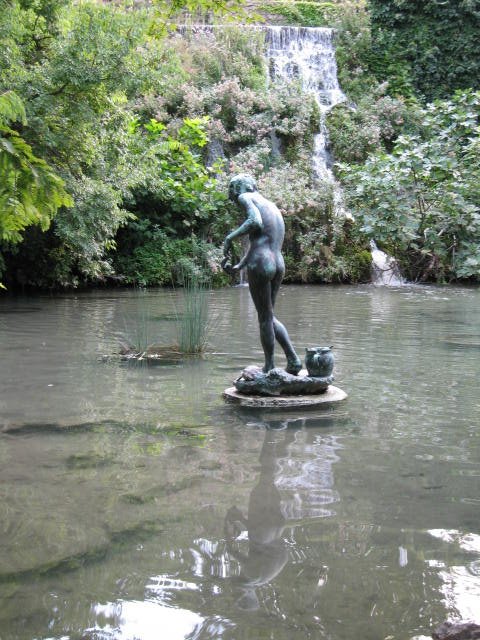
Since our check-in wasn’t until 2, we locked up our bags and went sight-seeing. We first stopped by Elizabeth Balint’s apartment (which she owns, but it’s not called a condo here), and met her mother. We then took a bus to Margrit Island – an island in the middle of the Danube between the Buda and the Pest sides of Budapest. It had a beautitul fountain and sculpture in a pond. We walked around the garden at the end, then took the bus – followed by the tram – to the Parliament building. The Mayor of Szentes had arranged for a special tour just for our group. It started at 2:45 p.m. which put us in the dome area during the guard tribute. Three guards, dressed in old-time uniforms, proceeded into the dome, saluted the crown/scepter/orb, stood guard for 15 minutes, then returned to their prior stations. This tribute happens every hour on the hour and we were fortunate to be able to witness it.

Following our tour of the Parliament building, we went to the most remarkable market. It was in a glass building and had all kinds of food vendors on the first floor (where we got paprika) and various shops on the top floor (where we bought tablecloths and hand-carved eggs). The place was packed with residents purchasing food and tourists purchasing goods. (I couldn’t help but think of Carty running around saying “this is what our Erie Street Market should be.”)

After dinner, we took a night cruise on the Danube and saw the buildings lit up at night – a remarkable sight, indeed!


This is the front entrance to Parliament. The middle main entrance is only used for visits from heads of state.


The accepted date of the founding of the nation of Hungary is 896 AD. There are, therefore, 96 steps leading from the main entrance to the main floor of the building.


One of the many figures on the columns in the lobby of the House of Lords - a peasant woman with her skirt filled with grapes. They were placed there to remind the Lords of the people they represent and on whose behalf they were making decisions.


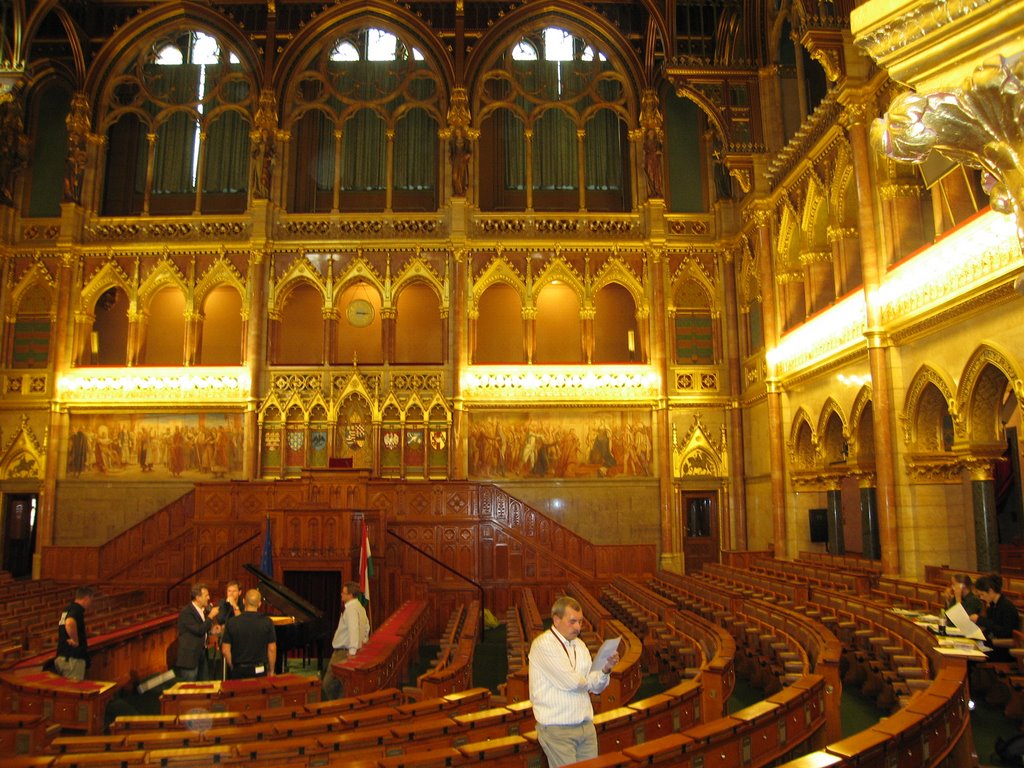
The House of Lords was eliminated in favor of a single, combined parliament. The chamber is now use for special events, speeches, etc. It was being set up for some type of piano concert during our visit.


Night photos of Budapest...


Monday, September 11, 2006

Last day of the official program

Today was a very busy day – perhaps the busiest in terms of number of people we met and in the amount of time spent on the official program.

We started the morning with the President of the Csongrad General Assembly. We talked about the expectations each county has for the sister-county relationship. Csongrad and Lucas are very similar. Both have a major city (Toledo and Szeged) with smaller suburban cities and villages. While Lucas has townships, Csongrad has the rural, undeveloped areas. All of Hungary is in a process of change as they more closely align with the policies of the European Union. A lot of time is being spent on developing priorities for how the country will spend their allotment (or grant) from the EU. The purpose of the monies is to bring the infrastructure and roads up-to-date…but every county and city is lobbying for their project over the others. And there is a lot of room for improvement in creating highways and installing sewer systems.

Like Lucas, Csongrad faces an unemployment rate that his higher than the country’s and the issue of how to more effectively market the products. They are concerned about bird flu, dioxins, ensuring the safety of the food products made/grown in the county or imported (due to their closeness to the border. Diabetes is a problem with a significant number of people and, while they have developed food products to address such issues, they have no willing investors to help manufacture them in sufficient quantities. Market demand for such products is also an issue. Just about every conversation with elected leaders ended up in a request for, or encouragement of, private investment in their country.

There are many positive things about the county as well, but like in any society, the problems seem to dominate the conversations. It gave me some comfort to find that Hungary is considering eliminating the county governments in favor of regional governments which would cover an area equal to about three counties. There is significant opposition to this from county government, but the larger cities believe it is a way for them to gain more influence within their regions as well as on a national level. The smaller communities are not very much in favor because they already feel dominated by the larger cities and believe that power and funding will flow to the larger cities to their detriment. Sounds a bit familiar….

We also met with the city of Szeged and had a short but very informative power point presentation on the city’s current attributes and planned developments. They are strategically located on the main route into Romania and they’d like to take better advantage of their location for warehousing and transportation industries. They are working on a small airport and on a technology park. They have a highly educated workforce because of the success of the University of Szeged, but many of the degrees are in areas where there is an abundance of graduates.

Interestingly, they have a publicly owned company which is run independently of the city government. This company has a contract with the city to do economic development and long term planning. Their goal with this company is to provide continuity to the community in terms of the strategic planning and to take advantage of the willing involvement of the education and business community. I think we could learn from this arrangement.

We then walked to the University of Szeged and had a presentation from the Vice Rector (equivalent to a vice president) and met with the dean and former dean of their pharmacy college. If I understood the translation properly, the University of Szeged has been ranked among the top 300 universities in the world for the last 4 years. I also learned that their pharmacy college and the College of Pharmacy at UT have agreed to the details of an international exchange and credit program. They expect to the sign the agreement in the near future. We also had a tour of the University’s new library/student center. It is open and spacious. There are computer terminals for about 400 students – and their study tables have room to seat 4-8 and include a computer.

Our next stop was a visit to a culinary and services school. The students range from 14-22 years, with the school serving as a high school and certification program. The kids learn service (wait duties), cooking (chef), baking (pastry chef), economics and management. We were treated to a delicious dinner prepared by the teaching staff and served by their most recent winner in an international competition. Their students are required to learn two languages in addition to Hungarian and their final examination, as well as the competitions, must be performed in a language other than Hungarian.

Our final stop was a musical concert at the Jewish synagogue as part of the synagogue’s festival (which is not a festival as we have them – rather, a month of activities coinciding with certain holy days in the Jewish calendar). The group was a cross between traditional Jewish music and – believe it or not – Dixieland jazz. There were terrific and the synagogue, at 103 years old, was beautiful.

Our delegation was also very appreciative of the kindess expressed as this was September 11th. All our hosts mentioned how shocked they were five years ago when they learned that terrorists had crashed planes into our buildings. Most of them knew people in America or had friends who knew people - and they expressed their sympathies at our losses as remember those who died on that date.

As I’m still having some problems with the internet here, I won’t be able to publish the photos. I’m hoping that I’ll be able to do so tomorrow when we arrive in Budapest. Thanks to the mayor of Szentes and the deputy mayor of Szeged, both of whom are members of Parliament, we’ve been allowed to visit Parliament tomorrow and observe their ‘discussion’ of the new prime minister’s first 100 days. They promised it would be interesting!

Sunday, September 10, 2006

Sunday in Szeged

Today was spent on a tour of the city of Szeged. We had two interpreters, Anna and Andrea who showed us the sights and told us some of the extensive history of the town. The evening was the official cultural program and we were hosted by the Vice President of the Csongrad General Assembly and the Vice Mayor of the City of Szeged, who is also a member of Parliament.

Unfortunately, the program was in Hungarian, so I do not have all the names of the performers nor the pieces they did. (I will provide it as soon as I get it translated.) The first group was traditional folk music and very unique. The trio did a tribute to the Hungarian composer Bartok. The second performance was a pianist playing Bartok. It was wonderful to compare the folk music tribute and then to hear Bartok on piano. Many of the keys played sounded just like the violin and guitar-like instrument when they are played. It was a wonderful way to introduce us to both the composer and the traditional folk music of Hungary. We also had poems and several opera selections. The cultural program was followed by a reception in the ‘marriage room’ of the city hall. This room is used for marriage ceremonies and it is decorated with paintings of couples and children.

I must mention the extraordinary gift to the citizens of Lucas County from Csongrad, presented by Mr. Attila Marosvari, Vice President of the Csongrad General Assembly. This year marks the 50th anniversary of the 1956 uprising against the communist government. Through historical research, they have learned that the uprising actually began in the City of Szeged the week before the actions in Budapest. Three individuals have documented the activities of the Szeged university students during that week in a series of photographs which have been made into posters. The posters will be unveiled as part of the nation’s celebration. The gift to us is a set of these posters with the request that we help them in their commemoration by displaying them during October. I agreed that we would find an appropriate way to display such a wonderful treasure and will also help them to celebrate the courage of the Hungarian people which gave inspiration to the world.

(Note: There seems to be some problems with blogger over here and I can't upload any photos. I will try to do so tomorrow.)

Saturday, September 09, 2006

Memorial Park and Festivals

Saturday – today was considered a ‘fun’ day with no official duties. We started early in the morning and traveled to Opusztaszer which is the home of the National Memorial Park – an expansive facility dedicated to the history and culture of Hungary. Both historical data and folklore indicate that this was the location where Chief Arpad brought the seven Hungarian tribes/clans together and decided to establish the country of Hungary.

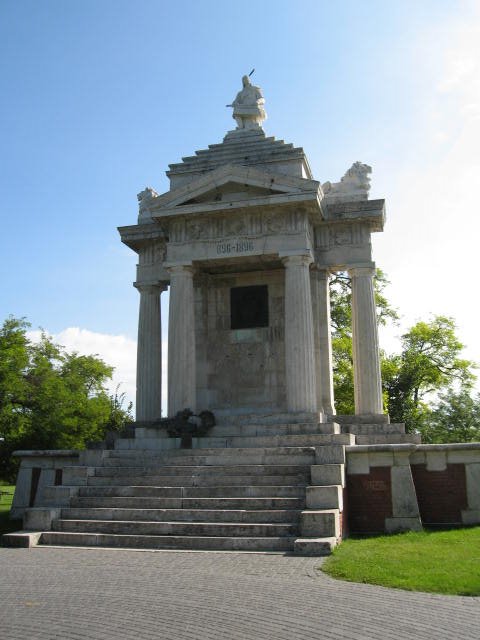
The memorial park has a monument which was built in 1896 to commemorate the 1000 year anniversary of the decision.

This monument has a statute of Arpad on top and is surrounded by 20 busts of various kings and leaders of the Hungarian people.


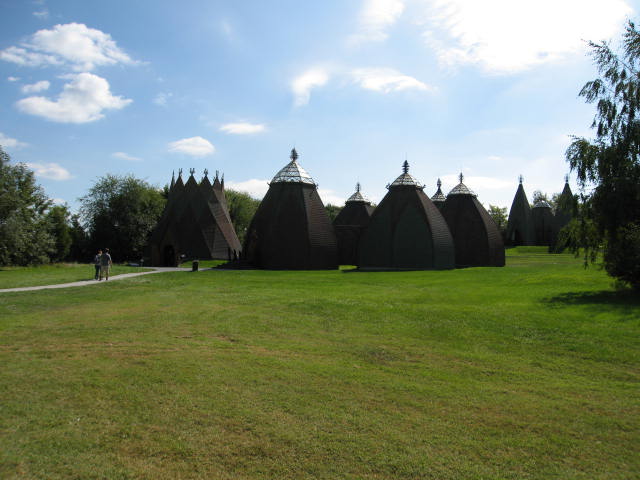
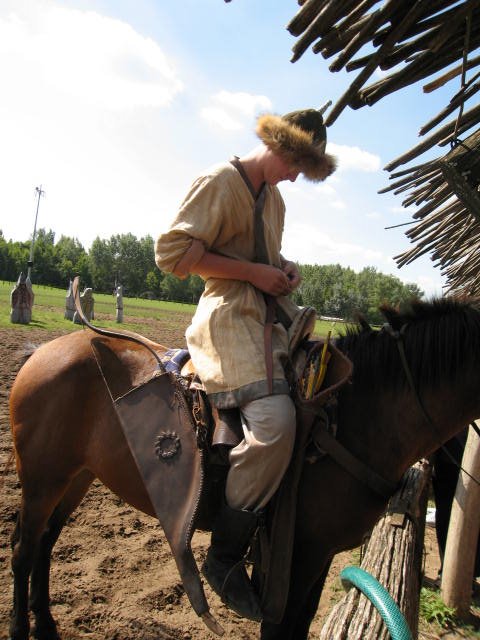
To the side are the ruins of an ancient monastery. There is an area with traditional yurtas recently built to house museum information. There is also an historical village (very similar to our Sauder Village) and each house was donated by a city or village within Csongrad County. They also host a horse show where actors, wearing historical costumes demonstrate shooting arrows from horseback, lance throwing and games designed to improve horsemanship.


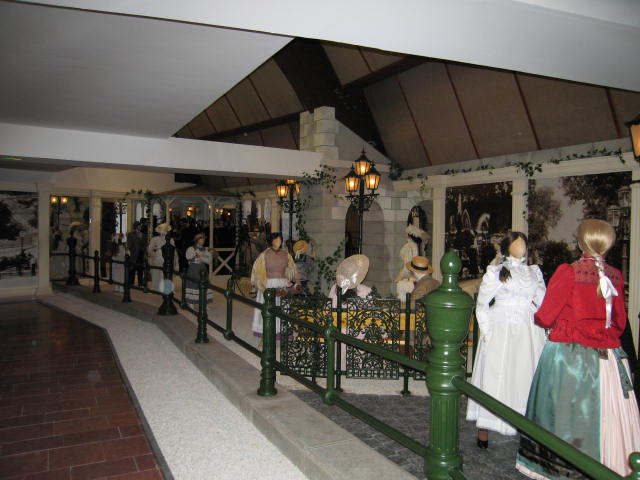
Inside the rotunda building is a cyclorama – a circular painting depicting Chief Arpad’s victory over the local people and the conquering of the land which became Hungary. This was extremely unique (one of only about 20 such paintings in the world) but no pictures were allowed. Also inside the rotunda are two street recreations from about 100 years ago – one a small village street (also known as a peasant village) and one a larger city. The costumes are amazing – with the peasant village having more of the traditional costumes we’re used to seeing at the Birmingham festival and the city street having costumes more like what you’d see in any large English city.

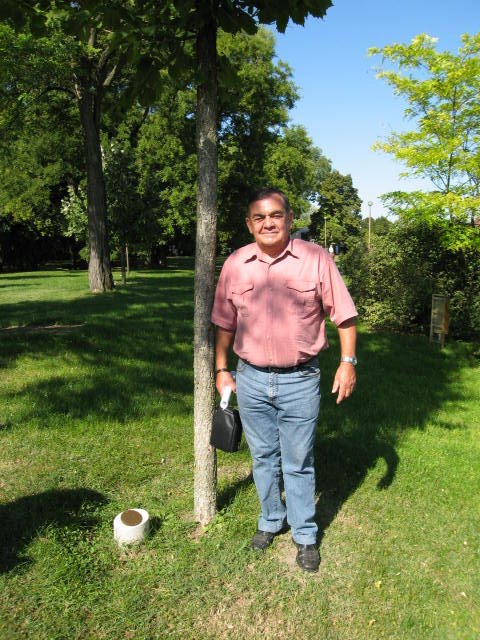
We were especially honored to have Mr. Jozsef Ott, vice president of the Csongrad General Assembly, join us for our tour. Mr. Ott was part of the delegation to Lucas County in May and is a board member at the Memorial Park. There is even a tree planted in his honor at the park in recognition of his many years of public service to the park and in elective office.

Mr. Ott treated us to lunch at a restaurant near the park. Our lunch was a pork rib soup with small pasta-like noodles and carrots and then the main dish of a ham cooked inside bread served with sauerkraut and vinegared potatoes. There was a also a dessert – similar to a cheesecake, but with the consistency of ricotta cheese and a slight hint of lemon. Very good, but the helpings are so generous as to be enough for two. This meal was served family style and the presentation was impressive.

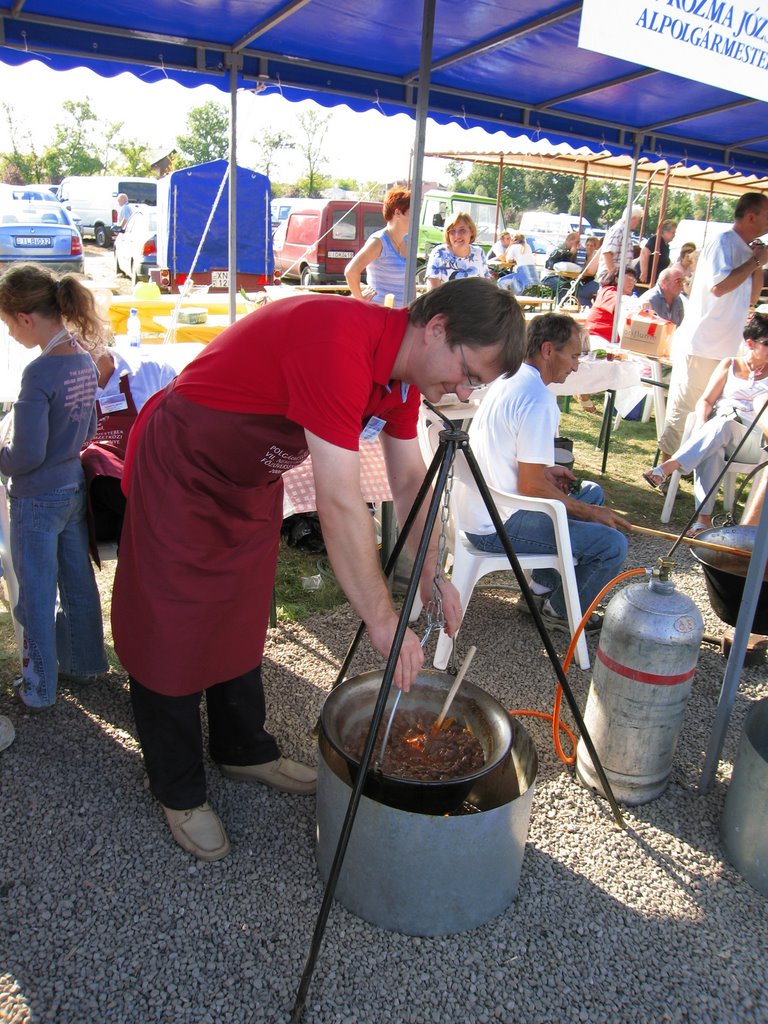
Following lunch and a short stop at the hotel for more batteries and memory cards for our cameras, we proceeded to the village of Deszk for their annual village festival. The highlight of their event is a cooking contest between the mayors of various villages and cities, including their international sister cities. (Photo is Dr. Jozsef, Vice Mayor of the City of Szeged.) Festival goers are provided bowls and forks and can sample the various entries. Several civic groups also compete and this year’s winner was the local Serbian club. The village of Deszk has a large population of Serbs who originally came looking for work, but stayed. Their children’s dance group, which recently won an award for folk preservation also performed with many other traditional and modern dancers and singers as part of the cultural program. Fireworks finish off the evening but our delegation was tired and left before the fireworks began.

Tomorrow is sightseeing in the City of Szeged with the cultural program and formal presentation of gifts and recognition of our sponsors and facilitators.

Friday, September 08, 2006

Mako Onion Festival

Today, Friday, we attended the Mako Onion Festival. It started early in the morning with a presentation of the flags and a procession (parade). We participated in the procession and then the opening ceremonies. This was followed by the official measurement of the longest braid of garlic in the world. They believe that they qualified for the Guiness World Record. These activities took place in the beautiful town center. Mako just recently won an international bronze medal for the quality of their floral decorations around the town.

We drove by car to the festival grounds where the formal welcome to festival-goers and presentation of awards took place. The Hungarian Minister of Agriculture was present to help with the official welcomes. Mako’s primary products are onions and garlic. They grow an excellent product but do not market it well. Since Hungary’s now a part of the EU, they are beginning to develop marketing plans for selling their onions and garlic throughout Europe. This was part of the Minister’s opening remarks.

We had some time to walk through the festival grounds. For a comparison, it was about the same size as the Birmingham Festival in terms of displays and number of booths. I bought a bottle of Hungarian wine, sampled plum and pumpkin jam, bought some homemade candy for my niece and nephew and saw demonstrations of zithers, gingerbread decorations and lace making/embroidery.

It was then time for lunch. They cook, in a big cauldron over an open wood fire, goulyash – a stew with meat, potatoes, carrots, onions and a small dumpling…and lots of paprika. It’s ladled into large bowls which are then placed evenly along pre-set picnic tables. The tables have water, beer and plastic cups, spoons and a very large bread roll wrapped in a napkin and placed in the individual bowl. You go in the tent, sit down and help yourself to the stew. Refills are plentiful and for dessert there was an apple square whose filling was similar to an apple pie.

Tomorrow we attend another festival in a smaller village – this is where various mayors have a cooking competition. Seems like a lot of what we do centers around food – imagine that!

Here are photos from the Onion Festival – enjoy!

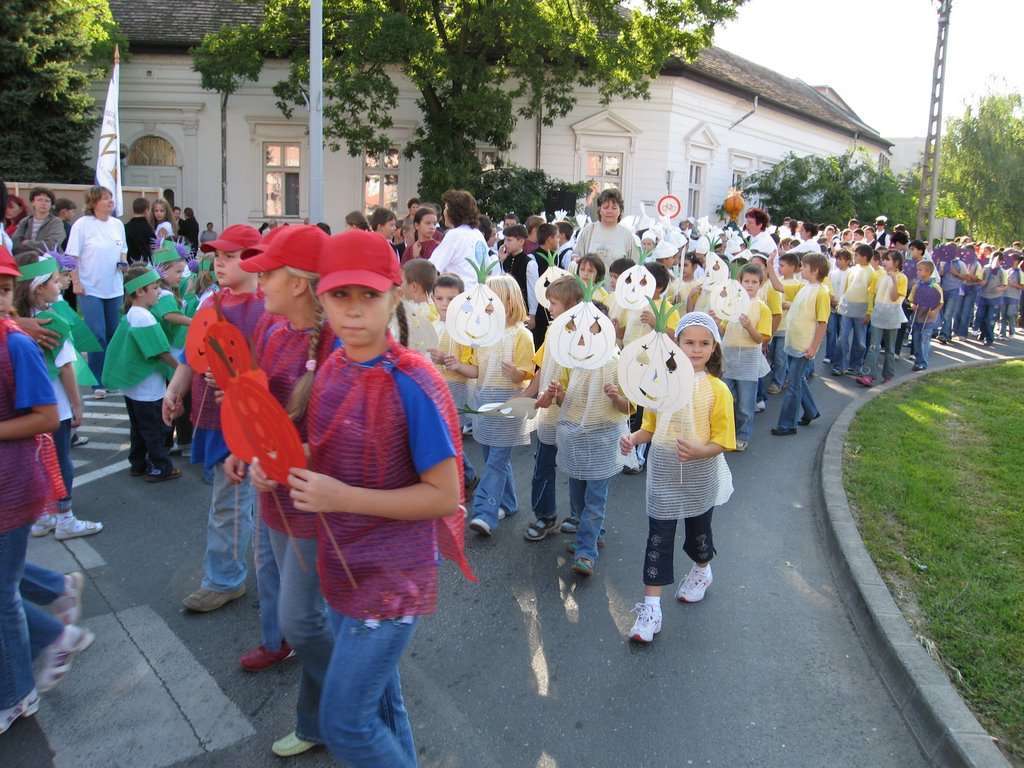
Kindergarteners getting ready for the festival. This class had pumpkins as its theme. The children to the left in green with a purple pincushion on their hats were chives.


The Mayor of Mako with the 'children's mayor' at the start of the procession. The young lady holds a position equivalent to our president of student council in her school. The marching band is behind them.


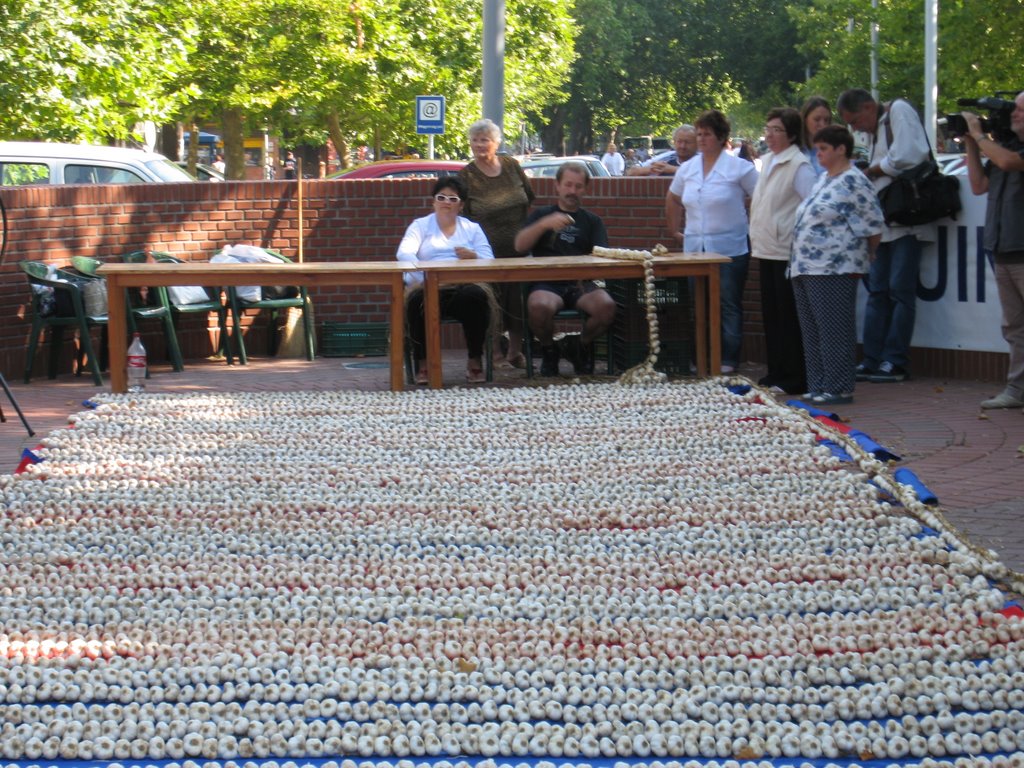
The gentleman sitting on the right side is braiding the garlic cloves. Streaming down the front of the table and along the ground in front of him is the garlic braid. I believe the total length was around 250 meters.


The cauldron where the stew was cooked and the chef with the empty cauldron following lunch.


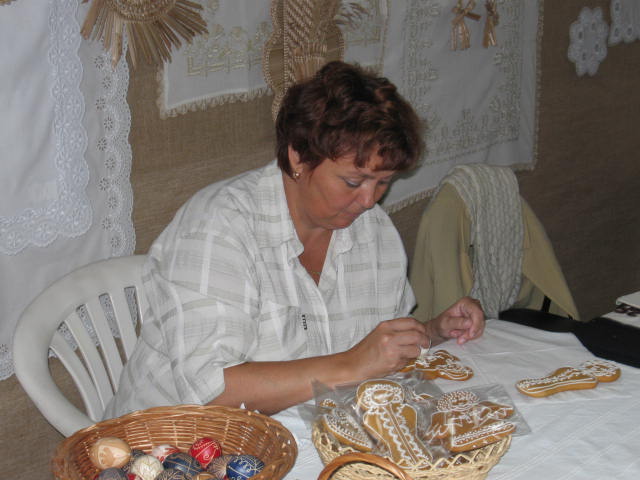
An artist decorating gingerbread. She also did etched eggs and carved eggs. You can see samples of lace and embroidery on the wall behind her.


Musicians playing their hand-carved zithers. Behind them are rugs and pillows, also done by hand.


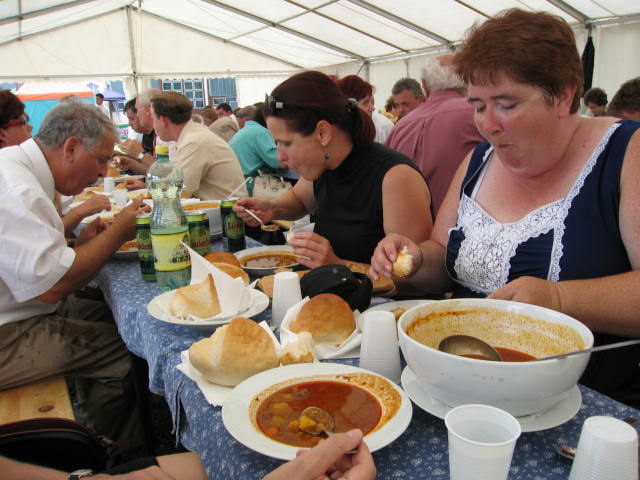
Lunch! You can see how large the bread is and the wonderful color from the paprika in the stew!

Thursday, September 07, 2006

Arrival in Hungary

As promised, I have my first post from Hungary. My flights - across to Amsterdam and then to Budapest - were very smooth and uneventful. We were actually early to arrive in Amsterdam, but late to arrive in Budapest....and no problems with the luggage (as long as you don't mind paying $25 for any bag over 50 pounds).

My flight left in the evening and arrived around 11 a.m. Amsterdam time. They say that flying East at night is the best thing, but I didn't get any sleep during either flight and was very tired with a headache upon arrival. Arpad Varga, who'd just spent two weeks in Toledo, met me at the airport for the 2 hour drive to Szeged.

Driving in Hungary is much different than in the States. Their speed limits are right around 100 mph, which seems a bit reckless to someone used to going around 65 mph on the highways...But the Csongrad General Assembly has three drivers on staff who do nothing but drive for members and guests of the Assembly, so I was in very good hands.

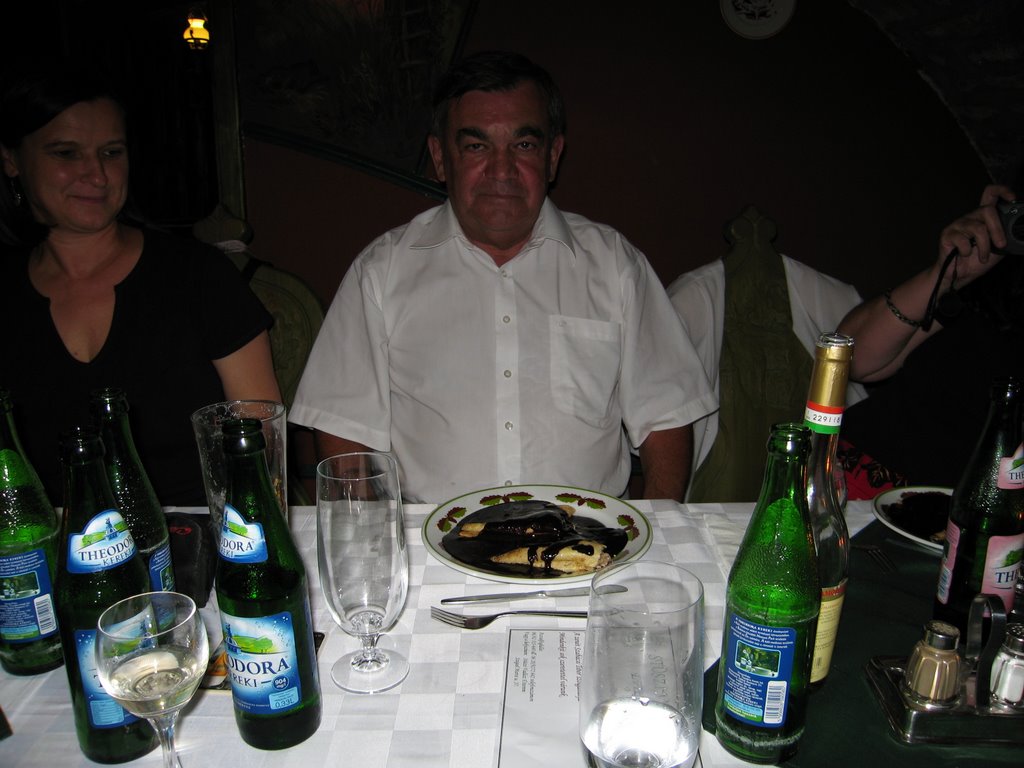
Our hotel is small, from US standards, but very nice. All our rooms are on the 8th floor (which is the top floor) and they face the Tisza river and the rising sun. The rooms are spacious and bright. Our dinner the first night was at a local restaurant which specializes in wild game. I had leg of wild boar with mushrooms, livers, onions and something else that was sweet in a sauce. It was served with a type of potato like a round, flattened tater-tot. It was delicious! This photo is of Mr. Jozsef Ott, the vice president of the Csongrad General Assembly. His recommendation was the crepe-like dessert with chestnut filling and chocolate sauce set aflame. Not sure if you'll be able to see the flames in the photo - but it was as impressive as it was good.

Thursday morning, we visited the town of Szentes (pronounced "sin-tesh") and met with the Mayor, Imre Szirbik. Mayor Szirbik is also a member of the Csongrad General Assembly and a member of the Hungarian Parliament. They have no rules or laws about people holding multiple elected offices - and to do so is quite common. We had a very interesting discussion about their geothermal heating in over 4,000 homes/apartments. Szentes is known for its hot springs and theraputic spas. Part of our tour of the city included their park with pools, water slides, competition pools (for water polo and swimming) and their spa (very warm water that is cooled for soaking). Several people were in the spa, including two who were playing chess on a floating table.

This photo is our group with the Mayor and members of the Szentes city council. We are standing in front of the refurbished building which used to house the Csongrad county assembly before the county seat was moved to Szeged.

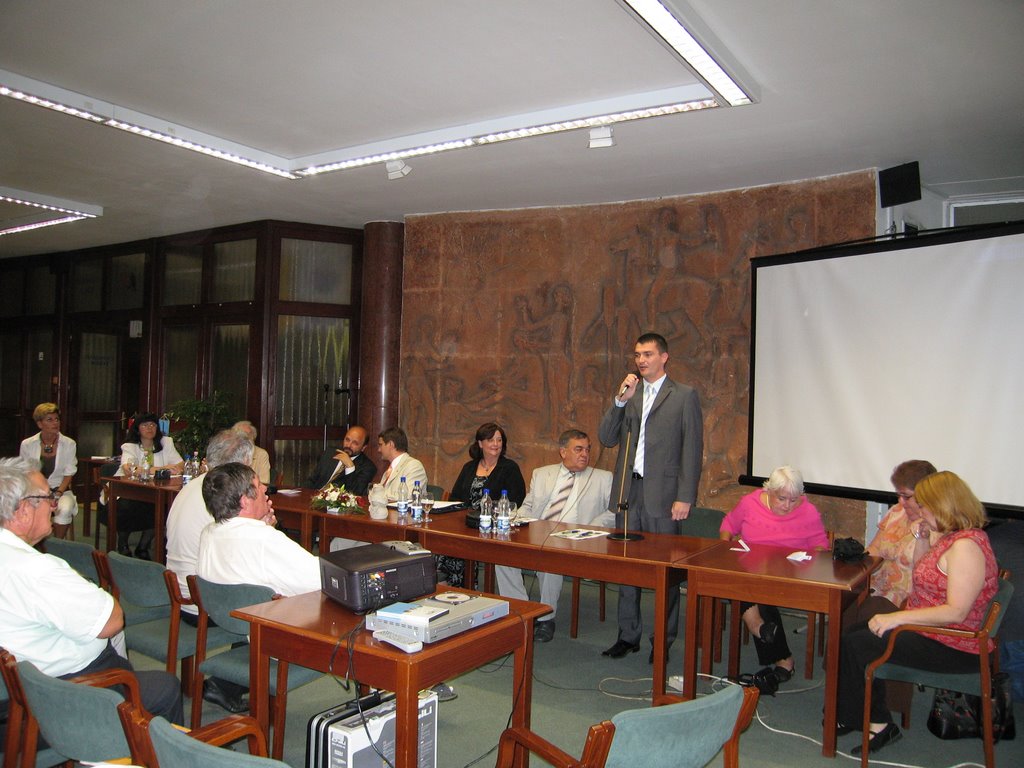
Our last event was a panel discussion held in the meeting room of the Csongrad General Assembly. It was called the "Cafe of Public Matters," and included representatives of the Csongrad General Assembly, the Szeged City Council and members of the Szeged/Toledo and Lucas County Friends Club. Many of the individuals who've visited Toledo and our area (including students and performers) were in attendance to talk about their time and their appreciation of the relationships with us. While Csongrad has many sister counties, they are especially proud of their agreement with Lucas and with the enthusiasm and support our citizens show for them and the exchanges and programs. Students from Szeged can even attend the University of Toledo without paying international fees - they are treated as if they are residents of Toledo. Csongrad officials often say that they're not supposed to have favorites when it comes to their sister counties, but they do - and it's Lucas!


Arpad Varga was the moderator for this event which included Mr. Jozsef Ott and Mr. Karoly Toth, a member of the Szeged City Council. Ms. Edina Szollosy, an assistant professor in the English Studies Department of the University of Szeged, was our interpreter. Her daughter is currently an exchange student in Toledo.

The panel discussion was followed by a pot-luck reception with wonderful food...terrific breads and biscuits, sweets and a unique pasta and pickle salad. (Two items I would never think to put together but which tasted so wonderful that I'm getting the recipe!)

Tomorrow is the Mako Onion Festival where we'll be participating in the opening ceremonies and manning a Toledo, Lucas County, Ohio booth. Hungary is 6 hours ahead of Toledo, so I'll bid you all good night!

Sunday, September 03, 2006

Off to Hungary

For the past two weeks, we've had a visitor from our sister-county of Csongrad, Hungary, here in Lucas County. Mr. Arpad Varga is a member of the Csongrad General Assembly, which is the counter-part to our board of county commissioners, and he was here in May for the official visit commemorating our 10-year anniversay of the Csongrad-Lucas sister county agreement.

Arpad arrived August 19th, but his luggage was 4 days late. During his visit, which was part business and part vacation, he spent time learning about our plan commission, attending both a BCC and plan commission meeting, visiting the Sylvania Senior Center, meeting with hospital representatives about transparency in billing and customer service, and getting a demonstration of the electronic voting machines along with a tour of the Board of Elections.

He also went on a sailboat race, enjoyed a traditional back-yard bar-b-que with homemade apple pie and was a featured guest at the Birmingham Festival.

On Tuesday, I will travel to Csongrad to participate in several events as part of the 10-year commemoration of our sister county agreement. I will visit Arpad's home town of Szentes, attend the Mako Onion Festival and host our County booth at their fair. I will participate in several other cultural events and activities, including two panel discussions.

I'll be posting updates on my visit (as well as photos) here and on the county website. I hope that you will follow along!

Monday, August 28, 2006

Freshman Mindset

Beloit College creates a list each year to help us realize what the incoming class of freshmen has as their mindset. It's interesting to realize that this group of freshmen, class of 2010, has grown up with no Soviet Union, one Germany and bar codes on just about everthing.

The Class of 2010 "...grew up with a mouse in one hand and a computer screen as part of their worldview. They learned to surf the internet as they learned to read."

From their website:

"...this year’s entering students form “a generation that has always been ‘connected’ and is used to things happening in ‘real time,’ like live satellite coverage of revolutions and wars, instant messaging and movies on demand. They expect solutions for every problem, from baldness to diseased organs. To the chagrin of teachers and parents, they’ve developed their own generational means of communication.”

The Beloit College Mindset List is used by educators and clergy and by the military and business in their efforts to connect with the new generation. Beloit creates the list to share with its faculty in anticipation of the first-year seminars and orientation.

"It is meant to be thought-provoking and fun, yet accurate. It often provides the base for good opening seminar discussions as faculty and students address the challenges of examining important issues from differing perspectives."

For the complete list, click here. And many thanks to Beloit’s Keefer Professor of the Humanities Tom McBride and Public Affairs Director Ron Nief, who created the list.

Monday, August 21, 2006

Questions on the arena financing plan

I've been asked to list the details of my questions regarding the financing proposal for the new arena. I covered these points when I was guest-hosting on WSPD, but since they don't make their shows available for download, I'll document them here. I'll apologize in advance for such a long post.

First, let me reiterate that I'm in favor of a new arena. I'm one of the few, if not the only, elected officials who's actually purchased season tickets. I realize that many people still want the arena on the east side, but to me, the location is less important than the fiscal plan. I don't mind the proposed location because of the ability to take advantage of some savings by linking it to the convention center.

I have no problem with the available parking estimates, even though I think people are less willing to walk during the winter than they are during the summer, so that needs to be considered. I'm even somewhat okay with the size. Some will say it needs to be larger, optimistically taking the position that if we build it, they will come. Some will say that the market survey included with the report doesn't support an 8,000-seat arena for the major tenant, so much of the space will be wasted. Considering the strong opinions on both sides, it appears that the proposed size will work for the recommended space.

I'm still researching the proposed governance structure, although I would be against the suggestion that the County Commissioners purchase a franchise.

The major concerns I have are about the financials. They say that the devil is in the details and that's certainly true of the plan that we've received. Primarily, the only private money that is being proposed for the construction is in the naming rights. The revenue from suite sales and premium seats is included as part of the yearly operating budget. The plan does not suggest that a franchise or team put any of their own money into the construction of the arena. My opinion is that the private funds should be the first in and be the majority of the money used to build and then operate any arena. The financing plan we've been given suggests only 17% private funding and 83% public - and that's a problem.

The arena is estimated to cost between $79 -84 million, so the figure used throughout the report is $81,850,000. Page 30 of the Action Plan states:

"The preliminary estimate for construction costs for the Superior site, including both hard and soft costs, is estimated at $86,561,981 for the 9,000-seat option, and $81,802,970 for the smaller, 8,000-seat option. If efficiencies can be achieved through the combined use of the heating and cooling capacity of SeaGate and if the arena relied upon SeaGate's food preparation facilities, the cost might be reduced to an estimated $84,611,981 for the 9,000-seat option and $79,967,970 for the 8,000-seat option."

The sources of revenue are listed below and then each is analyzed:

* $42,500,000 from an increase in the hotel/motel tax - assumes 1) tax is increased 2 percentage points, 2) City of Toledo and other municipalities contribute their share of the tax revenue, 3) enabling legislation is passed by the state, 4) bonds have a term of 30 years.

* $1,200,000 savings from retiring the current SeaGate center bonds

*$12,250,000 from the Ohio Cultural Facilities Commission (estimated at 15% of the development costs)

* $14,000,000 naming rights for the new arena and the SeaGate Convention Center.

* $2,000,000 Federal transportation grant for TARTA, similar to the one received for 5/3 Field.

* $9,900,000 Revenue bonds...County-backed bonds guaranteed by the estimated yearly income of $702,000 from the operations of the arena.

Of these, the TARTA grant and the savings on the SeaGate Center bonds are probably achievable.

So let's look at each of the other revenue sources...first, the Hotel/Motel tax.

Revenue from an additional 2 percentage points on the lodging tax is estimated to produce $43,700,000, of which $42,500,000 is counted as revenue for the arena. The current lodging tax in Lucas County is 8%, with 2% being dedicated to support of the Convention and Visitors Bureau for promotion of the area. Of the remaining 6%, most of what is collected goes to the County to pay off the SeaGate bonds. Municipal jurisdictions can impose 3% of the 6% and collect that themselves. Currently, Toledo, Oregon and Sylvania impose their 3% and dedicate that to the County. The City of Maumee, the Village of Holland and Springfield Township impose their 3% and keep it. The proposal for revenue assumes that these municipalities will begin to "contribute" their lodging tax for the arena.

The 2 percentage point increase (which is a 25% increase) would also require a change in the state law. While Columbus often takes the position of supporting 'permissive' taxation, any organized opposition by the Hotel/Motel industry would be a significant problem, especially in an election year.

But the biggest problems will be the opposition from local hotel/motel owners - and for good reason. Taxes on rooms include the lodging tax AND the sales tax. Total tax rate in Lucas County right now is 14.75%. Increasing this 2 percentage points will mean that our overall tax rate will be 16.75% which puts us FOURTH HIGHEST in the country. (I mistakenly said sixth highest on the radio.) Cincinnati is at 17.5%, Houston is at 17%, Kansas City MO is at 16.99% and Columbus/San Antonio/Toledo would be tied at 16.75%.

More importantly, Perrysburg is only at 9.5% total. So our nearest competition is only about 10 minutes from downtown and you could save 7.25% on every night's stay by NOT staying inside Lucas County. And any subsequent development would be more likely to take place next to where people are staying...meaning that we'd be more likely to have people commute into the arena and then leave.

I don't know that Lucas County can afford to increase our taxes (especially ones paid by visitors) and not have any negative consequences of doing so. As one person at the Community Voices forum said, "The last impression our visitors will have is of the third highest tax in the country - not good." So even if Lucas County does increase the lodging tax, we need to balance the projected increases from the increased tax against the estimated reduction in room rentals likely to occur from an increased price.

And the whole purpose of a lodging tax is to help put "heads in beds." I've not seen anything in the report to indicate that such a tax will actually put more "heads in beds."

State support is estimated at $12,250,000 which is 15% of the project costs. This money would come from the state's capital budget through the Ohio Cultural Facilities Commission. In the past, this commission has provided support for sports facilities, along with other projects. Their website shows they have supported such facilities at between 8-13% of the project costs. The arena already has $5.5 million from previous state budgets committed to the project. But I do not think it is realistic to expect 15%, especially with the other projects that are requested within Lucas County.

However, even if we could get 15%, the 15% ONLY applies to the project LESS PROPERTY ACQUISITION. The cost of acquiring the property is estimated at $7,750,000. Subtracting that from the total cost of $81,850,000 gives us a project cost of $74,100,000. This means that 15% from the state would only be $11,115,000 or $1,135,000 short of the estimated revenue.

Naming rights presents another challenge. According to namingrightsonline.com, getting $14 million for our new arena - even if combined with naming rights for the convention center - would put us third highest in the country. While I'd LOVE to have someone walk in and plop down a check for $14 million to name the arena, prudence tells us that such a company would do their research and know what naming rights are going for and make an appropriate offer.

And that leaves us with revenue bonds. The revenue bonds are county-backed bonds that are paid for from operating income - profit - from the arena. Part of the revenue includes $293,000 in parking income. However, the report does not identify WHERE the parking income comes from. There is nothing in the report to indicate that parking spots are going to be built as part of the arena. So this means that current owners of lots would be expected to share their profits with the arena. One of my colleagues phrased this as "giving back" to the arena, although I'm not sure what the parking lots owners would be 'returning'....

So the first challenge would be getting an agreement with parking lot owners to turn over a portion of their profits to the arena. Absent such an agreement, the potential profit would be reduced by $293,000.

The total profit for the arena is estimated at $702,000 (which is the lower number in the two scenarios in the report) which would support bonds of $9.9 million. However, from this gross profit amount, the consultants recommend that $188,000 be set aside for capital reserve funding. This is prudent and I support it, but it leaves a net profit of only $514,000. If we use the actual profit, we'd only be able to support bonds of $6,853,000. This means that there is currently a gap of $3,047,000 million in bonding ability. And if you exclude the revenue from the parking spots, you reduce the net profit to $221,000 which can only support $2,950,000 in bonds - a gap of almost $7 million.

Further, you'd have to leave some room for not achieving your revenue projections - or for having some expenses exceed your budget. So no matter what the projected profits are, you could not rely upon having ALL of those profits available to finance bonds.

The problem with not having solid numbers for the revenue bonds is that the County (meaning you and me) would be on the hook for meeting any shortfall between actual revenue and the debt payments for the bonds that do get issued.

These are my concerns about the financial plan that has been presented. There are other concerns as well - such as:

* should we go forward with site acquisition without having a signed tenant?
* should we be putting more focus on private funding versus public funding?
* should we go forward with any other part of the plan prior to having the state law changed to allow us to collect the additional hotel/motel tax (which counts for over half the funding)?
* if this project makes financial sense, should this be the major priority of the county, or should we be focusing more on such capital items as a new/renovated jail or shovel-ready properties for development?

I don't raise these questions to stop the project or, as I'm often accused, of trying to delay or be an 'obstructionist.' I raise these questions because 1) no one else seems willing to and 2) because they need to be answered!

There are serious financial risks and the only way that we can face such risks is to first know what they are. We, as a community, may decide that these are risks we're willing to take, but we cannot make an informed decision if we negate them or refuse to face them. And I don't abide by that old "trust me - we'll take care of the details later" approach.

I again encourage you to read the report and then participate in the public hearings that will be scheduled.

Sunday, August 13, 2006

Letter to Russ Lemmon

Russ Lemmon is usually pretty good about covering letters and emails he gets. But just in case there's a space issue, I wanted to post my response to his column in today's paper:

Russ - Just for the record, I'm not opposed to an arena. As a long-time Storm fan, I'd LOVE for them to have a new home. But I am also not in favor of what I've seen, so far, in terms of a fiscal plan for a new arena. The two questions I have consistently asked are: 1) Is this a sound fiscal decision that won't end up being a drain on the taxpayers of Lucas County and 2) if so, where should this fit in our priorities of major projects?

The title of your column, "Questions surround arena plan," is very appropriate - the report raises more questions than it answers. However, it seems that I'm the only one willing to ask the tough questions about the financial stability of the project. This 'new' plan is a re-arrangement of the old ones with a new price tag and a new site analysis. It presents an extremely optimistic picture, but doesn't support that optimism with realistic facts and figures.

Rather than criticize me for failing to be optimistic, why are you not criticizing Commissioners Gerken and Wozniak and Mayor Finkbeiner for failing to be realistic with public dollars? Unlike my collegues, my concerns are not personal nor political - they're financial!

If this project is truly going to be the 'slam-dunk' success that everyone claims, why do Pete Gerken and Tom Chema fear my questions and exclude me from conversations and input? If all is truly well, then such questions, honestly answered, should do nothing but strengthen the perception that this is a good project worthy of public dollars.

You wrote, "When "credit" for the arena is dispersed, she won't deserve any..."

I don't make decisions with other people's money just so I can take credit for them. But if my concerns about the financials prove valid, then assigning blame or credit will be the least of our worries, as the taxpayers will be footing the bills - yet again.

Maggie Thurber
County Commissioner

Friday, August 11, 2006

Weapons versus People

Quick thought:

Considering that we're now banning all liquids and gels from carry-on baggage, I had to wonder. We're focusing on preventing anything that might be used to create a bomb - and it's easier to just eliminate all liquids and gels than it is to check every one of the items to ensure that they are what they're supposed to be.

But then I remembered a criticism that I once heard ... that America is going about security wrong - we're looking for weapons - not people.

(cross posted at Moderate Toledo)

Thursday, August 10, 2006

School Funding

Thanks to RightAngleBlog, I came across this website which gives all kinds of great information on our school funding.

Interestingly, when you compare per pupil operating revenue among the various Lucas County school districts, you'll see that most schools between 1990 and 2005 got between $1,000 and $3,000 per pupil in state funding and that their local funds far exceeded the state amount.

EXCEPT Toledo Public Schools...

TPS has gotten operating revenue between $3,000 and $5,000 per pupil from the state (higher than the other districts) and our local funds have been between $2,000 and $3,000 (but not reaching $3,000) per pupil.

Lots of interesting conclusions can be drawn from these charts...have fun!

Wednesday, August 09, 2006

Arena Action Plan

The Arena Action Plan is available on the county website. To go directly to the plan, click here. To go directly to the exhibits, which provide all the detailed support for the plan, click here.

As bloggers are so good at analysis, I'm very interested in your perspectives!

Another stint behind the microphone

Well, my first experience behind the "News Talk 1370 WSPD" microphone was a lot of fun - and it must have been okay, because they've invited me back to guest host for Brian Wilson in the 3-6 p.m. time slot.

I'll be doing the show on August 14th and 16th. The topic for the 14th is the minimum wage, with guest Alan Reynolds, economist and a senior fellow at the Cato Institute. The topic on the 16th is the arena and the report being released today (unless you're The Blade who got the report yesterday...a day before the commissioners). My goal is to put the entire report on a website for viewing by all, so you'll have the information necessary to have informed opinions. I'll post here, on Toledo Talk and on Moderate Toledo when it's available.

I should emphasize that these are the planned topics and they could change depending upon any breaking news.

Hope y'all will tune in and call in!

Friday, August 04, 2006

Three Unrelated Thoughts...

1. My Aunt often sends me inspirational readings and other quotes...today's was a bit different. It's a quote from England's Prime Minister Tony Blair. When asked by one of his Parliament members why he believes so much in America, he said: "A simple way to take measure of a country is to look at how many want in... and how many want out."

2. The SOB Alliance has quite a buzz going on about Ted Strickland. It appears that the tax forms he recently released show a residence in Columbus - nothing wrong with that. However, if his residence is in Columbus, then his voter registration needs to be Columbus as well. If he voted in a place other than the location of his permanent residence, this would be against Ohio law. So the burning question is: did he vote in Columbiana County in the May primary?

This is very easy to determine - simply check the voter registration at the Columbiana BOE. Personally, I'd have checked that BEFORE making such a big deal out of the issue.

3. The Toledo Artists Club is having a rather unique fundraiser this November. They've invited local "celebrities" to paint a picture, they'll hold a preview in a local gallery and then auction them off in November. I was honored to be one of the "celebrities" even though I have no artistic ability whatsoever. But their idea is to focus on the 'artist in all of us' and they paired us with a REAL artist to do the print.

I painted yesterday, with significant help from Diane Trabbic who is truly gifted. We painted with acrylic and water in a really unique way. I don't want to give away all the goodies on this, and I'll cover it more as we get closer to the unveiling and the auction. But, I had a terrific time and was truly awed that I produced what I did. Now I have to name it...stay tuned!

Wednesday, August 02, 2006

Lucas County spending

The Buckeye Institute recently added a "spend-o-meter" which tracks state spending. For this fiscal year, the state will spend $822.97 each second.

Which made me wonder about Lucas County's spending. While it certainly isn't as large at the state's, it's not insignificant. Our general fund budget for 2006 is $139,063,266. This works out to:

  • $ 380,995.25 per day
  • $ 15,874.80 per hour
  • $ 264.58 per minute
  • $ 4.41 per second

And that's just the general fund. I didn't have the heart to add up all the other funds to get the total county spending. But I will if anyone wants that information.

Sometimes, ignorance is bliss....

Wednesday, July 26, 2006

Is commercial fishing heading to the bottom?

In Tuesday's Gongwer's news service, there was a blurb about a bill introduced by Sen. Bob Spada (R-North Royalton) to appropriate $4 million from the state's general revenue fund to buy out all the remaining commercial fishing licenses in Ohio. His bill is a companion to the bill Rep. Jim McGregor (R-Gahanna) introduced in June.

According to Gongwer's, these bills are a result of an investigation by the ODNR Division of Wildlife Enforcement into fishermen who failed to properly report their catches of yellow perch. Several convictions have already been handed down and there are five more cases pending. The unreported amount stands at 40 tons.
This is the latest in the sqabble between commercial fishermen and charter fishing boat operators. The ODNR denies taking sides in the conflict. Obviously, the commercial fishermen are opposed to the bill, saying it will costs jobs and create a monopoly on perch for Canada. Additionally, a petition from the Ohio Fish Producers Association says that the measures will mean bankruptcy for some license holders.

Gongwer's reports:

"Sen. Spada said the recent convictions of several commercial fishermen convinced him of the need for the legislation.

"Based on the court cases, I believe they've been lying, cheating, and stealing fish from the residents of Ohio for profit," he said. "This is a classic case of underreporting income," the former Internal Revenue Service agent added.

Sen. Spada said he researched the issue thoroughly before sponsoring the bill and came to the conclusion that the penalties were too insignificant and the problem was too extensive for other options. "It costs us a lot more to regulate these commercial fishermen than we get in fees from them."

Buying out the commercial fishing industry would also be benefit the travel and tourism industries in Ohio, Sen. Spada added."


When I read this I was astounded. If commercial fishermen have not reported catches properly, then they should be punished. But to eliminate commercial fishing simply because some of the fishermen did something wrong seems a bit of overkill. By the logic of this argument, whenever there is an act of embezzlement in a bank we'd have to eliminate the banking industry.

And the sponsors of these bills are Republicans. I fail to see how the Republican philosophy of "less government interference" is reflected in these actions. Besides, if it costs more to regulate this industry than the government gets in fees, perhaps Sen. Spada should look at REDUCING regulation rather than eliminating a whole industry from our state, especially at a time when Ohio is hurting for jobs.

Tuesday, July 25, 2006

Lucas County Fair

It's FAIR time!

The Lucas County Fair opened last night with a parade and the crowning of the fair King and Queen.

To be honest, I'd not attended a fair before I became a commissioner...it always seemed to conflict with our family vacation to Put-In-Bay for a sailboat regatta. But it's one of the things that I've come to truly love about being a commissioner.

I'm constantly impressed by the kids in the 4-H and FFA Clubs. They're intelligent and polite; they know how to meet adults and hold conversations with them; they're talented and knowledgable about their crafts and animals. Basically, when people say they're afraid for our future because of our kids (and every generation does this), I think of the great kids I meet at the Fair and know that we'll be in good hands.

Most people go to the Fair for the rides and the entertainment - and this year promises to be a fun time as well. But when you go, make sure you walk through the barn areas and see the animals and horticulture displays, too. Take some time to ask the kids about their projects or see them "flip a turkey," ride the horses or show the dogs they've trained. After all, this is where city and country meet!

For a complete schedule, click here. Also - today (Tuesday) is FREE!

Tuesday, July 18, 2006

on being a talk show host...

Well, my guest hosting on WSPD for three hours was fun, but a lot of work. Don't get me wrong - I'm sure there are more strenuous jobs out there. But it's not as easy as you would think just listening every day.

Between watching one screen on the left for callers and one screen on the right for the time and breaks (you'd think they'd be able to combine the two), and having one sheet with the schedule and another with the cue lines (and yes - I messed up on those a couple of times), along with all your notes for discussion or topic AND making sure to keep your mouth facing the the mike.....Well, let's just say that you juggle.

Some of the things that didn't flow well are simply a matter of experience. People who want to do this for a living have probably had the lessons and market research in branding and consistency. I know that the tag line is "news talk 1370 WSPD," but remembering that I had to say it before they could go to the news was something else entirely. Likewise the time...I don't think that I did the time right more than once. It's not just "it's 3:15," it's supposed to be "it's 3:15, 15 minutes after 3." Now WHY it's this way I still don't get, but I understand that the market research says this is the best way to do it.

Overall, I enjoyed the experience. I did three interviews: Dr. Paul Heinrichs, from the board of the Dental Center of NWO, Matthew Faltes (sp?) for the regular 'after the bell' segment, and Lisa Renee Ward of GlassCityJungle. Although my sincere apologies because I'd written, in several places, Lisa RENEE, but called her Lisa MARIE. Extremely embarassing, but she's forgiven me, thank goodness.

I'm very grateful for all the positive comments about my stint - and for the understanding when I goofed something up - thank you!

As Brian Wilson explained, most radio stations don't have a backup of talent for covering vacations, so having a couple of people in the community who are willing to come in and host is an added advantage. Maybe I'll be invited do this again sometime.

Friday, July 14, 2006

Guest Hosting on WSPD

Just wanted to let y'all know that Monday afternoon I'll be guest hosting Brian Wilson's show on WSPD.

In addition to all the normal stuff that they do on the show, I'll be having Lisa Renee Ward of Glass City Jungle as a guest. Lisa will be on after the 3:30 p.m. news break and we'll be talking about blogging in general, her blogging specifically, and how blogging can be an alternate source of news imformation in addition to being a catalyst for political involvement.

Hope those of you who frequent the blog sites will listen in!

Mosquito Control

I've gotten a lot of questions over the last several days about mosquito control and spraying...

There's also a pretty interesting - and bothersome - post on Toledo Talk about Gallon Nippers - very large blood-sucking creatures (no - not politicians).

So I thought that you may be interested in how mosquito spraying is done and who is responsible.

All the details are available at the website of the Toledo Area Sanitary District. Under state law, the Judges of the Common Pleas Court, following a citizen petition, established the district in 1945. David G. Huey is the current director appointed by the judges. The TASD is responsible for mosquito control throughout the entire county.

The website has information on mosquitos, West Nile Virus, contact information and spray schedules - except that the spray schedules do not appear to be updated with the actual dates. They work west to east and the Point Place area was sprayed within the last couple of weeks, for reference.

If you have questions, you can call them at 419-726-7891.

Wednesday, July 12, 2006

ADAS - Mental Health Board Merger

There's been some coverage of this merger in the news over the past several days, but the real story about this started much earlier.

Originally, when the state mandated that Alcohol and Drug Addiction Services be created, counties were given the option of forming a new board or of incorporating those services into their existing Mental Health Boards. Eight counties chose separate boards, the primary reason being the concern that adas-type services would be 'lost' in the delivery of services to mental health clients. Lucas was one of those counties.

In 2001, the Mental Health Board, in doing their proper role of evaluating their performance (especially in light of levy requests) conducted a study, the results of which were easily available on their website until today. To see the whole report, click here.

That report focused on the Mental Health Board, but included a review of how agencies work together and it stated (on page 12), "TAC believes that many of the benefits of coordination and collaboration can be achieved without combining the LCMHB with the ADAS board."

In 2003, state law was amended to allow, between July and December, a window of opportunity for the 8 counties with separate boards to consider a merger of those boards. Both the ADAS and Mental Health boards said they were not interested in a merger. Commissioner Tina Skeldon Wozniak, on Dec. 16th, introduced a resolution to have the boards merge. Comments from ADAS and MHB members were against such a merger and the BCC, listening to and respecting the recommendation of the boards, voted against the resolution to merge (2-1 Thurber & Barlos against, Wozniak for).

But then the makeup of the BCC changed and in 2005, the ADAS and MH boards were asked to do a study on a merger. The report of their study was completed in February, 2006, and the state law, at the request of the boards in Lucas County, was again amended to allow another opportunity for merger. Like in 2003, the window for merger was between July 1 and December 31st. (To see more of the maneuverings on this, see my post of May 7th, "Of Special Meetings and Grubs....)

While there is significant benefit to studying such an issue, the report our boards produced as a result of this study was certainly lacking - or perhaps my expectations were too high.

If I were asked to study an issue, I'd produce a report which identified the issue or concern; produced documentation on the extent of the concern; detail options - and their pros and cons - to address the concern; report on the decision as to the best option; and then make a recommendation which would include 'next steps' in the process. In this instance, if the recommendation was to merge, I'd also include sections in the report on the impact of the decision on funding sources, wages/benefits (if the agencies had different scales), organizational structure and any layoffs, costs of office renovations, etc...

These items were lacking in the document presented to the BCC. In fact, the rationale for the merger was only two pages with bullet points, and many of the pages in the study were only a paragraph or two on a page, making the entire report about 15 pages (including an organizational chart and a page on the amendment language).

Because this was a merger of two public agencies, I believed that many of the questions I had should be asked and answered during the public hearing - which I did on July 6th. However, as is typical, legitimate questions such as "what's changed since 2001 and 2003 which you were opposed to this path," and "are you prepared for questions about this just being a way for ADAS to get levy monies since their individual levy was rejected several times by the voters," received criticisms of an "ambush" and an "attack." In bringing up the levy - critical funding for the Mental Health Board and a bullet point under their rationale for merger - I was accused of bringing up a "wedge" issue and trying to "disguise the purpose of the merger."

Unfortunately, critical thinking and analysis are often criticized because they bring up issues others would rather not have made public.

However, during the merger hearing, two critical points were made - it's just that they weren't included in the report. They were:

1) In addressing the coordination of services for dual-diagnosed or "cross-over" clients, there needs to be one entity responsible and accountable for the services and the outcome. That is best accomplished by merging the two boards.

2) A single board can accomplish more on behalf of their clients than the two boards can accomplish individually.

I have asked that the merged board create a document - bullet points, if possible - to list the many things that can be accomplished under point #2.

The study did identify some salary savings by eliminating duplicate positions, but since the disparity in wages between the ADAS staff and MHB staff was not addressed, it's still uncertain how much money may be saved. And the costs of office renovation, changes in letterhead, etc... were not detailed - but neither were any savings that providers of services may see as a result of dealing with only one agency instead of two.

In the end, this was a done deal as soon as Commissioner Wozniak had another vote on the BCC - and everyone knew it. The issue then became - if we're going to have to do this, how do we do it right? Which may explain why the documentation in support of the merger is so lacking...

Despite my concerns, I voted to support the merger. In the final analysis, I decided that the unanimous support of the Commissioners was more important to the people who depend on these services than any objection I could raise, given the fact that the merger was going to happen regardless. I hope that I've made the right decision, but since the new Mental Health and Recovery Services Agency will have a levy on the ballot next year, only time will tell.

Monday, July 03, 2006

Of taxes and freedom

I'm a big fan of Texas Congressman Ron Paul (R) who always looks first to the authority within the Constitution before casting a vote. He does a weekly column and this week's Texas Straight Talk column is entitled "A New Declaration."

His premise is that Congress has lost sight of what our founding fathers intended when they established this great country, especially when it comes to taxation ... and, as we celebrate our birthday, now is a time to look at where we are.

While I hope you'll read it in its entirety, he concludes the short essay with this:

"Everybody seems to agree that government waste is rampant and spending should but cut—but not when it comes to their communities or pet projects. So members of Congress have every incentive to support spending bills and adopt a go-along, get-along attitude. This leads to the famous compromises, but the bill eventually comes due on April 15th.

Our basic problem is that we have lost sight of the simple premise that guided the actions of our founding fathers. That premise? The government that governs least is the government that governs best.

When we cut the size of government, our taxes will fall. When we reduce the power of the federal bureaucracy, the cost of government will plummet. And when we firmly fix our eyes, undistracted, on the principles of liberty, Americans truly will be free. That should be our new declaration."

Happy Independence Day!


Sunday, July 02, 2006

Happy Fourth of July!

Sunday mornings I love to watch fishing shows on ESPN...today, however, they've got hunting and outdoors programs. So, in surfing around, I found an interesting website about all things related to the Fourth of July.

James Heintze, American University's assistant university librarian, is the researcher and author of the information on this site. It includes notable July Fourth celebrations and music events, speeches, and a listing of what the presidents did each holiday. It even notes Independence Day weather and cuisine.

"People need to know the history of their country in terms of the impact of the Declaration of Independence and what it means to them today,” continued Heintze, whose 300-page Fourth of July Encyclopedia will be published by McFarland later this fall. (from an article by Adrienne Frank for the American Weekly Summer News)

In reading his history of the "first" holiday celebration, I found the similarities to our current activities somehow reassuring. Enjoy!

Philadelphia, July 4, 1777


One of the most elaborate celebrations in 1777 and the first organized celebration of its kind occurred in Philadelphia. This event had all of the elements of typical future celebrations--the discharge of cannon, one round for each state in the union, the ringing of bells, a dinner, the use of music, the drinking of toasts (it would subsequently be traditional to have one toast for each state in the union), "loud huzzas," a parade, fireworks, and the use of the nation's colors, in this case the dressing up of "armed ships and gallies" in the harbor. The following is a description of the event as printed in a local newspaper:


  • Yesterday the 4th of July, being the Anniversary of the Independence of the United States of America, was celebrated in this city with demonstration of joy and festivity. About noon all the armed ships and gallies in the river were drawn up before the city, dressed in the gayest manner, with the colours of the United States and streamers displayed. At one o'clock, the yards being properly manned, they began the celebration of the day by a discharge of thirteen cannon from each of the ships, and one from each of the thirteen gallies, in honour of the Thirteen United States. In the afternoon an elegant dinner was prepared for Congress, to which were invited the President and Supreme Executive Council, and Speaker of the Assembly of this State, the General Officers and Colonels of the army, and strangers of eminence, and the members of the several Continental Boards in town. The Hessian band of music taken in Trenton the 26th of December last, attended and heightened the festivity with some fine performances suited to the joyous occasion, while a corps of British deserters, taken into the service of the continent by the State of Georgia, being drawn up before the door, filled up the intervals with feux de joie. After dinner a number of toasts were drank, all breaking independence, and a generous love of liberty, and commemorating the memories of those brave and worthy patriots who gallantly exposed their lives, and fell gloriously in defence [sic] of freedom and the righteous cause of their country. Each toast was followed by a discharge of artillery and small arms, and a suitable piece of music by the Hessian band. The glorious fourth of July was reiterated three times accompanied with triple discharges of cannon and small arms, and loud huzzas that resounded from street to street through the city. Towards evening several troops of horse, a corps of artillery, and a brigade of North Carolina forces, which was in town on its way to join the grand army, were drawn up in Second street and reviewed by Congress and the General Officers. The evening was closed with the ringing of bells, and at night there was a grand exhibition of fireworks, which began and concluded with thirteen rockets on the commons, and the city was beautifully illuminated. Every thing was conducted with the greatest order and decorum, and the face of joy and gladness was universal. Thus may the 4th of July, that glorious and ever memorable day, be celebrated through America, by the sons of freedom, from age to age till time shall be no more. Amen, and amen (Virginia Gazette, 18 July 1777). (emphasis added)

Wednesday, June 21, 2006

A Study in Contrasts - Lt. Gov. Candidates Part III

My previous two posts were the comments and points made by each of the Lieutenant Governor candidates during their presentations at the County Commissioners Association of Ohio summer Conference in Akron.

I did my best to highlight their statements objectively, offering no opinion or perspective...so that's what this post will do.

Both Tom Raga (R running with Ken Blackwell) and Lee Fisher (D running with Ted Strickland) were highly professional and complimentary to each other. As Fisher said, the campaign is not about the individuals, but about their ideas. And both indicated an appreciation and respect of the other while still differing on the ideas of the campaign.

Both were excellent representatives of their ticket. Raga's presentation was a bit more formal while Fisher seemed much more at ease as a candidate for lt. governor than he did as a candidate for governor.

Raga's presentation was policy. Fisher's presentation was emotion. Raga focused on specific initiatives and plans, emphasizing the core philosophy of the ticket (lower taxes, fiscal responsibility and limited government). Fisher focused on an appeal for urgency and a return to faith in elected leaders.

Despite the Democrat Party's national emphasis on "culture of corruption," Fisher - recognizing that his audience consisted both Republican and Democrat elected officials - made a point of saying that no political party has a lock on virtue.

Raga's speech included specific initiatives or goals the Blackwell ticket would work toward. Fisher mentioned only one specific (the Knowledge Bank), focusing instead on a personal appeal to set aside partisanship and work together rather than against each other.

Raga did not say anything negative about Strickland or Fisher, perhaps following the old adage that you don't acknowledge anything about your opponent. Fisher spent several minutes questioning Blackwell's stand on the TEL (Tax Expenditure Limits) and his consistency on issues. He also attacked Blackwell for focusing on "socially divisive" issues.

The style of delivery, along with the subject matter, was a study in contrasts. I don't know what it is about Republicans and Democrats, but you often will hear Dems publicly praise other dems on the dais, or in the audience. Republicans do this sometimes - but not nearly as often or as well as the Democrats do.

In general, Republicans tend to focus on the logical aspects - here's a problem and here's what I'm going to do about it. Democrats tend to focus on the "feeling" aspects - this is terrible and we all feel badly about it so here's how I'm going to fix it.

It's a rare politician who can combine both aspects effectively into a presentation (former Presidents Reagan and Kennedy come to mind). Watching the audience, it was clear that the two different approaches were effective with their respective party members. But it was also clear that many more women than men were nodding their heads in agreement with the emotional perspectives.

Whether the difference in approach is reflective of individual style or campaign strategy is yet to be determined - and only futher appearances will answer that question. However, both men made it plain that their gubernatorial candidate looks at local government as a partner and, in making that point, told the commissioners what they wanted to hear.

Sunday, June 18, 2006

Lt. Governor Candidates Part II

At the County Commissioners' Association of Ohio summer conference last week, both lieutenant governor candidates came in to speak. This is the second of a three-part posting where I will highlight the specific points made by each candidate (parts 1 and 2) and then share my impressions of the presentations (part 3). (Best if read in order.)

Because he arrived second, Lee Fisher (D) was the second to speak. Comments are given in bullet points and are not verbatim.

Background: President and CEO of the Center for Families and Children, serving northeast Ohio...home to a nationally recognized fatherhood initiative. Oversees 300 people and an $18 million budget...in 2004, winner of the non-profit executive of the year award. Former state senator, state representative and former Attorney General of Ohio. Candidate for governor in 1998. Notable accomplishments: author of the crime victims assistance law.

POINTS:
  • Not exaggerating when I say that this is the most important political race, and it doesn't matter what your political affiliation.
  • There's a tendency for "politicians" to speak from the mountaintop..."we know better than everyone else." I find this arrogant. We won't always be right and we won't always agree, but you'll say that this administration (Strickland/Fisher) is fair, listens, is responsive, flexible and treats us as full and equal partners.
  • 26 years ago, the issue was unfunded mandates - still an issue today.
  • No one in local government can do it alone - commissioners are closer to the gound than we'll ever be - we'll park our political and partisan hats at the door come January. Best leaders understand that politics stop on November 7th.
  • This is a race for Ohio's future - stakes are huge - restoring pride and hope and faith. Our state is the heart of America - we are in the deepest trouble in last century - the edge of a cliff and governor choice will determine whether or not we go over.
  • We're first in the wrong things and last in the good things.
  • First in scandal and corruption - no political party has a lock on virtue - Democrats got arrogant and complacent and got kicked out of government in 1994...I was part that got kicked out, but I don't think I was arrogant or complacent...just part of the group.
  • Ohioans have an intuitive sense of fairness. Don't want to see one-party control on a federal, state or local level, even though it's more understandable from a local level.
  • A lock on offices leads to arrogance - a belief that a party "owns" the offices. You can't have politicans believe that they can trade offices like stops on a monopoly board.
  • Blackwell focuses on socially devisive issues - abortion, gay rights, guns...Regardless of where you stand individually, there is a difference of opinions which needs to be respected. But focusing on such issues creates fear and diverts attention from the role of government in creating jobs and educating children.
  • Ohio is 50th is small business creation, 39th in the number of college degrees, 1st in home forclosures, 10th in terms of the highest tuition rates...old bumper sticker I like: If you're not angry or offended, you're not paying attention.
  • Need to put party aside - this affects the future of YOUR families and the approach you take to government is more important than position papers.
  • Five-point agenda: 1) restore honesty, integrity and accountability; 2) stop trying to turn Ohioans against each other - turn toward each other to turn Ohio around; 3) don't distract Ohioans from what's most important; 4) live within our means and invest in what matters; and 5) single most important thing - tell the truth...lead with real solutions not quick-fix slogans.
  • Democrats should be as fiscally conservative as Republicans have the reputation for being.
  • Wants to do a top to bottom review of state government. For every problem there's an answer that is simple, neat and wrong.
  • TEL stands for Truly Escaping Leadership...it is insulting, offensive and inexcusable to tell people we're going to put guardrails on the government road, but we're going to handcuff you and not allow you to steer the car as it goes down that road.
  • Don't need someone who says one thing in the primary and another in the general election - who says one thing to Republicans and another thing to everyone else.
  • Need a governor who will be consistent even if it means he loses your vote.
  • Isn't this harsh, you'll ask? This is a campaign for the future - not about who's nicer - it's about who's the better candidate. I'm not going to squander the opportunity to make the point.
  • What will happen when Blackwell gets to be governor? Will he say that the statutory TEL isn't working? Will he focus again on passing a constitutional amendment? I'm not being partisan when I say be careful about him bringing back the TEL.
  • What we will do...unbreakable link between educational attainment and economic prosperity - the more you learn, the more you earn. Build a first-class educational system...learning is life-long...state's responsibility to give education to young.
  • Knowledge Bank - create a culture of thinking about college in kindergarten...invest money to supplement earnings - each child gets a bank account and the state will put money into the account every single year - ask businesses to match money from the state...every child should be able to say that finances won't prevent me from going to college.
  • Reduce school reliance on property tax - state must take the largest piece of the funding pie.
  • Strategically invest in strengths - focusing on the strengths of each region.

CONCLUSION: I'm passionate and apologize for going on so long. The state will be your strongest, fairest partner, bringing flexibility and responsiveness. And no unfunded mandates.

***NOTE: Fisher did not stay within the requested time limit CCAO had given.

Next column will be my personal impressions of the two speeches and the points made...

Lt. Governor Candidates Part I

At the County Commissioners' Association of Ohio summer conference last week, both lieutenant governor candidates came in to speak. This is a three-part posting where I will highlight the specific points made by each candidate (parts 1 and 2) and then share my impressions of the presentations (part 3). Please remember that the comments are directed to County Commissioners and that, as a creature of state statute, we are technically an arm of state government implementing state services on a local level.

Let me first acknowledge that both candidates were highly professional and friendly with each other - one apologizing for the same stump speech he'd just given and the other complimenting the approach that they've taken in the campaign. This was their second joint appearance in the campaign. Both recognized the other politely in their openings. Lee Fisher (D) said about Tom Raga (R), "Campaigns are not about people, but ideas. I'm glad we're focusing on the issues."

Because he arrived first, Rep. Tom Raga was the first to speak, so his comments start us off. Comments are given in bullet points and are not verbatim.

Brief background: State Representative in his third term from the 67th District. Previously a township trustee in Deerfield Township. Vice Chair of the House Finance and Appropriations Committee, Chair of Majority Policy Committee.

POINTS:
  • good government is about partnerships between state, county, townships and cities
  • we need to forge a new understanding of how to deliver services in better partnerships - better managing the property tax system
  • This ticket's agenda: fiscal responsibility, lower taxes, and limited government to get the state moving again.
  • Americans cut their taxes and protect their earnings by moving. Ohio is 3rd in total tax burden and 50th in new business start-ups.
  • We need tangible, real results - starts with fiscal restraint. The TEL (tax expenditure limit) is off and the "statutory TEL" (SEL - recently passed and signed into law) applies only to state functions. The state needs to go first to prove that it can work.
  • Tax Reform - need to accelerate the phase out of the corporate tax - the tangible personal property tax.
  • Regulatory Certainty - need to mandate that state regulations can go no further than their federal counterparts. Regulations slow us down. There are 350 permitting and taxing authorities in the Cleveland area alone. Louisville and Indianapolis - with unigov - are examples of how we have to champion regionalism to be successful.
  • Plan to boost the economy by leasing the turnpike - other states have done it - use the proceeds to fund investment in economic development..."jobs fund."
  • Education - pre-k education and early care are priorities. Starting early and providing assistance to parents means more parents working, decreasing money spent in the criminal justice system and less state spending on health care costs. (I missed part of this topic because of a person who took a cell phone call during the presentation...his point was that by starting with earlier education, the state would see long-term results.)
  • ODJFS (Ohio Department of Jobs and Family Service) - he acknowledged that it is always a challenging relationship with every attempt by the state to control costs giving the impression that more restrictions will be placed on counties. Plan to help the department get their act straight and get the proper information to counties - counties can't be negatively impacted because of state problems. (This has to do with state interpretations and instructions to counties about federal law which the feds later say are incorrect.)
  • CSEA (Child Support Enforcement Agency) - the ticket recognizes that a loss of funding for these operations means less collected which means more reliance on public welfare - it's a double hit.

CONCLUSION: there are a long list of issues. The next governor will have to partner and the strongest partner will be the county. This ticket realizes that the actions of the state dramatically impact local governments. From state perspective, must treat all citizens equally, but provide flexibility for unique areas. Best chance for the state is this ticket's agenda: fiscal responsibility, lower taxes and limited government to get the state moving again.

***NOTE: Raga stayed within the requested time limit CCAO had given.

Next column will be Lee Fisher's speech...

Tuesday, June 13, 2006

Flag Day - June 14th

The following is the history of Flag Day, taken from the National Flag Day Foundation. Please remember to fly your flags on the 14th!


The Fourth of July was traditionally celebrated as America's birthday, but the idea of an annual day specifically celebrating the Flag is believed to have first originated in 1885. BJ Cigrand, a schoolteacher, arranged for the pupils in the Fredonia, Wisconsin Public School, District 6, to observe June 14 (the 108th anniversary of the official adoption of The Stars and Stripes) as 'Flag Birthday'. In numerous magazines and newspaper articles and public addresses over the following years, Cigrand continued to enthusiastically advocate the observance of June 14 as 'Flag Birthday', or 'Flag Day'.

On June 14, 1889, George Balch, a kindergarten teacher in New York City, planned appropriate ceremonies for the children of his school, and his idea of observing Flag Day was later adopted by the State Board of Education of New York. On June 14, 1891, the Betsy Ross House in Philadelphia held a Flag Day celebration, and on June 14 of the following year, the New York Society of the Sons of the Revolution, celebrated Flag Day.

Following the suggestion of Colonel J Granville Leach (at the time historian of the Pennsylvania Society of the Sons of the Revolution), the Pennsylvania Society of Colonial Dames of America on April 25, 1893 adopted a resolution requesting the mayor of Philadelphia and all others in authority and all private citizens to display the Flag on June 14th. Leach went on to recommend that thereafter the day be known as 'Flag Day', and on that day, school children be assembled for appropriate exercises, with each child being given a small Flag.

Two weeks later on May 8th, the Board of Managers of the Pennsylvania Society of Sons of the Revolution unanimously endorsed the action of the Pennsylvania Society of Colonial Dames. As a result of the resolution, Dr. Edward Brooks, then Superintendent of Public Schools of Philadelphia, directed that Flag Day exercises be held on June 14, 1893 in Independence Square. School children were assembled, each carrying a small Flag, and patriotic songs were sung and addresses delivered.

In 1894, the governor of New York directed that on June 14 the Flag be displayed on all public buildings. With BJ Cigrand and Leroy Van Horn as the moving spirits, the Illinois organization, known as the American Flag Day Association, was organized for the purpose of promoting the holding of Flag Day exercises. On June 14th, 1894, under the auspices of this association, the first general public school children's celebration of Flag Day in Chicago was held in Douglas, Garfield, Humboldt, Lincoln, and Washington Parks, with more than 300,000 children participating.

Adults, too, participated in patriotic programs. Franklin K. Lane, Secretary of the Interior, delivered a 1914 Flag Day address in which he repeated words he said the flag had spoken to him that morning: "I am what you make me; nothing more. I swing before your eyes as a bright gleam of color, a symbol of yourself."

Inspired by these three decades of state and local celebrations, Flag Day - the anniversary of the Flag Resolution of 1777 - was officially established by the Proclamation of President Woodrow Wilson on May 30th, 1916. While Flag Day was celebrated in various communities for years after Wilson's proclamation, it was not until August 3rd, 1949, that President Truman signed an Act of Congress designating June 14th of each year as National Flag Day.

And a presidential proclamation:

Flag Day and National Flag Week, 2006 A Proclamation by the President of the United States of America

From our Nation's earliest days, Old Glory has stood for America's strength, unity, and liberty. During Flag Day and National Flag Week, we honor this enduring American symbol and celebrate the hope and ideals that it embodies.

In 1777, the Second Continental Congress established the flag of a young Nation, whose 13 original states were represented in the flag's 13 stars and 13 alternating red and white stripes. Today, the Stars and Stripes commemorate the revolutionary truths of our Declaration of Independence and Constitution. As Americans, we revere freedom and equality, the rights and dignity of every individual, and the supremacy of the rule of law. These fundamental beliefs have guided our country and lifted the fortunes of all Americans, and we have seen their power to transform other nations and deliver hope to people around the world.

During Flag Day and National Flag Week, we also honor the men and women who carry our flag into battle. Through their bravery and sacrifice, they help keep America safe and advance peace and freedom around the globe. By flying the flag, we express our gratitude to these heroes and all those who help ensure that the many blessings of our great country continue for generations to come.

To commemorate the adoption of our flag, the Congress, by joint resolution approved August 3, 1949, as amended (63 Stat. 492), designated June 14 of each year as "Flag Day" and requested that the President issue an annual proclamation calling for its observance and for the display of the flag of the United States on all Federal Government buildings. The Congress also requested, by joint resolution approved June 9, 1966, as amended (80 Stat. 194), that the President issue annually a proclamation designating the week in which June 14 occurs as "National Flag Week" and calling upon all citizens of the United States to display the flag during that week.

NOW, THEREFORE, I, GEORGE W. BUSH, President of the United States of America, do hereby proclaim June 14, 2006, as Flag Day and the week beginning June 11, 2006, as National Flag Week. I direct the appropriate officials to display the flag on all Federal Government buildings during that week, and I urge all Americans to observe Flag Day and National Flag Week by flying the Stars and Stripes from their homes and other suitable places. I also call upon the people of the United States to observe with pride and all due ceremony those days from Flag Day through Independence Day, also set aside by the Congress (89 Stat. 211), as a time to honor America, to celebrate our heritage in public gatherings and activities, and to publicly recite the Pledge of Allegiance to the Flag of the United States of America.

IN WITNESS WHEREOF, I have hereunto set my hand this sixth day of June, in the year of our Lord two thousand six, and of the Independence of the United States of America the two hundred and thirtieth.

GEORGE W. BUSH

Monday, June 12, 2006

Congrats to Maumee!!!

Congratulations to Maumee, the Mayor, City Council, administration, businesses and citizens on being named an All-America City!!!!!

This recognition, along with being named one of the "Best Places to Raise a Family: the Top 100 Affordable Communities in the U.S." from Frommer's, is well-deserved.

A video of their winning presentation is expected to be on their website later tonight.

Tuesday, June 06, 2006

Point Place Days Parade and Car Show

Some photos from the Point Place Days parade and car show...thanks to doknowdocare who took them and sent them to me!


The Honor Guard...


Antique Fire Truck from Firefighter's Musuem


Point Place Heritage Society's "Teen Town"


Shoreland Elementary Float


Twirl Michigan


Washington Township Fire Department rescue boat


Photos from the Car Show


License Plate Fee

Today, the BCC voted, 2-1, to increase the license plate fees. I voted no.

Overwhelmingly, the people who spoke to me told me that they're already overtaxed and they didn't want to have to pay more. Several mentioned the large number of levies requested to be on the ballot in November, along with rising prices everywhere (gas, oil, electricity).

The County Engineer made a very valid statement when he said that roads and bridges are the legitimate function of government. He's right. But when government spends so much money on non-essential services, it's hard to convince people to support an increase for legitimate governmental functions.

County Engineer Keith Earley has done a good job, so far, of managing the roads and bridges. He's correct when he says that construction and material costs are increasing, meaning that the money currently collected is going to cover less.

What my fellow commissioners fail to understand is that government cannot keep increasing fees and taxes, just because our prices go up. Something has to give, because the same people we want to collect more money from are experiencing the same increases in costs in their personal lives as we are in government.

We should be cutting our expenditures, reducing the size of government, and prioritizing our efforts and spending toward the mandatory government functions. But we're not, and it's our children who will pay the price.

Friday, June 02, 2006

The Sheriff's Bus

Lucas County has a vehicle policy. It was revised in 2004 after former Treasurer Ray Kest was cited with a DUI. It pretty much limits the use of county-owned vehicles to employees and official business.

It's a good policy, as it is based upon the Ohio Revised Code, and does allow for exceptions - for such things as law enforcement and emergency management purposes.

It also requires that elected officials who want exceptions under the policy request them of the Commissioners. This provision is to accommodate for the fact that other county office holders are not accountable to the Commissioners, but the county-owned vehicles are titled under the Board of Commissioners and we're responsible for providing insurance and liability for them.

On December 1, 2004, Sheriff James Telb wrote a letter to the BCC requesting exemptions under the policy for certain vehicles. He wrote: "Further, the Elexibil bus is utilized at various times for special assignments and for official business of the Lucas County Sheriff. It may be used to transport individuals not employees of Lucas County." His exemption request was granted.

Thursday, June 1st, this county-owned bus was used for Mayor Carty Finkbeiner's public relations tour of his proposed bike path in the South end of Toledo. I've also been told that this is the bus used by the Mayor for his regularly-scheduled neighborhood tours with his staff.

According to the prosecutor's office, the Sheriff has the flexibility under the law to determine the definition of "official business." While the Sheriff does have jurisdiction throughout all of Lucas County, he and his deputies are not the primary responder to crime inside the city limits.

Now, I'm sure that someone could stretch the definition of "official business of the Lucas County Sheriff" to include regularly-scheduled neighborhood tours through Toledo - you could argue that you were looking for illegal activities, drug houses, graffiti and gang activity, etc... You could.

But, there is no way to twist the definition of "official business of the Lucas County Sheriff" to include a tour of a bike path with the mayor of any city. And since the operations of the bus are paid for by the County, I'm sure that the Mayor appreciates us picking up his tab.
Google Analytics Alternative