Showing posts with label health care exchange. Show all posts

Thursday, September 12, 2013

AFL-CIO: Obamacare 'highly disruptive' to union health plans


The AFL-CIO is holding their national convention this week and they have approved a resolution that says the Affordable Care Act, also known as Obamacare, is being implemented in way that is "highly disruptive" to union health care plans.

At issue is how the regulations impact union-sponsored health plans. They also want the subsidizes for low-income workers who enroll in the exchanges to be available to low-income union members who participate in union-sponsored health plans.

Here is one report from Fox News:

The AFL-CIO approved a resolution saying that President Obama's health care overhaul will drive up the costs of union-sponsored health plans to the point that workers and employers are forced to abandon them.

In a strongly worded resolution released Wednesday, the federation said that labor unions still support the Affordable Care Act's overall goals of reducing health costs and bringing coverage to all Americans, but added that the law is being implemented in a way that is "highly disruptive" to union health care plans.

Some individual unions have complained about the law's impact for months, but the resolution marks the first time the nation's largest labor federation has gone on record embracing that view. Unions were among the most enthusiastic backers of the law when it passed in 2010.

A labor official told The Associated Press that White House officials had been calling labor leaders for days to urge them not to voice their concerns in the form of a resolution. The official, who wasn't authorized to discuss the conversations publicly and requested anonymity, said many union leaders insisted that they wanted to highlight their concerns.

Continue reading...

And here is the AFL-CIO post on the resolution where they identify it as calling for "fixes" in the act.

Friday, August 02, 2013

Ohio insurance rates to increase 41 percent due to Obamacare; subsidies may not help


Here's the latest from the Ohio Department of Insurance:

Health Insurance Premiums to Increase 41 Percent Due to Affordable Care Act

Premiums for Federal Exchange Show Higher Costs for Ohio Consumers and Small Businesses


COLUMBUS — The Ohio Department of Insurance announced today that individual consumers buying health insurance on the federal government's health insurance exchange for Ohio will pay an average of 41 percent more than they did in 2013.

In addition, ODI confirmed previously-released preliminary calculations that insurance companies’ costs to provide individual health coverage will increase by 83 percent.

“Ohio has traditionally had a more competitive health insurance market than other states with a wider range of prices and choices – from simple, high deductible coverage to comprehensive, full service plans,” Lieutenant Governor Mary Taylor said. “That level of diversity is essentially outlawed under Obamacare so Ohio's rates and premiums are going up significantly, and going up more than in other states where prices were already high.”

Wonderful.

So Ohioans had a wide diversity of options and costs and with Obamacare, that much diversity is 'essentially outlawed'???

Did anyone who voted for and supported the Affordable Care Act really think about the implications?

Oh - wait - they had to pass to it to know what was in it. Even Congress doesn't like what it sees in the law and the IRS chief, charged with enforcing it, doesn't like it either.

For individuals plans in Ohio, the average cost is $236.29 per month. That cost will increase to $332.58 in 2014 due to the provisions of the Act.

The ACA is actually driving rates across the country closer together, the press release notes. Since Ohio had lower costs to begin with, we're seeing rate increases that are higher than other states, while some states with higher costs are seeing steady or even lower rates. Since the ACA is really a one-size-fits-all approach, Ohioans are also seeing fewer options when it comes to type of insurance because of the minimum level of coverage mandated by the federal law.

The states were supposed to be the place where innovations and 'experiments' could be tried. If a state was successful with an idea, other states could duplicate it. Conversely, they could avoid failures after seeing them elsewhere. Our federal government was never designed to be this involved in such affairs and the results, perhaps good for some, are very costly for Ohio.

Benjamin Franklin said:

"History affords us many instances of the ruin of states, by the prosecution of measures ill suited to the temper and genius of their people. The ordaining of laws in favor of one part of the nation, to the prejudice and oppression of another, is certainly the most erroneous and mistaken policy. An equal dispensation of protection, rights, privileges, and advantages, is what every part is entitled to, and ought to enjoy... These measures never fail to create great and violent jealousies and animosities between the people favored and the people oppressed; whence a total separation of affections, interests, political obligations, and all manner of connections, by which the whole state is weakened."

Apparently, our federal government took that as a prescription and not a warning when it came to Obamacare...

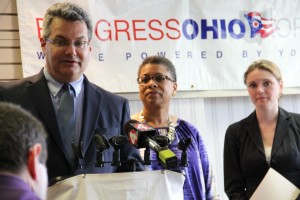
Photo from NetrootsNation.org
Interestingly, I received an email from ProgressOhio about the latest estimate which said:

** This statement can be attributed in whole or in part to Brian Rothenberg, Executive Director, ProgressOhio.

"It goes against the trends seen in big states and doesn’t include the discounts created by the subsidies. Announcing them without the subsidies is cynical because that’s not how people are going to buy insurance. If the goal is to enroll people, announcing rates without examples of subsidies makes no sense.

It’s not surprising that this is how Republican Lt. Gov. Mary Taylor would handle this. Her well known hatred for the Affordable Care Act is causing her to take an action as the state's insurance commissioner that hurts the people of Ohio. She shouldn’t announce rates without illustrating what that means for real people benefiting from tax credits that can be substantial in some moderate income categories."

It raises a good point about including the offset due to expected subsidies, but it misses the bigger picture regarding the basic concept that taxpayers are seeing increased rates while at the same time paying for others to have those higher rates subsidized.

And the subsidies might not be there for Ohioans.

According to this article in the Washington Free Beacon, the legality of the subsidies is being challenged.

As the article explains, the subsidies were part of the deal for the states to set up exchanges.

The law says that the government can provide subsidies for insurance sold on an “Exchange established by the state.” Thirty-four states have refused to set up their own exchanges, leaving the federal government set them instead.

The Obama administration maintains that the subsidies can be applied to a federal exchange as well, though some legal experts and Republicans in Congress say that's outside the scope of the law.

“When Congress passed the health care act, they presented states a choice,” (Oklahoma Attorney General Scott) Pruitt told the congressmen. “That choice was to establish a state health care exchange or to opt for a federal exchange. The ACA included with that choice a set of consequences and benefits.”

If states opted to create an exchange themselves, then their citizens would receive federal subsidies to buy insurance on the exchange, but employers would also be subject to fines for not offering affordable health insurance, Pruitt argued. However, if they opted against the exchange, they would not receive subsidies and employers would not be subject to fines.

Pruitt has launched a lawsuit against the administration arguing that they do not have the power to offer the subsidies on federally run exchanges. Experts predict that Oklahoma’s lawsuit, if successful, could fatally cripple the law.

Since Ohio did not set up its own exchange, defaulting to the federal one, residents may not see any subsidies if the lawsuit is successful.

Of course, states will then be criticized as being evil, uncaring and 'responsible for deaths' along with all sorts of terrible things for not wanting their residents to have that handout. But if it could "fatally cripple the law," Ohioans would benefit by not having such huge increases in insurance rates while maintaining a large diversity of plan options and costs.

The problem is that no one in Congress writing this law could have the depth of knowledge to re-design an insurance program/health care coverage that will fit the needs of so many people. This is where a free market comes into play.

In a 'free' market, entrepreneurs can create a product or service that fits the needs of some, while not needing to fit the needs of all. Ohio is a good example with our current variety of options that fit a multitude of needs and budgets.

With the federal government, they've decided what everyone must have (forced it upon us, actually) and then told us we'll have to pay for it, even if we don't need or want it.

Well-baby care is an example. My husband and I don't have kids and have no need for well-baby care which includes office visits, immunizations, etc... But that coverage is mandated by the ACA and the state of Ohio. So I'm paying for a portion of insurance that I don't need and will never use. A 'free' market, would give me the option to have a plan that didn't include that at, hopefully, a lesser cost than one that did.

Another example is young people who are generally healthy and don't need a full-service comprehensive plan. In a 'free' market, they could choose something like the old 80-20 insurance plans where routine doctor visits were not covered, but hospital bills for emergencies, injuries or serious illness were covered at 80%.

The Affordable Care Act - Obamacare - has removed those options from us, forcing us to have to what a bunch of bureaucrats in D.C. *think* we need. There is no way they can ever meet individual wants and needs the way a free market does so we are all forced into the one-size-fits-all mandate - and you and I will pay more as a result.

Wednesday, May 22, 2013

Is new Sears bill another version of the Obamacare Medicaid expansion for Ohio?


I'll admit to not being an expert on the Medicaid expansion that Gov. John Kasich proposed for Ohio - as part of Affordable Care Act, also known as Obamacare - but this new bill introduced by Rep. Barbara Sears sure sounds a lot like it.

The House, after significant public pressure from conservatives and tea party groups, removed the Medicaid expansion from the budget bill (H.B. 59) earlier in the year. Rep. Sears was extensively criticized for her role in pushing the expansion and for what some considered was a violation of the Health Care Freedom Amendment overwhelmingly passed by Ohioans. She responded to those allegations, saying she did, in fact, support the Health Care Freedom Amendment, though she believed a pending bill would conflict with that amendment.

Speaker Bill Batchelder told reporters that a bill separate from the budget could be passed by the House before the end of June.

The press release below details some of the provisions of her legislation:

Rep. Sears Introduces Medicaid Reform Legislation

COLUMBUS—Today, State Representative Barbara Sears (R- Monclova Township) introduced legislation requiring the Director of Medical Assistance to implement Medicaid reforms that will identify ways to lower costs, reduce uncompensated care, and extend coverage to Ohio’s most vulnerable citizens.

The legislation would extend coverage to Ohioans under 138% of the federal poverty level and will provide critical health care services to Ohio’s poorest citizens. New enrollees in the Medicaid program will be fully funded by the federal government for the first three years. The bill provides protections for Ohio should the federal assistance percentage decrease below the specified amount after the third year.

Additional provisions of this legislation include encouraging personal responsibility through cost sharing, promoting employment-related services, and ensuring those who abuse narcotics receive proper treatment.

“Ohio’s Medicaid system has made substantial improvements over the past few years and this legislation furthers that effort,” Rep. Sears said. “By providing a ladder up and out of poverty through quality care, we are allowing for citizens to achieve greater self sufficiency and creating a healthier Ohio.”

The bill also includes requiring the Medicaid director to present a report to the General Assembly on the progress being made and specifies that the Joint Legislative Committee on Medicaid Technology and Reform consider and review the reforms implemented by this legislation.

-30-

The bill will be assigned a number Tuesday, but here is a link to the language submitted, as provided by her office.

Tuesday, July 17, 2012

Buckeye Institute shows how Blade is wrong on health care exchange


I was going to take apart the recent Blade editorial chastising Gov. John Kasich for not accepting federal monies for a health care exchange, but the Buckeye Institute has done a nice job already with "Obamacare, Politics and the Myth of Free Money," so why duplicate efforts?

Here's what they have to say specifically about The Blade's warped thinking:

Second, the underlying argument assumes that federal spending is somehow “free” money and that the offer of expansion is simply to good to pass up.

In a rather rich case of projection, Innovation Ohio accuses Governor Kasich of playing politics while Ohio loses millions. The ideologically sympathetic Toledo Blade follows a similar line, accusing Kasich of politics on the issue rather than taking the generous federal money and immediately implementing Obamacare in Ohio.

The irony is that this mindset is what has gotten us to where we are today. It is a belief that federal dollars are free and Ohioans should grab every penny lest they be scooped up by other states. The history of Medicaid is one of states getting hooked on federal dollars only to have the program gobble up their budgets even as it offers less and less flexibility and reduced quality of care.

But state taxpayers are federal taxpayers. These dollars don’t magically appear in Washington to be doled out to states, the money comes from individuals in those very same states. Ohioans are rightly concerned about the federal deficit and about paying higher taxes. Increased spending in Washington impacts Ohioans to pretend otherwise is to ignore fiscal reality.

The Blade casually tosses aside the fears of increased Medicaid enrollment through a woodworking effect as if the dollar amounts are not significant. But those numbers are big enough to give governors across the country, both Republican and Democrat, pause. And whose numbers should we trust, state experts or liberal think tanks who support Obamacare?

These governors understand that Medicaid is a deeply flawed system that hooks states on a process of expanded enrollment with the promise of federal funds. Once on this path any attempt to reign in spending or control costs means giving up not only the state’s share of spending but the feds as well.

And is it really realistic to assume the federal government will never attempt to roll back the amount it covers? Half the assumed savings of Obamacare comes from reducing Medicaid reimbursement rates. Facing a deficit beyond what many of us can conceptualize, will Washington continue to pay out vast sums to states already committed to expanded coverage for their citizens?

In reality, what underlies this debate is a mix of politics, policy disagreements and deep uncertainty about the future. Governors understand that what is good for Washington is not always (rarely?) good for the states. They understand that Medicaid is a failed program that has devastated state budgets, increasingly involves reduced flexibility, and carries with it perverse incentives.

I especially love the point that "state taxpayers are federal taxpayers. These dollars don’t magically appear in Washington to be doled out to states, the money comes from individuals in those very same states."

You'd think whoever wrote The Blade editorial would know that - and know that Toledoans know that as well.


Tuesday, March 27, 2012

1851 Center: beware of back-door Obamacare in Ohio

From the 1851 Center for Constitutional Law:

Two Years Ago: Obamacare Passed

Today: The US Supreme Court Hears Oral Arguments to Decide if Obamacare is Constitutional


With all attention on the Supreme Court, Ohio officials could quietly impose the mandate and restrict choice in Ohio through creating a state Obamacare exchange.

Ohio left-wing and Democratic Party front groups have recently ratcheted-up pressure on state officials to create an Obamacare exchange for Ohio. Meanwhile, it's unclear whether the Kasich Administration buys rhetoric that enacting its own Obamacare exchange will give Ohio increased flexibility.

But the issue should be a non-starter: Ohioans have already fought and won this battle. The Ohio Health Care Freedom Amendment prohibits Ohio from implementing Obamacare in Ohio through creating an exchange.

By creating an Obamacare exchange in Ohio, state government would be doing the following:

* indirectly compelling the forced purchase of government-defined health care insurance
* prohibiting Ohioans from choosing doctors and insurance plans of their choice
* imposing a host of new taxes and fees on Ohioans
* turning Ohio's health care markets over to the federal government
* gift-wrapping a victory for Obamacare by making it easier for the federal government to enforce in Ohio and elsewhere
* undermining the sincerity of Ohio's current Supreme Court challenge to Obamacare

"Any state that creates an Obamacare exchange is ultimately voluntarily choosing to enforce Obamacare and its mandates and restrictions on freedom of choice, while simultaneously reducing the chance that Obamacare will repealed or rewritten," according to 1851 Center Director Maurice Thompson in
Does Ohio's Health Care Freedom Amendment Prohibit it from Imposing an Obamacare Exchange? Thompson suggests that legal action would be appropriate to stop the exchange, and that the 1851 Center may take it. Read the entire report here.

More information on this important topic is available at www.StoptheExchange.com, where Ohioans can directly share their feeling on this topic with the Kasich Administration.
Google Analytics Alternative