Showing posts with label health care. Show all posts

Monday, January 12, 2015

Who is responsible for your health?


This ad is from the CDC which is no longer
just the Centers for Disease Control,but is
now the Centers for Disease Control
and Prevention.
Forgive me for getting this wrong, but I always thought I - and I alone - was responsible for my health.

Sure, genetics play a role, but whether I was overweight or underweight , ate junk food or fruits and vegetables, exercised or not ... all that was on me.

Apparently I'm wrong.  Well, at least according to today's lead editorial in The Blade.

Yes, they do say our individual health is partially on us and the decisions we make, but they also say:

"The report notes that Ohio ranks near the top in the percentage of its adults who smoke, and of children exposed to secondhand smoke in their homes. Such things are as much a matter of individual responsibility, or its absence, as of inadequate public policy.
Really?  Inadequate public policy is to blame if you or I smoke?

Who DOESN'T know that smoking is bad for you?

In fact, people who do smoke, do so in spite of the fact that they know it's bad for them and for anyone who lives in their smoke-filled house.

How can inadequate public policy be to blame for that?

They even write:

"But it isn't just the responsibility of government to make Ohioans healthier and more productive."

Hmm... I guess I missed that responsibility in the U.S. Constitution as well as the state constitution.

For the record, I don't smoke - never have.  Neither has my husband. My sister does, but she doesn't smoke in my house and has never asked to do so.  Most smokers are considerate in that respect.

But no amount of government spending is going to make her stop. In fact, I doubt that anyone has decided to stop smoking because government spent money on an advertisement bemoaning the ill effects of the practice.

People stop smoking when THEY want to. They are the ones who must make the choice, which means it is entirely an individual responsibility and action.

The primary reason for the editorial is to call for "greater public investment" - that means spending - arguing that the more government spends on preventive care, the less it should end up spending on actual, more expensive, care as a result of bad habits.

You see, the 'logic' is that if government spends more money up front telling people how to be healthy, they'll have to spend less treating these people when they end up with costly diseases like cancer, heart disease, etc...

But first the people have to actually head the direction from the government to lead healthier lives - and that certainly isn't the case, at least, not for the majority of people.

There's an easy solution to the state spending so much money on actual care of illnesses that are preventable:  Don't.

What if the government warned people ahead of time that if they get cancer from smoking none of their health bills will be covered?  In fact, what if the government said that the cost of any illness or disease that was the result of self-inflicted activity wouldn't be covered?

Would people make better decisions knowing they'd be responsible for all the costs associated with bad habits, or that they might have to go without treatment if they couldn't afford it?

It's an interesting question and one that too few stop to consider.

But the government is all too happy to pay because, in doing so, they develop justification for telling you how to live. It is the 'logic' they use for controlling your life:  We're going to end of paying for your health care so we have the authority to tell you how to keep yourself healthy so we don't have to pay so much.

Oh, they might not say so in so many words, the bottom line is control - of your eating habits, exercise regimen and decisions.

Just look at Michele Obama's Healthy Hunger-Free Act which, as of a year ago, had 1 million kids leaving the school lunch line.

It doesn't stop.

And sadly, too many editorials are all to happy to jump on the bandwagon and advocate for even more government involvement in our daily lives, because (clearly) they know what is best and its for our own good.

Monday, September 16, 2013

Film explores why alternative medical treatments are shunned in health industry


I received the following press release and am sharing it...


‘Doctored’ reveals deception, criminality and greed in healthcare

Northwest Ohio chiropractic physicians are sponsoring a one-time showing of the eye-opening documentary film, Doctored, at 7 p.m., Oct. 10 at Maumee Indoor Theatre, 601 Conant St., Maumee.

Doctored follows surgeons, physicians, and patients ranging from Olympic gold medalists to people sent home to die, focusing how the current healthcare system fails many patients. Doctored also follows a 15-year legal battle (known as the Wilk case) where the American Medical Association’s (AMA) attempts to abolish non-drug providing therapies (including chiropractic care) are exposed.

“Although the United States only makes up five percent of the world’s population, we consume over 50 percent of the world’s pharmaceutical drugs, yet our health is worsening,” said Dr. Thomas M. Baur, chiropractic physician at New Life Spine Center, 1331 Conant St., Maumee. “For years, certain doctors have told their patients that medicine or surgery is the only way to go and they have belittled alternative therapies. We have decided to show this film to support the findings of this documentary and to open up a conversation in Northwest Ohio about true patient-focused healthcare.”

Director Bobby Sheehan and Producer Jeff Hays investigate the unseen “influencers” in the current healthcare system: those who stand to benefit financially from turning patients into compliant, pill-popping revenue generators. They bring forth shocking details of how the AMA worked for decades to denounce the chiropractic profession for their own professional gain. They go in the courtroom with five chiropractors who had been labeled “an unscientific cult” and document their fight and landmark win against “big medicine.”

“As chiropractors, we understand the importance and roles medicine and surgery play in patient care,” said Dr. Cindy Ratkowski, president of the Northwest Ohio Chiropractic Association and chiropractic physician at Advanced Wellness and Chiropractic Center, 3425 Executive Pkwy., Toledo. “But we also know that many patients are issued these solutions without exploring alternatives first. We promote whole-health care, prevention and a fully-realized continuum of care—and we feel patients are often herded in and out of doctor’s offices and issued medications and directives with no real desire on the physician’s part to really delve into the issues of what is causing the pain or illness, how to best treat it and even better, how to prevent it.”

“Ideally, patients should have a network of health professionals working for their betterment, whether it’s prevention or treatment,” said Dr. Jay P. Anderson, chiropractic physician at Anderson Family Chiropractic, 751 Michigan Ave., Waterville. “This film reveals the shortcomings in the current healthcare system and proves that not all medical professionals are working in the best interest of the patient. We want to educate patients about all their options and work to create a more cohesive healthcare system—because we know drugs alone are not working.”

Doctored will kick off with food, refreshments, and live music by the Linden Street Band at 6:30 p.m. Admission is $5 and all profits benefit the Arthritis National Research Foundation (CureArthritis.org). Movie goers will be treated to organic popcorn, water and prize giveaways throughout the event.

Tickets to the showing, or $10 DVDs are available at local Northwest Ohio chiropractic physician offices. For more information about the movie or about chiropractic care, visit nocachiro.org.

Thursday, September 12, 2013

AFL-CIO: Obamacare 'highly disruptive' to union health plans


The AFL-CIO is holding their national convention this week and they have approved a resolution that says the Affordable Care Act, also known as Obamacare, is being implemented in way that is "highly disruptive" to union health care plans.

At issue is how the regulations impact union-sponsored health plans. They also want the subsidizes for low-income workers who enroll in the exchanges to be available to low-income union members who participate in union-sponsored health plans.

Here is one report from Fox News:

The AFL-CIO approved a resolution saying that President Obama's health care overhaul will drive up the costs of union-sponsored health plans to the point that workers and employers are forced to abandon them.

In a strongly worded resolution released Wednesday, the federation said that labor unions still support the Affordable Care Act's overall goals of reducing health costs and bringing coverage to all Americans, but added that the law is being implemented in a way that is "highly disruptive" to union health care plans.

Some individual unions have complained about the law's impact for months, but the resolution marks the first time the nation's largest labor federation has gone on record embracing that view. Unions were among the most enthusiastic backers of the law when it passed in 2010.

A labor official told The Associated Press that White House officials had been calling labor leaders for days to urge them not to voice their concerns in the form of a resolution. The official, who wasn't authorized to discuss the conversations publicly and requested anonymity, said many union leaders insisted that they wanted to highlight their concerns.

Continue reading...

And here is the AFL-CIO post on the resolution where they identify it as calling for "fixes" in the act.

Friday, August 02, 2013

Ohio insurance rates to increase 41 percent due to Obamacare; subsidies may not help


Here's the latest from the Ohio Department of Insurance:

Health Insurance Premiums to Increase 41 Percent Due to Affordable Care Act

Premiums for Federal Exchange Show Higher Costs for Ohio Consumers and Small Businesses


COLUMBUS — The Ohio Department of Insurance announced today that individual consumers buying health insurance on the federal government's health insurance exchange for Ohio will pay an average of 41 percent more than they did in 2013.

In addition, ODI confirmed previously-released preliminary calculations that insurance companies’ costs to provide individual health coverage will increase by 83 percent.

“Ohio has traditionally had a more competitive health insurance market than other states with a wider range of prices and choices – from simple, high deductible coverage to comprehensive, full service plans,” Lieutenant Governor Mary Taylor said. “That level of diversity is essentially outlawed under Obamacare so Ohio's rates and premiums are going up significantly, and going up more than in other states where prices were already high.”

Wonderful.

So Ohioans had a wide diversity of options and costs and with Obamacare, that much diversity is 'essentially outlawed'???

Did anyone who voted for and supported the Affordable Care Act really think about the implications?

Oh - wait - they had to pass to it to know what was in it. Even Congress doesn't like what it sees in the law and the IRS chief, charged with enforcing it, doesn't like it either.

For individuals plans in Ohio, the average cost is $236.29 per month. That cost will increase to $332.58 in 2014 due to the provisions of the Act.

The ACA is actually driving rates across the country closer together, the press release notes. Since Ohio had lower costs to begin with, we're seeing rate increases that are higher than other states, while some states with higher costs are seeing steady or even lower rates. Since the ACA is really a one-size-fits-all approach, Ohioans are also seeing fewer options when it comes to type of insurance because of the minimum level of coverage mandated by the federal law.

The states were supposed to be the place where innovations and 'experiments' could be tried. If a state was successful with an idea, other states could duplicate it. Conversely, they could avoid failures after seeing them elsewhere. Our federal government was never designed to be this involved in such affairs and the results, perhaps good for some, are very costly for Ohio.

Benjamin Franklin said:

"History affords us many instances of the ruin of states, by the prosecution of measures ill suited to the temper and genius of their people. The ordaining of laws in favor of one part of the nation, to the prejudice and oppression of another, is certainly the most erroneous and mistaken policy. An equal dispensation of protection, rights, privileges, and advantages, is what every part is entitled to, and ought to enjoy... These measures never fail to create great and violent jealousies and animosities between the people favored and the people oppressed; whence a total separation of affections, interests, political obligations, and all manner of connections, by which the whole state is weakened."

Apparently, our federal government took that as a prescription and not a warning when it came to Obamacare...

Photo from NetrootsNation.org
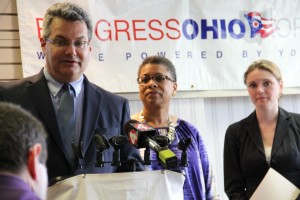
Interestingly, I received an email from ProgressOhio about the latest estimate which said:

** This statement can be attributed in whole or in part to Brian Rothenberg, Executive Director, ProgressOhio.

"It goes against the trends seen in big states and doesn’t include the discounts created by the subsidies. Announcing them without the subsidies is cynical because that’s not how people are going to buy insurance. If the goal is to enroll people, announcing rates without examples of subsidies makes no sense.

It’s not surprising that this is how Republican Lt. Gov. Mary Taylor would handle this. Her well known hatred for the Affordable Care Act is causing her to take an action as the state's insurance commissioner that hurts the people of Ohio. She shouldn’t announce rates without illustrating what that means for real people benefiting from tax credits that can be substantial in some moderate income categories."

It raises a good point about including the offset due to expected subsidies, but it misses the bigger picture regarding the basic concept that taxpayers are seeing increased rates while at the same time paying for others to have those higher rates subsidized.

And the subsidies might not be there for Ohioans.

According to this article in the Washington Free Beacon, the legality of the subsidies is being challenged.

As the article explains, the subsidies were part of the deal for the states to set up exchanges.

The law says that the government can provide subsidies for insurance sold on an “Exchange established by the state.” Thirty-four states have refused to set up their own exchanges, leaving the federal government set them instead.

The Obama administration maintains that the subsidies can be applied to a federal exchange as well, though some legal experts and Republicans in Congress say that's outside the scope of the law.

“When Congress passed the health care act, they presented states a choice,” (Oklahoma Attorney General Scott) Pruitt told the congressmen. “That choice was to establish a state health care exchange or to opt for a federal exchange. The ACA included with that choice a set of consequences and benefits.”

If states opted to create an exchange themselves, then their citizens would receive federal subsidies to buy insurance on the exchange, but employers would also be subject to fines for not offering affordable health insurance, Pruitt argued. However, if they opted against the exchange, they would not receive subsidies and employers would not be subject to fines.

Pruitt has launched a lawsuit against the administration arguing that they do not have the power to offer the subsidies on federally run exchanges. Experts predict that Oklahoma’s lawsuit, if successful, could fatally cripple the law.

Since Ohio did not set up its own exchange, defaulting to the federal one, residents may not see any subsidies if the lawsuit is successful.

Of course, states will then be criticized as being evil, uncaring and 'responsible for deaths' along with all sorts of terrible things for not wanting their residents to have that handout. But if it could "fatally cripple the law," Ohioans would benefit by not having such huge increases in insurance rates while maintaining a large diversity of plan options and costs.

The problem is that no one in Congress writing this law could have the depth of knowledge to re-design an insurance program/health care coverage that will fit the needs of so many people. This is where a free market comes into play.

In a 'free' market, entrepreneurs can create a product or service that fits the needs of some, while not needing to fit the needs of all. Ohio is a good example with our current variety of options that fit a multitude of needs and budgets.

With the federal government, they've decided what everyone must have (forced it upon us, actually) and then told us we'll have to pay for it, even if we don't need or want it.

Well-baby care is an example. My husband and I don't have kids and have no need for well-baby care which includes office visits, immunizations, etc... But that coverage is mandated by the ACA and the state of Ohio. So I'm paying for a portion of insurance that I don't need and will never use. A 'free' market, would give me the option to have a plan that didn't include that at, hopefully, a lesser cost than one that did.

Another example is young people who are generally healthy and don't need a full-service comprehensive plan. In a 'free' market, they could choose something like the old 80-20 insurance plans where routine doctor visits were not covered, but hospital bills for emergencies, injuries or serious illness were covered at 80%.

The Affordable Care Act - Obamacare - has removed those options from us, forcing us to have to what a bunch of bureaucrats in D.C. *think* we need. There is no way they can ever meet individual wants and needs the way a free market does so we are all forced into the one-size-fits-all mandate - and you and I will pay more as a result.

Thursday, June 27, 2013

Bill to put Ohio into multi-state health care compact introduced


Press release received today via email:

Reps. Retherford and Boose Introduce Health Care Compact Legislation

Proposal will give Ohio more control over costs and health care outcomes


COLUMBUS—State Representatives Wes Retherford (R-Hamilton) and Terry Boose (R-Norwalk) recently introduced legislation that would enter Ohio into a multi-state health care compact.

Rep. Mark Romanchuk, Rep. John Becker,
Rep. Wes Retherford, Rep. Terry Boose
A multi-state health care compact would allow Ohio to have full control over the federal health care dollars spent within the state, which in Ohio alone would equate to $35 billion annually. Additionally, states within the compact have the authority to craft their own health care systems and regulations to best suit their individual needs, rather than relying on centralized control by the federal government.

“Entering into an interstate health care compact would have tremendous long-term benefits for the state of Ohio,” said Rep. Retherford. “It will allow us to retain local control over tax dollars and help us to reduce waste, increase efficiency and provide better health outcomes for our citizens.”

“We need to allow our health care system the flexibility to provide sustainable, quality health care for Ohioans,” said Rep. Boose. “With health care decisions made at the state level rather than by unaccountable, distant federal bureaucrats, Ohio could tailor its own systems to address its needs.”

Eight states have passed health care compact legislation. The compact would go into effect with the approval of the U.S. Congress.

The legislation will be designated a bill number and assigned to a House committee in the near future.

-30-

Monday, September 10, 2012

I agree with Romney on health care - sort of


Over the weekend, Republican presidential candidate Mitt Romney said he wants to repeal Obamacare - the Affordable Care Act - but that there are portions of it he likes, including covering pre-existing conditions and children.

Actually, I believe that insurance companies should offer coverage to individuals with pre-existing conditions. I don't believe they should be forced to, but it would be to their advantage to do so.

But (yes, the infamous 'but') - they should not be forced to accept individuals with pre-existing conditions at the same rate as other customers without such conditions.

Life insurance for a healthy person is cheaper than for someone who has heart disease and a history of heart attacks. Why shouldn't health insurance work the same way?

Why shouldn't individuals with pre-existing conditions pay more for their health insurance, especially if they wait until after they are sick to obtain it?

If the government doesn't insist that individuals are absolved from the potential negative consequences of their actions, they might just be inclined to take the appropriate action ahead of time.

If you know you can get away with being irresponsible, you're more likely to be irresponsible. That's human nature. Just like children as they are growing up, you tell them repeatedly that touching a hot stove will hurt, but they keep trying until they succeed and learn, because it hurts, that it was the wrong thing to do.

So I agree with Romney that individuals with pre-existing conditions should have access to health care, but I believe that such 'access' should come at a higher cost.

And should 'children' be able to be covered? Sure. But then, I define 'chidren' as descendants (legal or biological) under the age of 18 or over 18 and still attending school.

I would even go so far as to say that insurance companies would find an abundance of clients if they allowed relatives living in the same household to be covered under an insurance plan. They do this with car insurance - why not with health insurance?

Of course, this would work best if health insurance were purchased like car insurance and not just through your employer - with individuals receiving the same tax advantages as employers currently do.

Car insurance rates are affordable and there are plenty of policy options and coverage levels to fit every need. If health insurance were reformed to mirror the structure of car insurance, wouldn't that be a huge improvement?

These are good ideas, but the devil is in the details. Will government mandate such things, or open up the market so such structures can develop?

There's the rub...

Saturday, January 21, 2012

Contradiction abounds in requirement to provide free birth control

Friday, the Obama Administration announced final regulations requiring health care plans to cover birth control without charging any co-pays or deductibles to their participants. The requirement will begin Aug. 1.

The administrative rule will require organizations like religious schools and Catholic hospitals to offer birth control - at no cost - to employees covered by their health plans, though not until 2013. Houses of worship are exempt.

I'm certain that many people are going to be writing about the infringement on religion, and the Catholic religion specifically, but I want to focus on the clear contradiction in thought: that requiring health care plans to provide contraception (or any service/treatment/drug) without a co-pay or deductible somehow 'saves money.'

First, there isn't anyone who doesn't have 'access' to contraception. Any person can purchase condoms and anti-spermicide at the drug store counter - and the effectiveness of each is increased by using them together.

Any woman can get a prescription for birth control from numerous outlets. A doctor may recommend a specific type over another based upon the woman's personal and medical history, but there are so many doctors willing to write the prescriptions that no woman is without 'access.'

This regulation isn't about 'access' - it's about a woman not having to pay for the contraception she wants to use.

From The Hill:

"Birth control is not just basic health care for women, it is an economic concern," Cecile Richards, president of Planned Parenthood Federation of America, said in a statement. "This common sense decision means that millions of women, who would otherwise pay $15 to $50 a month, will have access to affordable birth control, helping them save hundreds of dollars each year."

As Richards readily admits, women already have access, but they're paying "$15 to $50 per month." With this new rule, they won't be required to pay anything - at least, not up front.

But someone always pays, hence the contradiction.

The manufacturer will still need to be compensated for the product they provide. So while the individual woman won't have to fork over any money at the time she actually get her contraceptive, insurance companies will still have a cost that will need to be covered. Without the ability to charge the individual user, they'll raise their rates on everyone to cover the expense.

This means higher rates for all - including the ones who think they're now getting their contraception for free. Talk about a contradiction between hype and reality.

So of course, it should come as no surprise that the overwhelming comments on the HHS rule were in favor of the requirement. All those people who supported it think they'll no longer have to pay. But that's just a bigger comment on their intelligence and reasoning skills - or perhaps our education system - than it is on the rule itself.

So what about seniors who don't need contraception? Or a single person who is celibate? What about men and women who have had a medical procedure that eliminates the need for contraception? Or individuals who are sterile?

All of these people will now be covering the costs so some can have the luxury of not having any out-of-pocket expenses for a product only they are using.

This is un-American. And it's no different than if my co-worker stole money out of my wallet in order to pay for her birth control pills.

Monday, May 16, 2011

Morning round-up of interesting things

Every now and then, I'll be doing a round-up of interesting news stories you might not have heard about:

* Think the federal Office of Management and Budget should be unionized? Here's a RedState.com column on the whole idea: Who’s the Boss? AFL-CIO Afilliate Seeking to Unionize Office of Management & Budget

* Also from RedState.com is this article on the hypocrisy of the left when it comes to money given to universities - with stipulations. The article contains links to stories you might not have seen concerning what some professors are doing in their classrooms (like recruiting members for the Communist Party). It's a good read: None Dare Call it Hypocrisy: The Left’s Outrage Over Teaching Free-Enterprise in Universities

* From the Canadian publication National Post comes this editorial pointing out the deficiencies of the Canadian 'government-only' health care system: Canada must abandon its health-care monopoly

* Finally, from Investors.com is another great column from one of my favorites, Mark Steyn: RomneyCare Is Problem, Not Part Of The Solution. Mitt Romney appears to be a front-runner for the Republican nomination for 2012, but his support - and continued defense - of his Obamacare-lite program for health coverage is getting in the way. As Steyn so wryly describes:

American conservatives' problem with RomneyCare is the same as with ObamaCare — that, if the government (whether state or federal) can compel you to make arrangements for the care of your body parts that meet the approval of state commissars, then the constitution is dead.

And Americans might as well shred the thing and scatter it as confetti over Prince William and his lovely bride, along with an accompanying note saying, "Come back. It was all a ghastly mistake." For if conceding jurisdiction over your lungs and kidneys and bladder does not make you a subject rather than a citizen, what does?

...

So RomneyCare is not just an argument about health care. It exemplifies what's wrong with American political structures...

Friday, April 09, 2010

Ballot Board attempts to block health care freedom amendment

This in via email:

For Immediate Release
Friday, April 9, 2010


Ballot Board Attempts to Block Health Care Freedom Amendment

Constitutional Rights Legal Center to File Action with Ohio Supreme Court


Columbus - Secretary of State Jennifer Brunner and the Ohio Ballot Board today ruled a proposed constitutional amendment aimed at protecting Ohioans from forthcoming health care regulations should be split into two parts. As a result, the board rejected the proposed amendment and told its sponsor, the Ohio Liberty Council, to start over.

The move places the Ohio Liberty Council in the untenable position of restarting the amendment language approval process and collecting two sets of 402,275 signatures by June 30. The group will ask the Ohio Supreme Court to block the Ballot Board's action.

"The Ohio Ballot Board got it wrong today," said Warren Edstrom of the Ohio Liberty Council. "We will ask the Ohio Supreme Court to uphold our amendment language and correct this error."

Maurice Thompson, executive director of the 1851 Center for Constitutional Law, drafted the amendment language and represented the Ohio Liberty Council at today's hearing. "The Ballot Board's decision is contrary to the law and its past precedent," said Thompson. "I am at a loss to find any logical reason for the board's decision other than its own policy preferences. Board members cited concerns with the single subject rule regarding the amendment. However, if different parts of an amendment address a common purpose, the single subject rule is satisfied. And, this amendment's common purpose is to allow Ohioans the right to choose their health care."

On March 22, the Ohio Liberty Council began the process of the placing a health care freedom constitutional amendment on the November 2010 ballot. The group filed petition summary language and nearly 3,000 signatures from registered voters in 48 counties with the Ohio Attorney General, who later approved the language as truthful and accurate.

The amendment provides that:

* In Ohio, no law or rule shall compel, directly or indirectly, any person, employer, or health care provider to participate in a health care system;

* In Ohio, no law or rule shall prohibit the purchase or sale of health care or health insurance; and

* In Ohio, no law or rule shall impose a penalty or fine for the sale or purchase of health care or health insurance.

The Ohio Liberty Council is a statewide coalition of non-partisan grass roots groups in Ohio including Central Ohio 9/12 Project, Cincinnati Tea Party, Young Americans for Liberty, Dayton Tea Party, Ohio Freedom Alliance and many more grass roots organizations. By working together, the member groups of the Ohio Liberty Council seek to achieve real results to protect and promote liberty in Ohio. More on the Ohio Liberty Council can be found at http://www.ohiolibertycouncil.org.

The 1851 Center for Constitutional Law is non-profit, non-partisan legal center dedicated to protecting the constitutional rights of Ohioans from government abuse. The 1851 Center litigates constitutional issues related to property rights, voting rights, regulation, taxation, and search and seizures. More on the 1851 Center can be found at http://www.ohioconstitution.org.

-30-

Sunday, April 04, 2010

Where's Marcy? Congresswoman fails to show for health care meeting with constitutents

I thought about calling this post, "Where in the world is Marcy Kaptur" - with apologies to Carmen Sandiego, but I realize that not everyone is familiar with the children's character.

But with recent events, it's certainly a good question to ask about our Congressional Representative.

According to numerous reports, here is what occurred:

* The week of March 22nd, President Barack Obama's Organizing for America sent out an email that Marcy Kaptur would be holding a meeting to answer questions about the health care bill. The email indicated that the meeting would be at 2 p.m. at the Toledo Lucas County Library downtown branch.

* Several members of the local tea-party-like group, Children of Liberty, who are on the email list, decided to share the notice with the group, encouraging people to show up and take advantage of the opportunity to have their questions about the bill answered.

(Side Note: many of these members have been trying to months to get answers about the health care bill from Marcy...)

* Several media outlets mentioned the meeting.

* The meeting, however, was not to be.

* Children of Liberty member John recounts his efforts to find out about the cancelled meeting:

I got word at around 8:50am that the event was canceled!!! . WWWHHHHHTT?

I called the Library at 9am, the room was reserved by Rep Kaptur, and the attendance estimate she gave to the Library when she reserved the room was 15 people.

Over the next ½ hour, I had several calls from people who were also planning on attending. They had called Rep Kaptur’s office and the Staff told them, “there wasn’t anything on the schedule and they didn’t know anything about it”.

What’s the deal?

I checked back with the Library about 9:30am, I was told that someone from Rep Kaptur’s office had just called and canceled the room (Hhmmm, I wonder if there’s a cancellation fee?)

I told the Library that we had several people coming from all around town and it would be impossible to let them know of the cancellation. I then asked if I could have the room, and we could at least continue some of the meeting without Rep Kaptur.

I indicated that I would be more than willing to pay for the room at its usual rate, and I’d be more than happy to accept the room set up for the original meeting; The Library will check into it.

An hour later (About 10:30am), I checked back with the Library, They’ll let me have the room, no problems. I indicated that I anticipated approximately 50 guests, but due to the Cancellation confusion, it could be less. (They need the guest count so they can supply the correct number of pre-paid parking passes)

At noon, when the Library opened, I meet with the Library Staff, they showed me the room (McMaster), and I signed the contract.

In reviewing the contract with the Library Staff, they made it clear that because this is a public facility, this cannot be a private meeting, and any meetings held in this room are automatically open to the public.

I arrived back at the Library at 2pm, where I found several people waiting to get in for the original 2pm Meeting that Rep Kaptur scheduled. None of these people were aware that Rep Kaptur had canceled.

I briefly explained that for some unknown reason, at 9:30 this morning, Rep Kaptur canceled the meeting and the hall.. At 10am, I reserved the room and planned on continuing the Health Care Q&A, but unless Rep Kaptur showed up, there wouldn’t be any “A” portion of the “Q&A”.

* Absent the Congresswoman, her constituents recorded the questions with the intent of sharing the video with Kaptur and getting answers to the questions.

* While she couldn't made the event she'd scheduled, a member of her staff was present and 'furiously taking notes.'

* Several reports after the fact had staff from her office claiming that the scheduled meeting was a 'private' one.

I can only wonder if this is the modus operandi for those who voted for the atrocious health care bill: meet only with people who agree with your vote while ignoring and avoiding the majority who opposed this measure.

Should the group receive any answers to the questions posed on the video, I'll report that, as well. But I'm not holding my breath!

Sunday, March 21, 2010

UPDATED: How Kaptur will justify her 'yes' vote on health care

UPDATE: As of Sunday morning, Rep. Marcy Kaptur confirmed she will be a 'yes' vote for the health care bill.

Watch her interview on WTVG here.


Original post from March 20, 2010 at 8:28 a.m.:

Rep. Marcy Kaptur has been claiming to be undecided on the health care bill currently being discussed in the House of Representatives.

She says that she wants to ensure that any language relating to the issue of abortion supports current law which only has government funding when the life of the mother is in danger or in cases of rape or incest.

However, according to Roll Call, she 'doesn't want to be a problem,' for Speaker Nancy Pelosi.

What???

I firmly believe Marcy will tow the party and vote (if there is a vote) in favor of the bill. She's too much of a party loyalist to do otherwise, even if she fails in getting her way on the abortion language.

Knowing that so many in her district oppose this, how will she justify going against the wishes of her district and her own position on abortion? She's already told us:

Kaptur said she believes health care reform legislation would reduce the total number of abortions and reduce the number of premature births and birth defects by providing coverage for pregnant women.

And here, from The Blade:

Asked whether she would oppose the bill if the abortion language was not clarified to her satisfaction, Miss Kaptur said she is weighing the number of abortions that occur annually with the number of infant deaths and premature and underweight births that can be attributed to inadequate health care resulting from the lack of health insurance.

"If we do a better job through the insurance system, we can save lives," she said.

My prediction is that she is going to say that the 'lives saved' by government control of health care will outweigh the 'lives lost' by funding abortion.

Of course, this is completely contrary to the usual liberal claim of 'if it saves even one life,' when instituting various other rules and laws.

And while I'm not Catholic, Marcy is. I doubt this type of justification sits well with her religious upbringing.

What's important to remember is not the specific issue of abortion. Nor is it about Marcy's Catholic faith. This is really about an elected official who states a position on an issue and is given the chance to stand up for that position.

This is about staying true to your principles, regardless of what the specific principle is.

Marcy has taken a public and well-known stand on an issue. Does she maintain her principled stand on that issue or sacrifice it to partisanship by going along with a vote necessary for the success of her party and president?

My prediction is that she'll go along, especially after saying that she 'doesn't want to be a problem' for Pelosi.

Thursday, March 18, 2010

Kaptur votes for Slaughter Rule

Michelle Malkin has the story...

And so does American Spectator:

Earlier this afternoon, House Democrats voted down a Republican measure that would have prevented the use of the "deem and pass" strategy, or Slaughter rule, paving the way for the House to pass the Senate bill without directly voting on it.

Here's the Roll Call Vote.

Basically, our representative, Marcy Kaptur, has decided that a vote is not necessary - that all the House has to do is 'deem' the health care vote to have taken place and passed, despite the fact that the Constitution requires a vote.

Wouldn't it be nice if you and I could do something like this? I know I'd like to 'deem' my taxes paid...

Additionally, this email was sent out by Rep. Eric Cantor's press secretary:

All –

The House just voted on the Cantor Resolution “That the House disapproves of the malfeasant manner in which the Democratic Leadership has thereby discharged the duties of their offices.” Those who voted against the resolution denounced Democrat leadership for their use of the “Slaughter Solution” to deceive the American people.

Final Vote: 232-181
R: 0-171
D: 232-10

To put it more clearly, the following 10 Democrats just denounced Speaker Pelosi, Leader Hoyer, Whip Clyburn, Conference Chairman Larson, and DCCC Chairman Van Hollen and the rest of the Democrat Leadership.

Rep. Boren
Rep. Childers
Rep. Giffords
Rep. Kissell
Rep. McIntyre
Rep. Mitchell
Rep. Minnick
Rep. Perriello
Rep. Shuler
Rep. Taylor

Note the absence of Marcy's name....

Tuesday, March 09, 2010

Government health care: it's all about big government

I hope you'll take a moment to read this terrific post on RedState.com by Lori Ziganto: Government Health Care Is Not About Health Care; It’s About Government.

She adds her own perception and thoughts to a column by one of my favorite authors, Mark Steyn, and succinctly spells out just why so many conservatives have a healthy fear of big government: because it stifles individual freedom in favor of a dependency upon the structure and ends the founders' concept of a limited government. As Steyn explains:

"I've been saying in this space for two years that the governmentalization of health care is the fastest way to a permanent left-of-center political culture. It redefines the relationship between the citizen and the state in fundamental ways that make limited government all but impossible."


And both see the takeover of the health care system as a major component to ensuring life-long dependency upon government and the politicians/bureaucrats who run it - reason enough to reject it outright.

It's a well-written article that deserves your attention.
Google Analytics Alternative